U.S. Treasury yields have emerged as a growing threat to the stock market rally, with the 10-year note yield climbing to a level that Bank of America considers increasingly uncomfortable for equities. The move comes just as Wall Street turns its attention to the Federal Reserve’s upcoming FOMC meeting, creating a potentially challenging backdrop for the S&P 500.
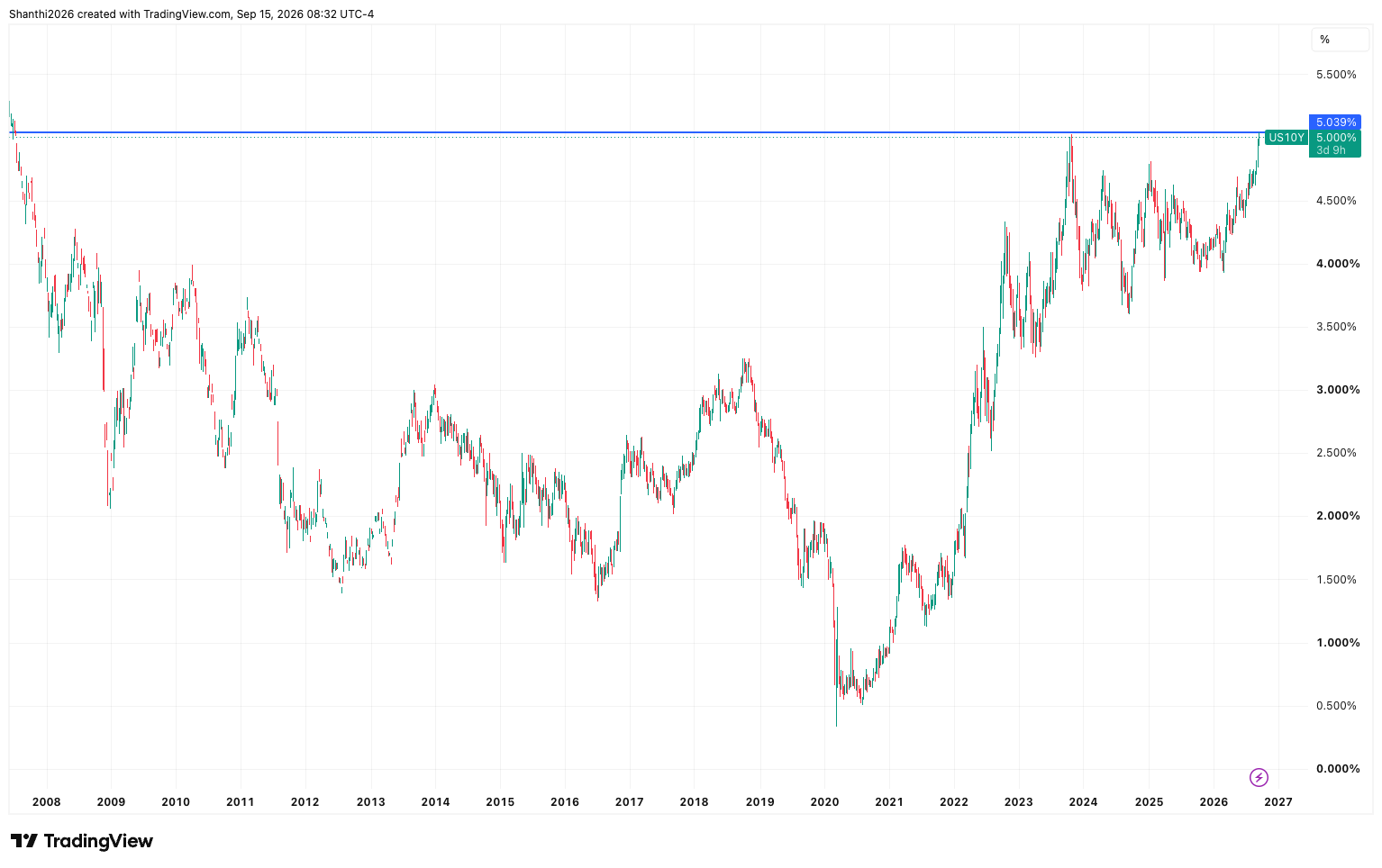
The benchmark 10-year Treasury yield has pushed past 5.2% in the European session, its highest level in nearly two decades. The yield spike has come as investors reassess the outlook for inflation, and monetary policy.
US 10-year Yield at Highest in Nearly 2 Decades
Source: TradingView
Rising oil prices are adding to those concerns, with crude recently pushing above $100 a barrel and raising the risk that renewed energy inflation could complicate the Fed’s policy path.
10-Year Yield Crosses a Key Threshold
The rise in Treasury yields is particularly important for equities because higher risk-free rates increase the discount rate applied to future corporate earnings. This can put pressure on stock valuations, particularly in long-duration growth sectors such as technology.
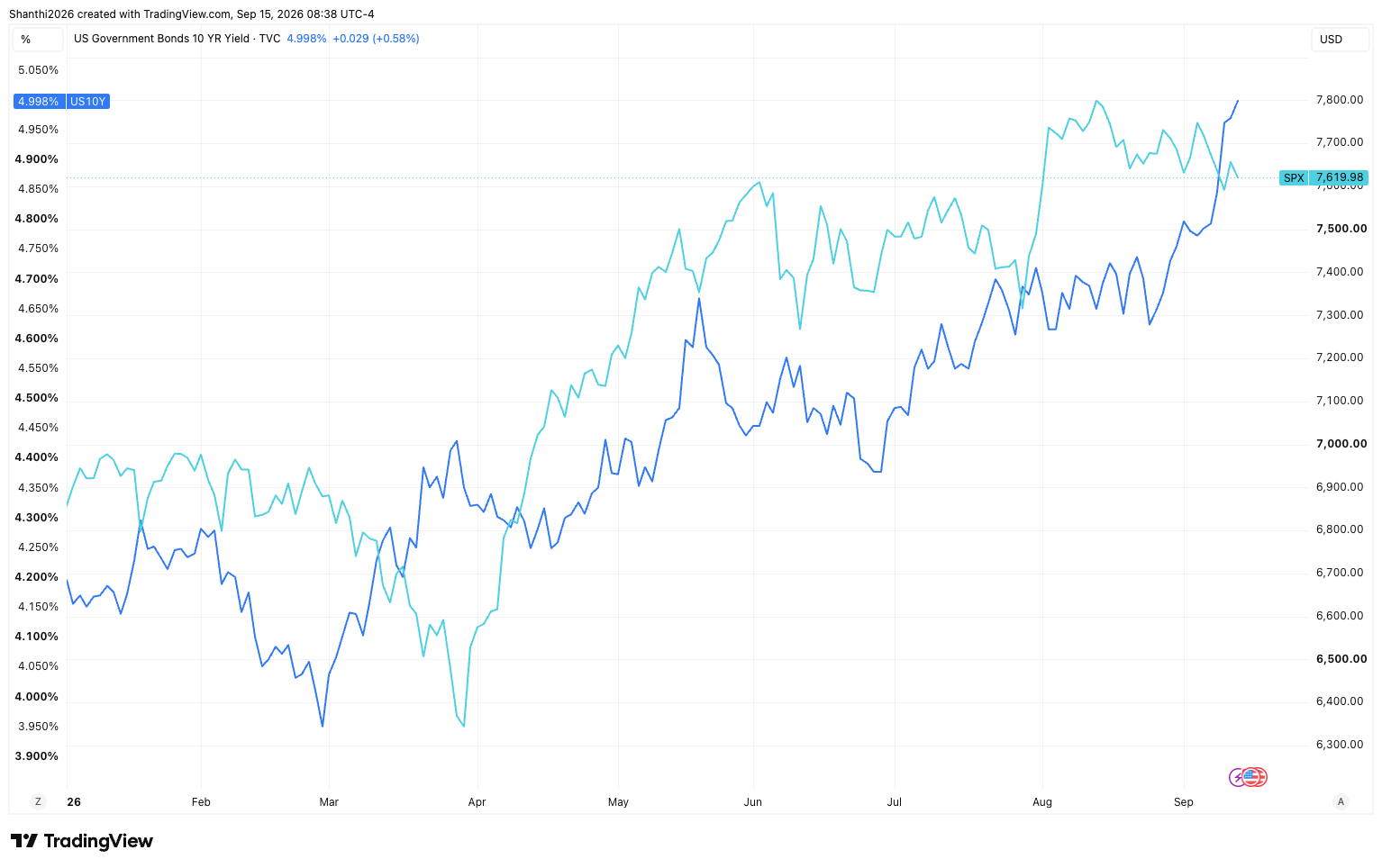
The move also comes after a powerful run in U.S. stocks, with the S&P 500 still near record highs. That leaves equities vulnerable if rising yields prompt investors to reassess elevated valuations and the relative appeal of bonds.
The shift also matters for the equity risk premium (ERP), or the additional return investors demand for holding stocks over relatively safer government bonds. As Treasury yields rise, the return available from risk-free assets increases, meaning equities may need to offer a larger potential return to justify their higher risk. If stock prices continue rising while bond yields climb, the equity risk premium can compress, potentially making stocks less attractive on a risk-adjusted basis.
S&P 500 Resilient as Treasury Yields Reach Critical Levels
Source: TradingView
A 5% Treasury yield changes the risk-return trade-off, according to Saxo Chief Investment Strategist Charu Chanana. At these levels, investors may begin to view bonds as a more compelling source of income, she said.
“For investors looking for income or greater visibility over future nominal cash flows, current yields may warrant consideration.”
That said, Chanana sees a continued case for owning equities even as bond yields climb. Bonds generally offer greater visibility into nominal income and repayment, while equities carry greater uncertainty but also offer the potential for revenues, earnings and dividends to grow over time.
“That growth becomes particularly important for investors with long horizons because inflation compounds as well.”
Within equities, Chanana sees cash-rich companies, quality financials, energy and commodity producers, healthcare and other defensive sectors, as well as consumer staples, as better positioned in a higher-yield environment.
By contrast, small-caps and highly leveraged companies, rate-sensitive property and housing stocks, consumer discretionary names, and long-duration or speculative growth companies could face greater pressure as borrowing costs and discount rates remain elevated.
FOMC Decision Could Set the Next Direction
Recent Fed meetings have repeatedly generated sharp swings in equities, but the June 2026 FOMC meeting produced the market's most hawkish reaction of the year. Although policymakers left rates unchanged, officials lifted inflation forecasts, shifted rate projections higher and signaled greater concern about persistent price pressures. The S&P 500 sold off in the days surrounding the meeting as Treasury yields rose and investors reassessed the likelihood of future tightening. Subsequent meetings produced volatility of their own, but none matched June's combination of hawkish projections and market repricing.
How 2026 Fed Decisions Impacted Stock Returns
| FOMC Date | Decision | SPX return over 5 days before | SPX return on D-day | SPX returns over 5 days after |
|---|---|---|---|---|
| Jan. 27-28 | Paused; no SEP; Powell emphasized a “wait-n-watch” approach | +0.6% | down marginally | -1.4% |
| March 17-18 | Paused; SEP; median still pointed to one 25bps cut in 2026 | -1.2% | -0.04% | +3.2% |
| April 28-29 | Paused; no SEP; Powell remained data-dependent | +1.1% | -0.04% | +3.2% |
| June 16-17 | Paused; SEP turned more hawkish; Dot plot implied a 25bps hike by year-end; Warsh emphasized inflation risks | -1.7% | -1.2% | -0.8% |
| July 28-29 | Paused; no SEP; 3 members dissented for a 25bps hike; Warsh said inflation remained too high | -0.9% | -1.5% | +5.6% |
A note of caution: The S&P 500’s reaction around FOMC decision days should not be attributed solely to the Fed. Other macro, earnings, geopolitical and positioning factors can also drive market moves and amplify or offset the initial policy reaction.
With the 10-year Treasury yield now above 5% for the first time since 2023, investors are once again confronting the same question that emerged after the June meeting: whether higher-for-longer rates can coexist with elevated equity valuations.
More than the policy decision itself, investors will be watching the FOMC statement, updated Summary of Economic Projections (SEP) and dot plot, along with Chair Kevin Warsh's press conference. Messaging from these could determine whether the recent rise in yields continues or begins to reverse.
A hawkish message could reinforce the bond-market sell-off if policymakers signal that inflation remains too persistent to justify aggressive easing. Conversely, a more dovish outlook could ease pressure on Treasury yields and provide fresh support for equities.
The market therefore faces a potentially important feedback loop: higher oil prices → greater inflation concerns → higher Treasury yields → tighter financial conditions → pressure on stocks.
Oil Adds Another Inflation Risk
The latest increase in yields cannot be viewed in isolation from the surge in crude oil.
WTI has moved above $100 a barrel, while Brent has also climbed above that psychological threshold as Middle East tensions continue to threaten energy supplies. The increase raises concerns that headline inflation could accelerate just as the Fed is trying to determine how restrictive monetary policy needs to remain.
That creates a particularly difficult environment for the central bank. A softer economy could argue for lower rates, but an oil-driven inflation shock could make policymakers reluctant to ease aggressively.
For equity investors, the concern is that the Fed could become less supportive at precisely the moment when valuations are already facing pressure from higher bond yields.
S&P 500 Rally Faces a Higher-Rate Test
The S&P 500's resilience has been impressive, but the latest move in rates presents a different kind of challenge.
Equities have been able to absorb elevated yields while expectations for earnings growth and AI-related investment have remained strong. But if the 10-year yield continues climbing above 5%, the valuation argument becomes increasingly difficult to ignore.
Technology and other growth stocks could be particularly sensitive because a larger portion of their expected cash flows lies further in the future. Higher discount rates reduce the present value of those cash flows, potentially compressing multiples even if earnings estimates remain unchanged.
That makes the Nasdaq and S&P 500's megacap technology segment especially important to watch following the FOMC decision.
What Traders Should Watch Next
The immediate question is whether the 10-year yield can stabilize below the recent highs or whether the FOMC triggers another leg higher.
A dovish Fed outcome: A softer policy statement, lower rate projections or a dovish Warsh press conference could pull yields lower and give the S&P 500 room to extend its rally.
A neutral outcome: If the Fed largely meets expectations, Treasury yields and oil prices could remain the dominant drivers of equities. In that case, stocks may continue trading with a higher sensitivity to moves in the 10-year note.
A hawkish outcome: A stronger inflation warning, higher rate projections or resistance to aggressive easing could push yields higher and increase the risk of an equity-market pullback.
For now, the 10-year Treasury yield is becoming the key cross-asset signal for stocks. With yields already above a key threshold and the FOMC about to deliver its latest policy signals, the S&P 500's ability to hold near record highs may depend increasingly on whether the bond market finally gives equities room to breathe.
MarketFramework's Positioning Edge tool shows strong bullish divergence for E-mini S&P 500 futures (ES), with profitable traders 55% long versus unprofitable traders at 39.5% long, a 16-point gap. Informed positioning appears to be leaning toward the view that a widely-telegraphed hike won't derail stocks the way the bond market's own signals.