The dollar's latest rebound is showing signs of losing momentum just as the U.S. Dollar Index (DXY) approaches the 101 area, leaving traders looking to Friday's durable goods orders for another catalyst.
The dollar has regained considerable ground after spending much of the past year under pressure. The move has been reinforced by a combination of higher Treasury yields, a more hawkish Federal Reserve, resilient U.S. economic data and renewed geopolitical uncertainty.
Yet the rally is facing an important test. DXY reached 101.40 on Thursday, its highest level since late July, before easing back toward 101.29. Not counting early Friday’s move, the index has gained 1.06% so far this week, but the advance was beginning to lose momentum despite rising yields.
The question now is whether another strong U.S. economic reading can extend the rate-repricing trade.
Dollar's Long Road Back From a Year of Weakness
The dollar's current strength needs to be viewed against a much weaker backdrop over the preceding year. On Sept. 25, 2025, DXY closed at 98.55, after trading as low as 97.74, ending 2025 with a loss of nearly 10%. Cut to this year, the index had reached a 52-week high around 101.80 in late-June,
In early 2026, the dollar was weighed down by concerns surrounding U.S. policy, fiscal sustainability, trade policy and expectations for easier Federal Reserve policy. The DXY subsequently found a floor and began rebuilding momentum as the market's expectations for U.S. monetary policy changed.
Hawkish Fed Gives the Dollar a Second Wind
The most important change has been the Fed's interest-rate narrative, which began changing more to the hawkish side after Kevin Warsh took over as the Fed Chair in May. As recently as this month, the Fed raised its target range by 25 basis points to 3.75%-4.00%, citing elevated inflation while describing economic activity as expanding at a solid pace.
More importantly for currency markets, the Fed's projections indicated one additional rate hike this year. Reuters reported that policymakers simultaneously raised their near-term inflation outlook.
That changed the relative-rate equation.
Higher expected U.S. rates increase the prospective return on dollar-denominated assets. As Treasury yields rose, the incentive to hold dollars increased, particularly against currencies whose central banks were perceived as being closer to easing or less likely to tighten as aggressively.
The repricing has been visible in the bond market. Long-dated Treasury yields moved to their highest levels in more than two decades, while the dollar headed for its first consecutive weekly gains in more than three months.
Fed Rhetoric Keeps Rate Hike Bets Alive
The rate hike itself is only part of the story. Several Fed officials have reinforced the possibility of additional tightening. New York Fed President John Williams said another increase this year was reasonable, while Cleveland Fed President Beth Hammack and Philadelphia Fed President Anna Paulson also pointed to continued inflation risks and the possibility of further increases.
That communication has kept the market focused on the possibility that the September hike was not necessarily a one-and-done move.
This matters for DXY because currency markets trade the expected path of interest rates, not simply the current policy rate.
If incoming data continue to show resilient growth and persistent inflation, markets could maintain or increase expectations for another hike. Conversely, softer activity data could cause traders to question whether the Fed can deliver the tightening currently priced into the market.
Durable Goods Orders: The Next Test for the Dollar
That puts Friday's durable goods report in focus. The consensus is for headline durable goods orders to decline 0.3% in August, following a 1.1% increase in July, while orders excluding transportation are expected to rise 0.6%.
Continuum Economics is slightly more constructive on the underlying data, forecasting a 0.3% decline in headline orders but a 0.7% increase excluding transportation. Non-defense capital goods orders excluding aircraft, an important gauge of business investment, may have increased 0.7%.
For the dollar, the details could therefore matter more than the headline number. A stronger-than-expected underlying orders figure would reinforce the argument that U.S. business activity remains resilient. Combined with elevated inflation, that could keep the Fed's tightening option open and provide another lift to Treasury yields and DXY.
A weak report would have the opposite implication: it could revive concerns that higher rates are beginning to weigh on business investment and economic momentum.
DXY Outlook: 101 Is the Immediate Battleground
The dollar's technical and macro picture has therefore become more balanced after its sharp rebound.
DXY's move above 100 represented an important psychological recovery, while the recent advance toward 101.40 brings the upper end of its recent range into focus. The 52-week range of roughly 95.55 to 101.80, makes the current zone particularly important for determining whether the rebound can develop into a broader recovery.
The fundamental setup remains supportive if U.S. data continue to reinforce the higher-for-longer Fed narrative.
But the dollar needs fresh catalysts to sustain the move. A disappointing durable goods report, softer inflation, weaker employment data or a decline in Treasury yields could reduce expectations for additional Fed tightening and take some pressure off DXY.
Conversely, strong economic data combined with sticky inflation and further hawkish Fed communication would keep the rate-differential trade alive, potentially giving the dollar another attempt at the upper end of its recent range.
For now, 101 is less a destination than a test of whether the Fed-driven dollar rebound has enough fundamental momentum to continue.
DXY Bullish Trend Holds, but Short-Term Momentum Cools
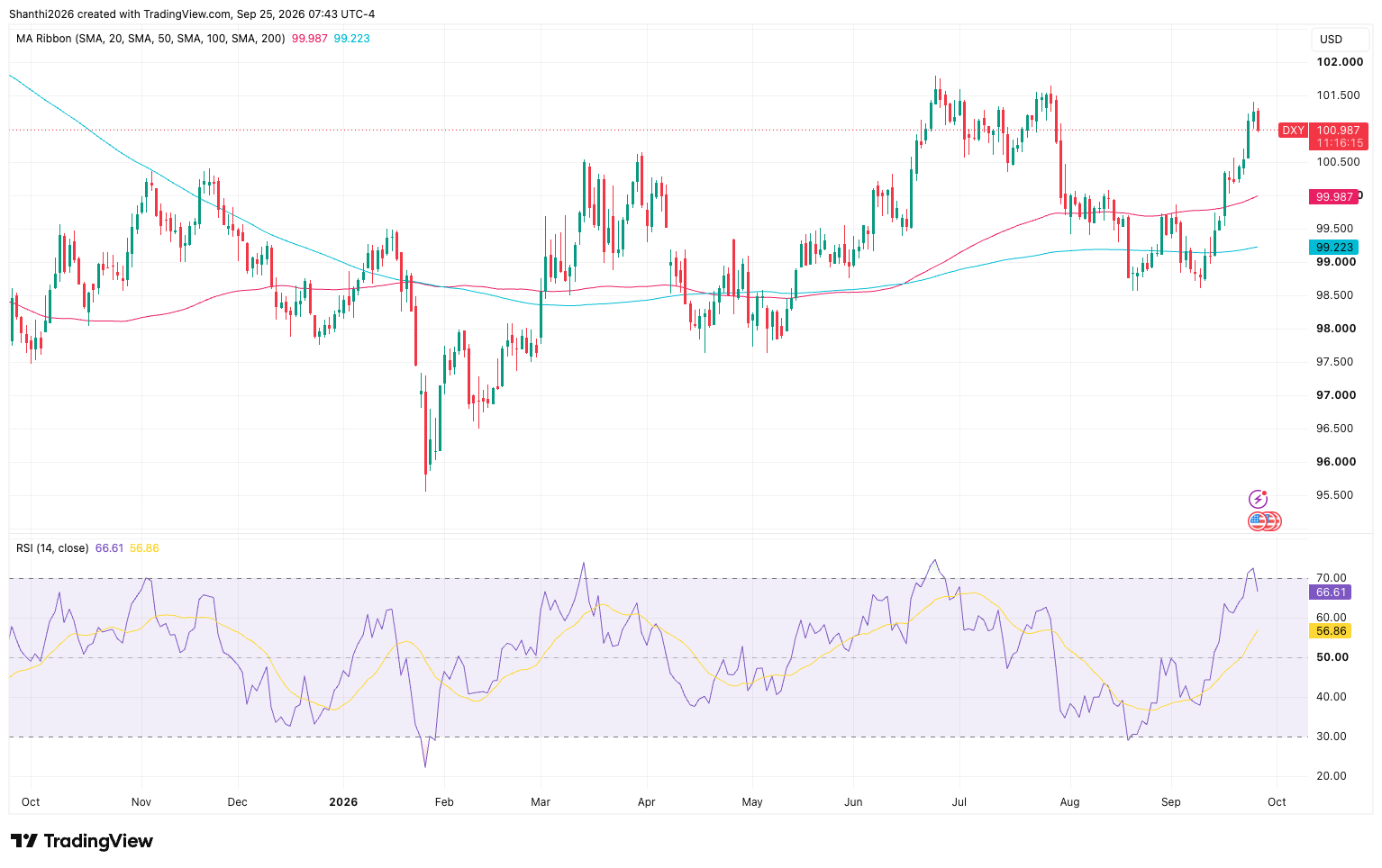
The daily chart shows the DXY bouncing strongly off support levels near 98.00-98.50 and trending upward toward 101.00. The price is currently trading above both key moving averages (99.987 and 99.223), indicating macro bullish momentum returning after a period of consolidation. Meanwhile, the Relative Strength Index (RSI) sits at 66.61, approaching overbought conditions but leaving room for potential continuation before facing overhead resistance near 101.50–102.00.
Source: TradingView
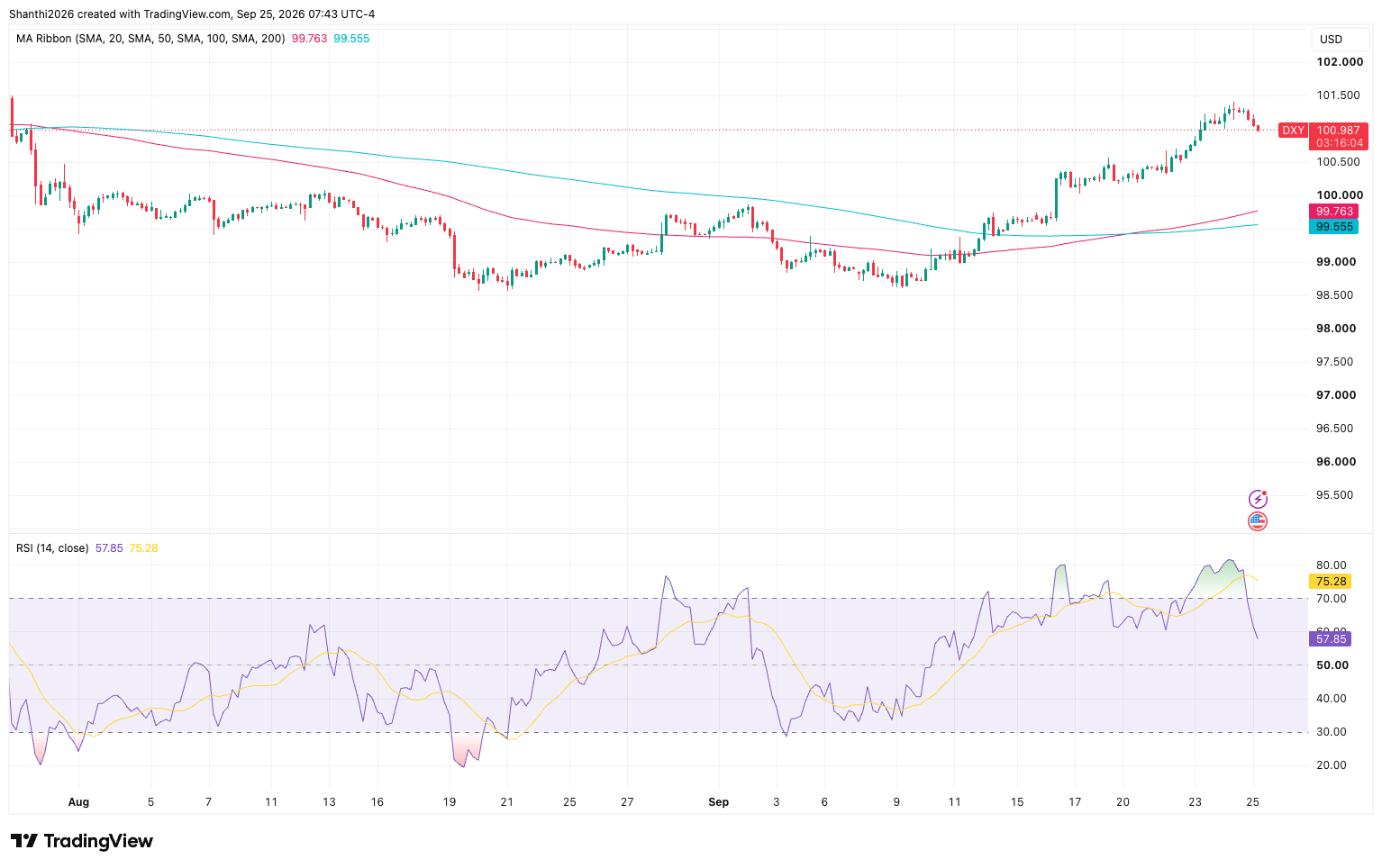
Zooming into the 4-hour time frame, the index displays a clear short-term uptrend starting from mid-September, breaking above the key moving averages around 99.55-99.76. Price peaked near 101.00 before pulling back slightly, while the RSI dropped sharply from overbought levels (above 80) down to 57.85. This indicates a brief cooling-off period or consolidation step, where bulls are taking a breather before attempting another push higher.
Source: TradingView
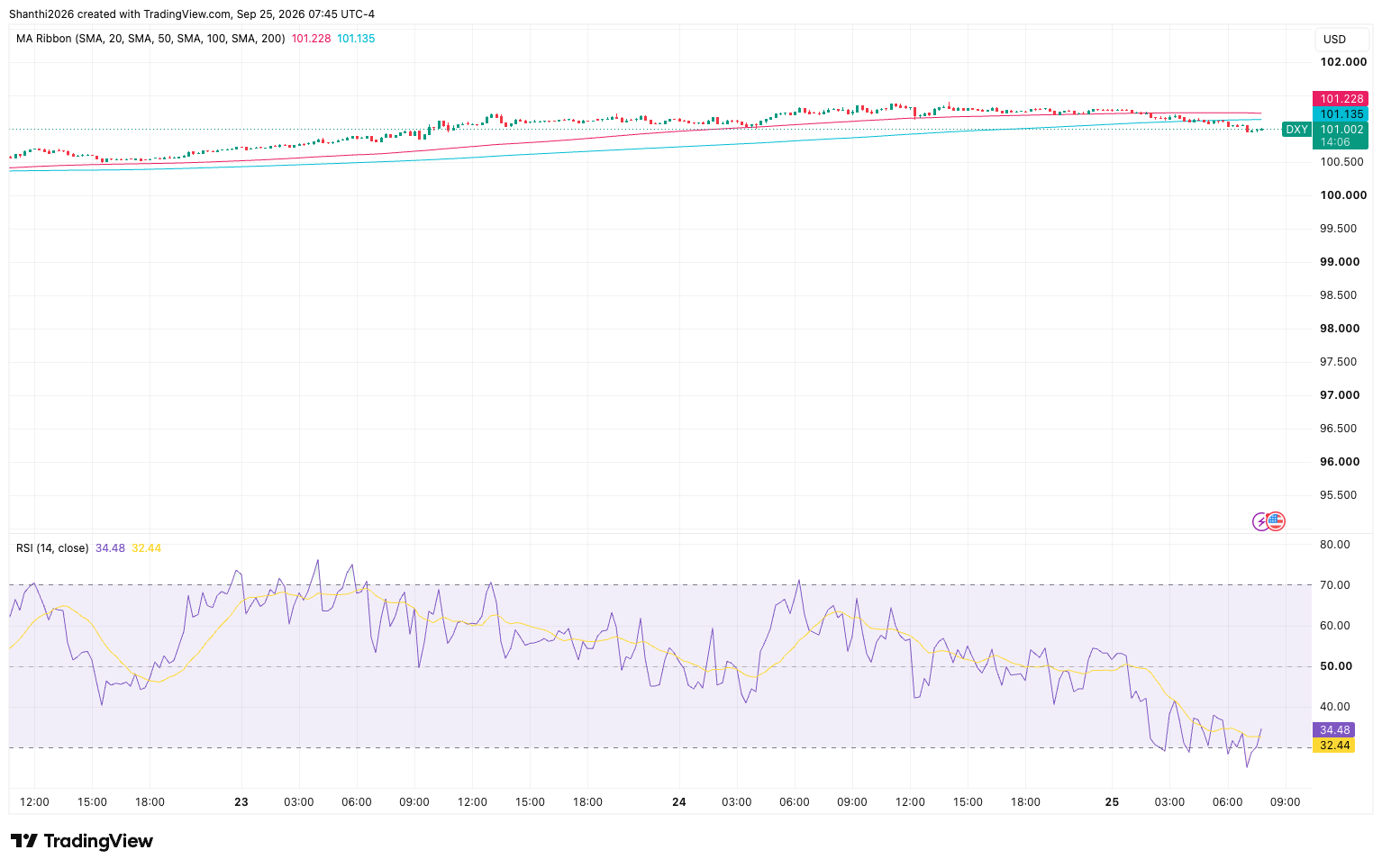
On the 15-minute chart, the index exhibits a gradual intraday decline after peaking earlier near the 101.20 region. The price has slipped slightly below both short-term moving averages (101.135 and 101.228) down toward 101.002, signaling mild short-term selling pressure. The RSI reflects this shift, hovering near 34.48 close to oversold territory, which points to a short-term bearish drift while looking for a potential stabilization level.
Source: TradingView
MarketFramework’s Top Traded Contracts tool shows Euro Forex futures (6E) positioning remains strongly short, with traders holding 100% short exposure today after a $9.5K weekly gain. The crowd remains skewed long among both winners and losers, but the heavier 75% long share among losing traders points to greater pain on the long side, reinforcing the bearish positioning signal. Given the euro’s dominant weight in the DXY, this positioning reinforces a bearish bias for EUR/USD and, by extension, provides a supportive signal for the U.S. dollar.