The U.S. Dollar Index (DXY) breached the 101 level on Wednesday, clearing a resistance zone that had capped the index during much of its recent rebound. The move came as stronger-than-expected U.S. economic data reinforced expectations that the Federal Reserve may need to keep policy restrictive for longer.
The breakout is significant, but it does not by itself establish a new dollar trend. The more important test is whether DXY can hold above 101 and turn the former resistance level into support. If it can, the move would have a stronger claim to being more than another short-lived extension within a broader range.
101 Breaks as US Growth Reaccelerates
S&P Global's preliminary September data showed the U.S. composite PMI jumping to 58.4 from 56.0 in August, its strongest reading in more than five years. Both services and manufacturing strengthened, while employment and new orders also improved.
That combination gives the dollar a more substantive fundamental backdrop than it had earlier in the rebound.
The significance for the dollar goes beyond the headline growth number. The survey also showed renewed pricing pressure, with services input-cost inflation reaching its highest level since November 2022 and selling-price inflation accelerating.
That creates an important link between the economy and monetary policy: stronger demand is supporting activity, but it is also giving businesses greater pricing power at a time when inflation remains elevated.
For the dollar, this is potentially more important than growth alone. A strong economy can support the greenback, but a strong economy combined with persistent inflation can also support the interest-rate differential that makes the dollar attractive.
The dollar's move above 101 also comes against a renewed flare-up in Middle East tensions. Oil prices rebounded on Wednesday after five straight sessions of declines as comments from Iran cast doubt on the prospects for a diplomatic breakthrough, while conflicting signals from Washington and Tehran kept uncertainty around the conflict elevated.
The renewed geopolitical risk gives the dollar another potential source of support beyond the interest-rate channel. A prolonged conflict can lift energy prices, reinforce inflation concerns and complicate the Fed's path toward lower rates. That combination can support both Treasury yields and demand for the dollar, particularly if markets begin to price a greater risk that the Fed will need to keep policy restrictive for longer.
The Fed Is Giving the Dollar Its Fundamental Fuel
The Fed raised its policy rate by 25 basis points last week to 3.75%-4.00%, its first increase since 2023. Policymakers' projections pointed to one additional hike in 2026, while the Fed said inflation remains elevated.
Since then, several Fed officials have maintained a cautious stance on inflation. Richmond Fed President Thomas Barkin has argued that inflation remains a significant challenge, while Boston Fed President Susan Collins has said a more restrictive policy rate could be needed to bring inflation back to 2%.
That matters because the dollar's recent strength has increasingly become a rate story. Markets do not need to price an aggressive tightening cycle for DXY to benefit; even the prospect of one more hike, particularly if accompanied by resilient economic data, can limit expectations for easing and keep U.S. yields relatively attractive.
ING strategist Francesco Pesole had identified 101 as a realistic near-term DXY target before the index reached the level, citing resilient U.S. data and hawkish Fed communication.
We retain the view that the dollar faces upside risks over the next couple of weeks, when a revamp of data releases can prompt markets to add bets on an October hike. In that context, DXY reaching 101.0 remains a very achievable near-term target.
Now that 101 has been breached, the question shifts from whether DXY can reach the level to whether it can establish itself above it.
101 Is the Technical Test
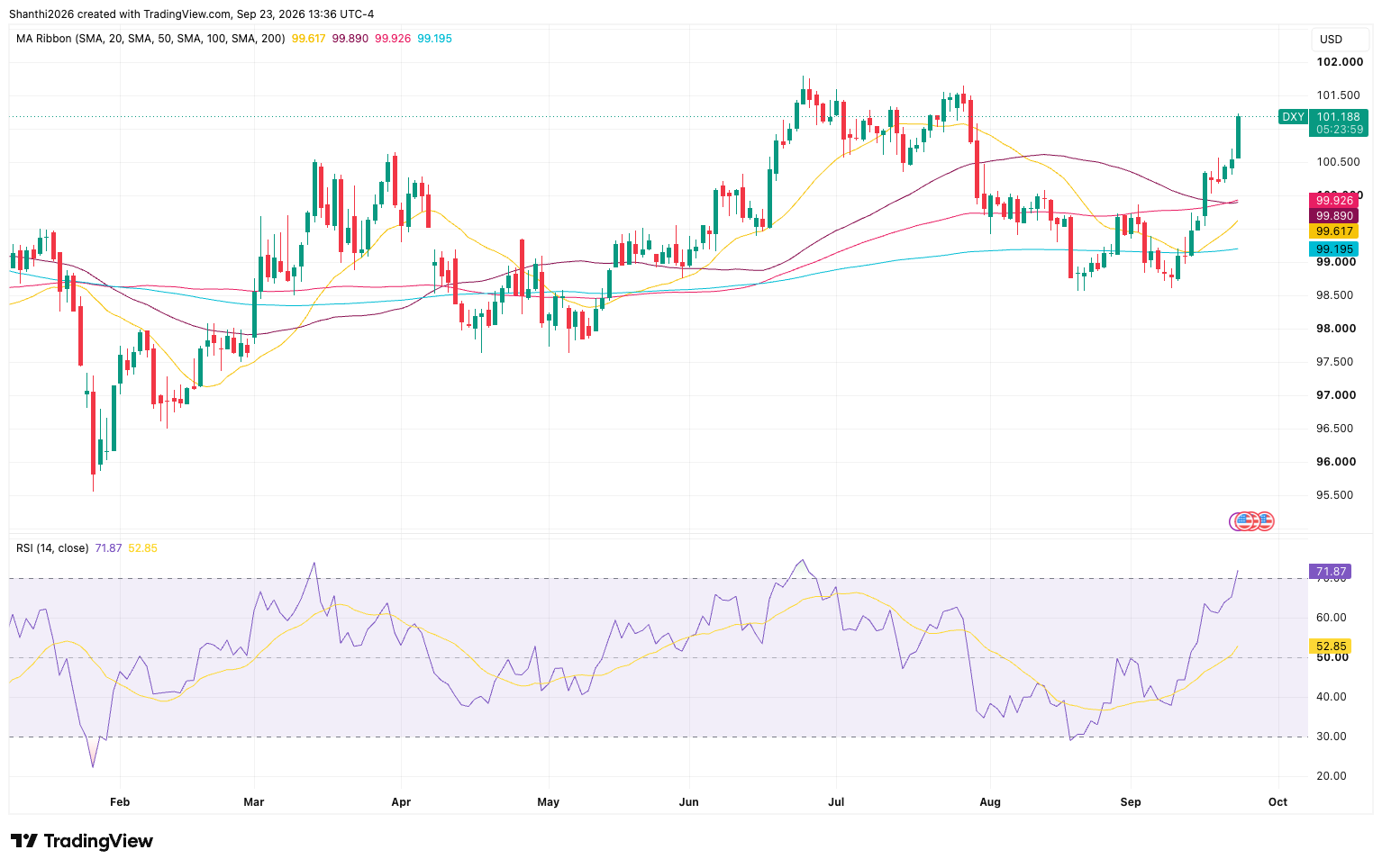
Technically, the DXY has strengthened decisively, with price at 101.19 now trading above all four key SMAs: the 20-day at 99.62, the 50-day at 99.89, 100-day at 99.93 and the 200-day at 99.20. The 50- and 100-day averages are tightly clustered around 99.90, while the 200-day remains lower, reinforcing the broader upward structure. The sharp move above 101.00 puts the 101.50 area in focus, while the 99.90–99.60 zone now becomes an important moving-average support band.
Source: TradingView
The next question for traders is therefore not simply "Did DXY break 101?" It is "What happens after the breakout?"
A Dollar Breakout Needs Broader Confirmation
The cross-market signals will be important.
- Treasury yields are one of the clearest confirmation channels. If DXY remains above 101 while front-end yields stay elevated or move higher on stronger Fed expectations, the breakout would have a stronger macro foundation.
- The euro is another important test because of its large weighting in the DXY basket. Continued weakness in EUR/USD would mechanically reinforce DXY's advance. On Wednesday, stronger U.S. PMI data were accompanied by renewed pressure on the euro as markets reassessed the path for U.S. rates.
- USD/JPY also bears watching. If the dollar advances against both the euro and yen, rather than simply benefiting from weakness in one major component, the move would represent broader-based dollar strength.
A genuine change in dollar momentum should eventually show up across multiple major currency pairs rather than only in the index itself.
Euro Forex futures (6E) positioning is firmly bearish, with Wednesday's crowd entirely short and the seven-day lean at Strong Short, according to MarketFramework’s Top Traded Contracts tool. Yet the winner/loser split provides a cautionary signal: 61% of winning positioning is associated with longs, while 80% of losing positioning is associated with shorts. That divergence suggests that, despite the strongly bearish aggregate positioning, short exposure has not been uniformly profitable across the tracked cohort.
What It Means for NQ, Gold and Silver
A sustained dollar breakout would also matter beyond FX.
For Nasdaq futures, a stronger dollar can become an additional headwind if it coincides with higher Treasury yields. The combination matters for long-duration growth assets because higher discount rates can pressure valuations.
For gold and silver, the picture is more nuanced. A stronger dollar and higher real yields generally create a headwind for precious metals, although geopolitical uncertainty and safe-haven demand can work in the opposite direction. Gold has already faced pressure from rising Treasury yields in recent sessions.
For silver, the tension is even greater because industrial demand provides an additional fundamental driver. A resilient U.S. economy can support the industrial side of the silver story, but a stronger dollar and tighter financial conditions can offset that support.
101 Is the Signal; Holding It Is the Confirmation
DXY's move above 101 is technically important, but calling it the beginning of a new dollar regime would be premature without confirmation.
The next few sessions should reveal whether 101 becomes a new support zone or simply another resistance level temporarily overcome by strong momentum.
The fundamental backdrop has clearly improved for the dollar: U.S. activity is accelerating, inflation pressures remain sticky and the Fed has reopened the possibility of additional tightening. That gives the breakout a stronger macro foundation than a purely technical move would have.
For now, 101 is best viewed as a confirmation point in the making. A sustained hold above the level, reinforced by Treasury yields, Fed expectations and broad-based gains across major dollar pairs, would make the case for a more durable dollar upswing considerably stronger.