
The U.S. private sector accelerated sharply, with activity readings for the month of September rising from a month ago and exceeding expectations, the results of a preliminary S&P 500 survey showed Wednesday. The breadth of the improvement is notable: both services and manufacturing strengthened, suggesting the economy entered the fall with considerably more momentum than previously indicated.
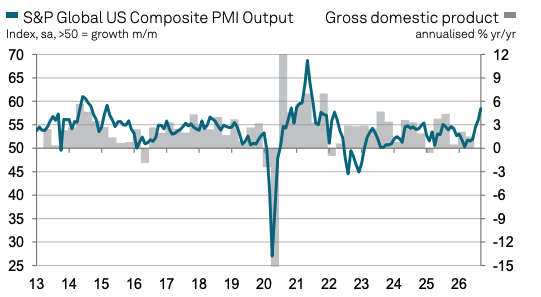
S&P Global's composite purchasing managers' index (PMI) climbed to 58.4 in September from 56.0 in August, marking a more than five-year high and the fourth consecutive month of expansion. The increase was driven by a further acceleration in services activity and a renewed strengthening in manufacturing output.
Source: S&P Global
S&P Global Chief Business Economist Chris Williamson said, "To put the growth surge in context, barring the spike in demand following the opening up of the economy after the COVID-19 lockdowns, the latest improvement in business activity is the greatest recorded since early 2015. Business is clearly booming now in both manufacturing and services."
The strength of the survey therefore complicates any argument that the economy is losing momentum quickly enough to relieve inflationary pressure. Instead, the September readings point to a combination of firm demand, rising employment and renewed production growth that could keep underlying price pressures elevated.
Williamson nevertheless cautioned that the buildup of uncompleted orders could give companies greater pricing power, creating an additional risk for the inflation outlook.
While this accumulation of uncompleted orders bodes well for the further expansion of output and capacity in the coming months, it also indicates that companies are developing more pricing power, and hence is a worry for the inflation outlook.
That is particularly relevant for the Federal Reserve following its September policy decision. A stronger activity backdrop gives policymakers less evidence of an imminent growth slowdown, while the acceleration in input and selling prices leaves little room to dismiss renewed inflation pressure as purely transitory.
The survey data were collected between Sept. 10 and Sept. 22, capturing a period in which energy prices were climbing sharply. That timing is important because higher energy costs can feed into both input prices and business expectations, potentially amplifying the inflation signal in the coming months.
Services Stay Buoyant
The Services Business Activity PMI climbed to 58.7, a nearly five-year high, from 56.5 in August and well above the 55.8 consensus estimate. The services sector was the primary engine of the September acceleration, pointing to particularly strong domestic demand.
New orders rose to their highest level since March 2022, with the increase driven primarily by the domestic market. Services exports advanced only modestly. The combination of stronger new orders and faster payroll growth suggests that service providers are responding to genuine demand strength rather than simply benefiting from temporary external factors.
Payroll growth accelerated to its fastest pace since June 2022, adding another positive signal for the labor market.
The stronger activity, however, came alongside a renewed deterioration in the sector's inflation profile. Input-cost inflation reached its highest level since November 2022, while the pace of selling-price inflation also accelerated notably in September.
For the Fed, the services data are particularly important because persistent services inflation can be harder to reverse when supported by strong domestic demand and wage-sensitive business costs.
Manufacturing Stages a Strong Rebound
The manufacturing PMI rose 3.1 points to 57, above the expected reading of 53.9 and marking the strongest improvement in business conditions since May 2022.
All five components helped boost the manufacturing PMI. After falling in the past three months, production growth accelerated, reaching the fastest rate since April 2022. The rebound suggests that the manufacturing sector is regaining momentum after earlier disruptions, rather than merely stabilizing at depressed levels.
New-order inflows also reached their highest level since April 2022, although export demand continued to weaken. That divergence reinforces the broader theme running through the survey: U.S. growth is being driven predominantly by domestic demand, while external demand remains less supportive.
Supply shortages (with supplier delivery times lengthening markedly) pushed up raw material prices. Nevertheless, input prices remained below the peak seen earlier this year during the initial months of the Middle East war.
The incidence of supply chain delays was the most widespread since July 2022, S&P said.
The manufacturing data therefore present a mixed picture for inflation: capacity and output are improving, but tighter supply conditions could limit how quickly producers can absorb stronger demand without passing higher costs on to customers.
Employment growth hit the highest rate since Feb. 2021, and inventories growth accelerated.
Business Confidence Holds, But Services Lag
Business output expectations for the year aheads remained unchanged in September after regaining pre-war levels in recent months. Business expansion plans reflected reports of confidence being buoyed by signs of ongoing demand growth and economic resilience.
Manufacturers remained more upbeat than service providers, and factory confidence has more or less returned to its long-run average. In contrast, service providers’ sentiment remained well below trend level amid worries over cost-of-living concerns, higher borrowing costs and political uncertainty.
The divergence matters because it suggests businesses are confident about near-term demand but remain cautious about the broader operating environment. In other words, current activity is considerably stronger than forward-looking sentiment might imply.
What It Means for the Fed and Markets
The September PMI delivers a distinctly strong growth signal, but its policy implications are more complicated. The economy is showing enough momentum to withstand elevated rates, while the simultaneous acceleration in input and selling prices suggests that demand is not yet cooling sufficiently to eliminate inflation concerns.
For Treasury markets, the data could reinforce the case for higher-for-longer rate expectations, particularly if subsequent inflation readings confirm the price pressures flagged by the survey. That would be most relevant at the front end of the curve, where expectations for the next Federal Reserve move are concentrated.
For equities, the reaction is more two-sided. Stronger activity supports earnings and reduces near-term recession concerns, but persistent inflation and higher-rate expectations can weigh on valuations, particularly for long-duration growth stocks. The combination therefore favors a market increasingly sensitive to the distinction between "good growth" and growth that keeps monetary policy restrictive.
For the dollar, a stronger U.S. activity backdrop combined with sticky price pressures could provide near-term support if markets push back expectations for additional easing. Meanwhile, commodities face a similarly mixed setup: resilient demand is supportive, but stronger inflationary pressure could keep real yields and the dollar elevated, creating an offsetting headwind for precious metals.
The key takeaway is that September's PMI is not simply a "strong growth" report. It points to an economy with considerable underlying momentum, but also to a potentially uncomfortable combination for policymakers: stronger demand, firmer employment and renewed pricing power. That could make the path toward sustained 2% inflation more difficult even if headline economic activity remains robust.