U.S. stocks spent Thursday fighting the bond market and ended roughly where they started. The Dow Jones Industrial Average fell 137 points, or 0.3%, its third straight losing day.
The S&P 500 and the Nasdaq both finished close to flat after recovering from their lows on a report of a possible U.S.-Iran deal.
The Bond Market Is Running the Show
Yields kept climbing. The 30-year Treasury yield touched 5.446%, a level last seen in June 2004, while the 10-year hit 5.15%. Traders now see about a 71% chance the Fed raises rates again in October, according to the CME FedWatch tool, up from about 55% a week ago.
The odd part is why. Wednesday’s strong PMI data showed U.S. businesses are still booming. As Jason Stephens of Evertern Wealth put it, investors are worried about rates because the economy is strong, not weak.
Higher yields hit the most cyclical parts of the market hardest, which is why the Dow lagged. They also squeeze consumers who are already paying more for fuel.
Hormuz Headline Sparks a Rebound
Stocks came off their lows after Reuters reported that U.S. and Iranian negotiators in New York are exploring a phased deal. Iran would reopen the Strait of Hormuz and the US would lift its blockade.
Oil pulled back from its session highs on the news but still closed sharply higher, with Brent above $106. That tells us traders want to see an actual deal before pricing out the war premium.
Trump–Xi and Stock Movers
President Trump met China’s Xi Jinping in Washington, with the U.S.-China trade truce already extended by two months to January 10.
Going into the meeting, MarketPulse’s Kelvin Wong noted that markets were leaning toward a positive outcome, but warned that firm tariff cuts and timelines would be needed to avoid a “sell-the-fact” reversal.
In comments attributed to Chinese President Xi Jinping by Xinhua, the Chinese President said that the economic and trade teams of the two sides held a new round of consultations and reached a new joint arrangement.
The Roundhill Magnificent Seven ETF rose 0.8% and is up more than 5% this week, as big tech again outperformed.
Oracle fell more than 3% after Bloomberg reported the company is citing force majeure to protect itself if a New Mexico construction project is delayed.
Nasdaq 100 Futures: Back Above the Key Averages
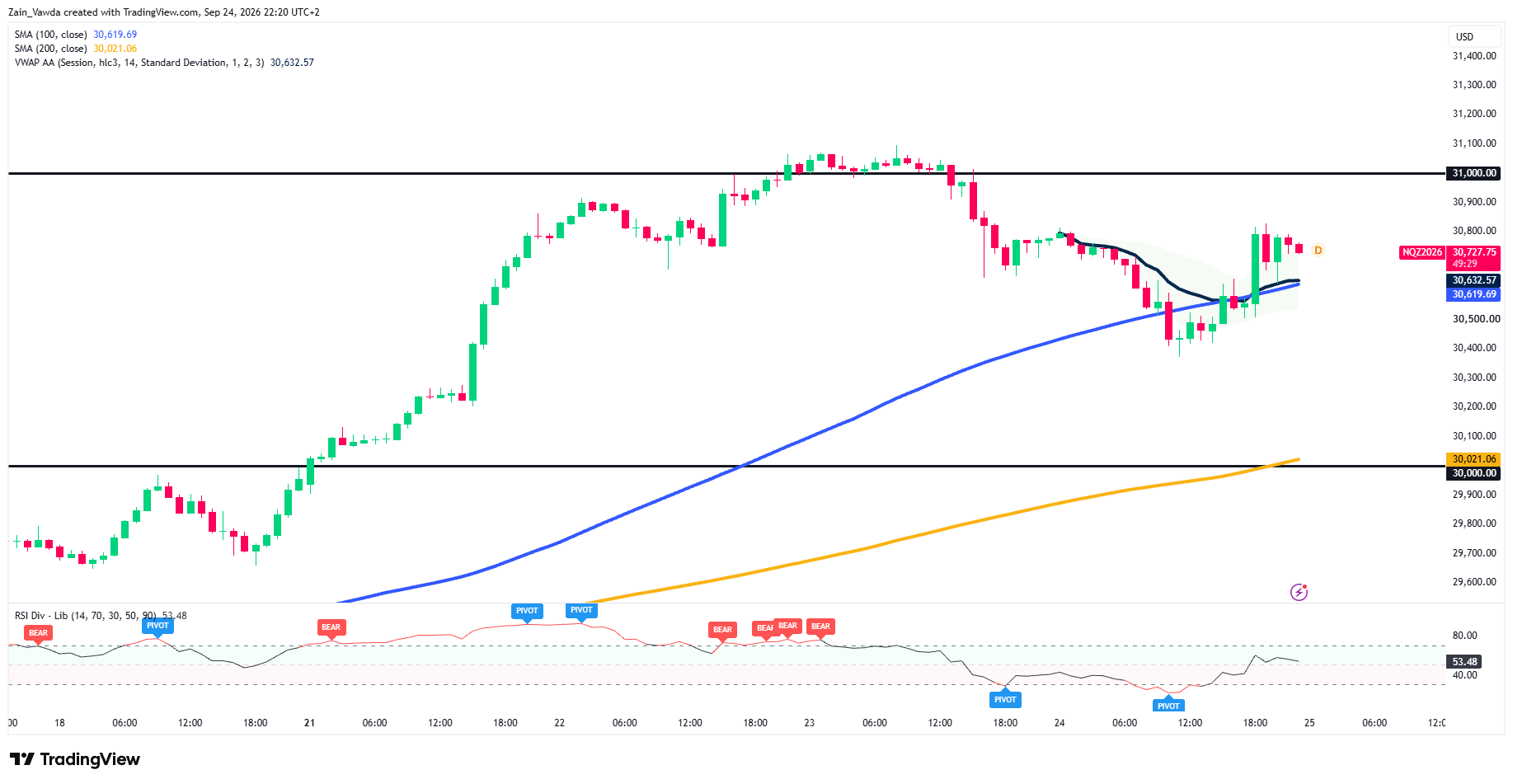
Nasdaq One-Hour Chart, September 24, 2026
Source: TradingView
On the one-hour (H1) chart, NQ was rejected at 31,000 on Tuesday and slid to about 30,370 on Thursday morning.
The Hormuz headline sparked a sharp jump to around 30,820. Price is now near 30,728, back above both the session VWAP at 30,633 and the 100-hour moving average at 30,620. RSI sits near 53, neutral, after bouncing from oversold.
The big picture is a range between 30,000 and 31,000, with the rising 200-hour moving average at 30,021 guarding the floor.
Outlook: Friday Session
| Scenario | Trigger | Nasdaq Path |
|---|---|---|
| Bull | Confirmation of Hormuz progress, oil and yields ease | Holds 30,620–30,633, retests 30,820, then 31,000 |
| Base | No new headlines, yields steady near 5.15% | Choppy range between 30,600 and 30,850 |
| Bear | US denies deal talk, 10-year pushes higher | Loses 30,620, targets 30,370, then 30,000–30,021 |