Nasdaq-100 futures have pushed decisively above the 30,500 area, extending a powerful rebound and moving closer to their record high as bullish momentum accelerates. The breakout comes as traders weigh the Federal Reserve's latest rate hike, Treasury yields, energy-price pressures and shifting expectations for the path of monetary policy, leaving NQ at a critical juncture between continued upside and a potential near-term pause.
The Fed's 25-basis-point rate hike to 3.75%-4.00% has complicated the outlook for growth-sensitive assets. While the move was widely anticipated, the Fed's emphasis on elevated inflation and the possibility of further tightening keeps Treasury yields and discount-rate expectations relevant for high-duration technology stocks. At the same time, the BOJ also raised rates, while the dollar still posted a weekly gain, creating a mixed cross-asset backdrop for Nasdaq futures.
Rate Outlook Keeps Nasdaq Bulls on Alert
The key issue for NQ is no longer simply whether the Fed has moved into a tightening cycle, but how far policymakers may need to go. Persistent inflation, renewed energy-price pressures and firmer inflation expectations could keep rates higher for longer even as economic growth remains resilient. Morgan Stanley’s Equity Strategist Michael Wilson, however, does not see the possibility of a 2022-style tightening.
The August core inflation print exceeded expectations, but the internals were not uniformly hot, giving Warsh room to deliver a credibility-enhancing hike without forcing markets to extrapolate a 2022-style tightening.
Morgan Stanley also sees another leg higher in oil prices pressuring the expected policy path, back-end yields and bond volatility.
The buffers that helped absorb these shocks over the last six months are also thinning as inventories have drawn, Chinese buying is picking and European product and gas stocks remain tight.
The firm also warns of the risk around managing the Fed’s balance sheet going forward.
That creates a delicate setup for technology and artificial intelligence (AI)-related stocks. Strong productivity growth and capital investment can support the earnings outlook. Morgan Stanley points out that median stock EPS growth is in the mid-teens, and revisions breadth for the high quality S&P 500 is back near cycle highs, and attributes it as the reason as to why the price damage for the S&P 500 and the Nasdaq 100 indices have remained contained.
However, higher yields can place pressure on the valuations investors are willing to assign to future cash flows.
For Nasdaq futures, therefore, the 30,500 area has significance beyond the chart. A failure to push through resistance while yields remain elevated could encourage profit-taking after the recent rally. Conversely, if rate pressures ease and risk appetite remains firm, the market could have room to challenge its previous record zone.
NQ Hits Technical Decision Point
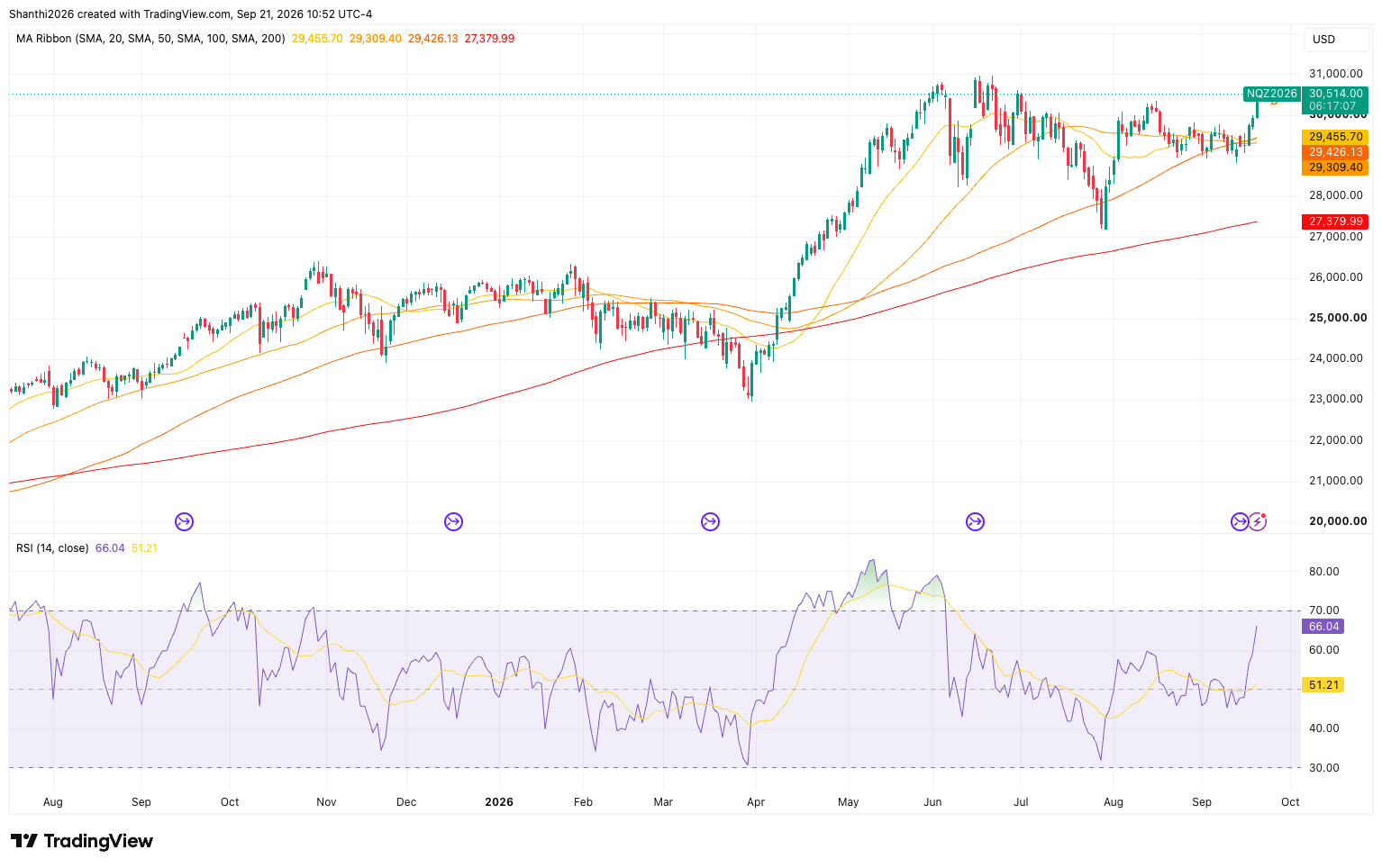
The daily chart for NQ displays a strong bullish expansion, with price breaking cleanly above the 30,500 psychological resistance. The market maintains a solid macro uptrend well above its rising 100-day SMA (29,426.14) and 200-day SMA (27,380.01), reinforcing strong institutional support above the major 27,209.50 swing low established during the August pullback. With buyers absorbing supply at lower levels, the immediate technical path points toward a retest of the major high at 30,988.75.
Source: TradingView
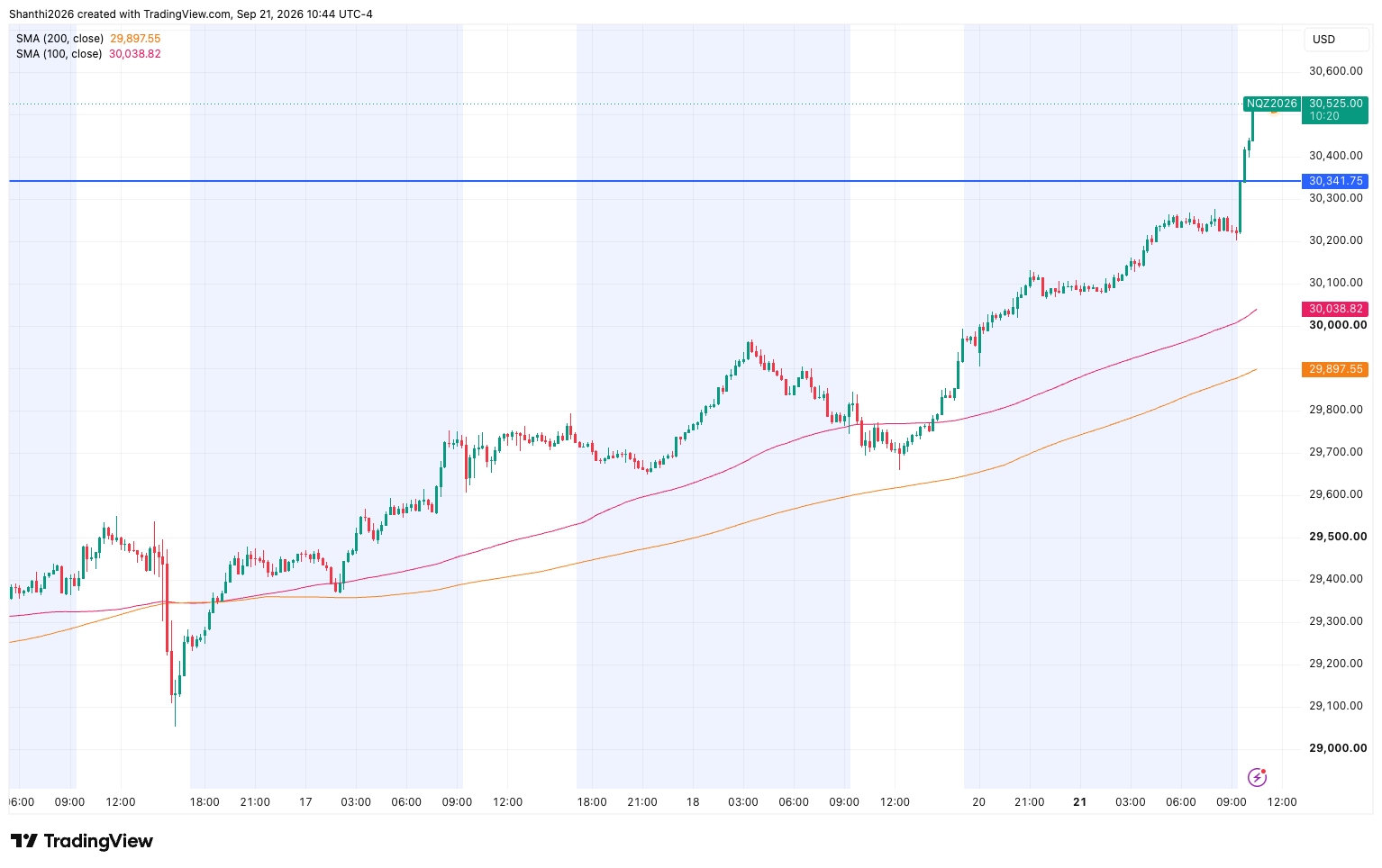
The M15 chart shows the micro-consolidation near local highs around 30,200-30,270 resolving higher, with price now around 30,530 after a sharp burst through the prior resistance ceiling. On the moving average chart, price remains in a firm intraday uptrend, trading well above the rising 100-day SMA (30,038.82) and 200-day SMA (29,897.55), which offer dynamic and structural trailing support.
Source: TradingView
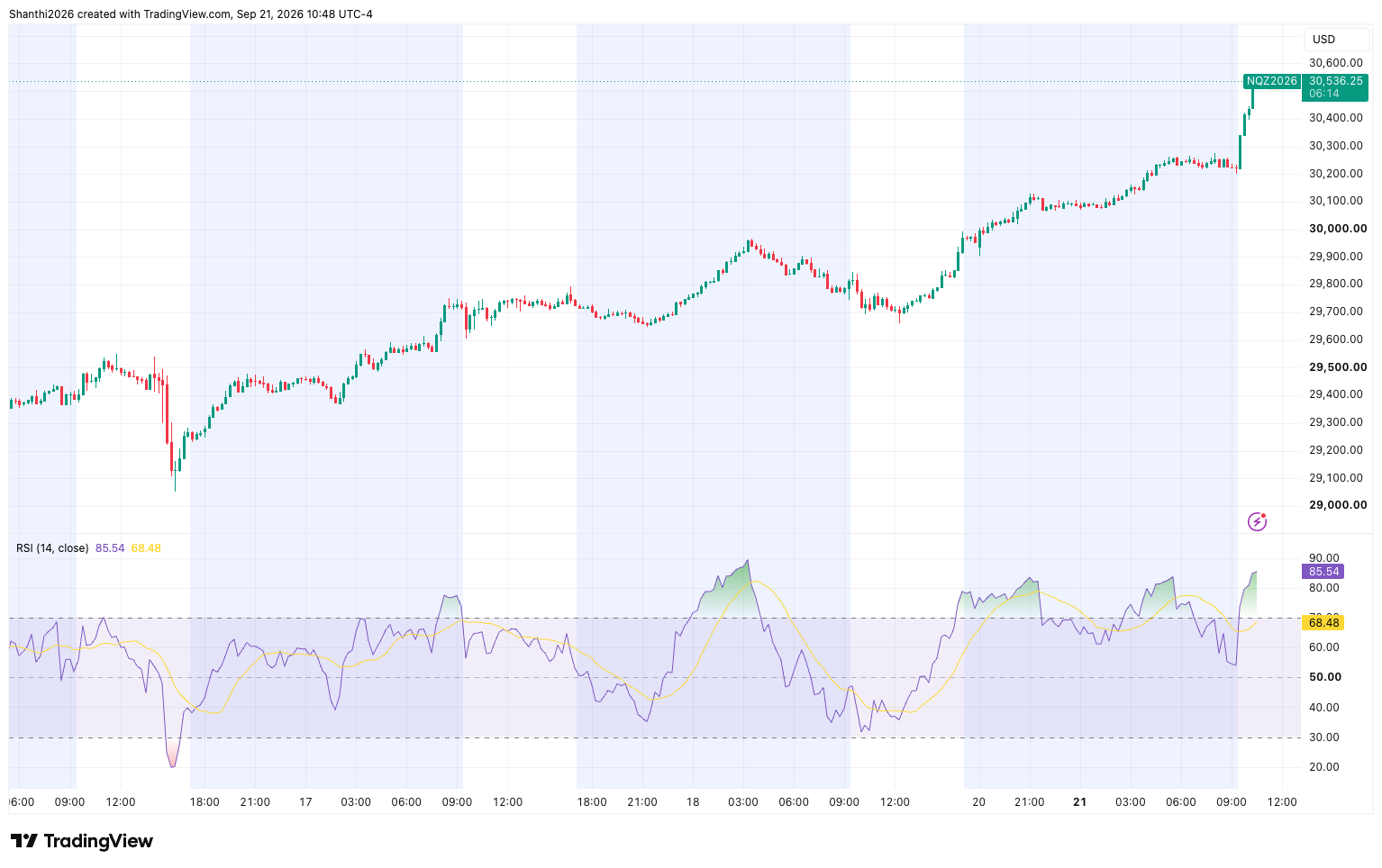
The 14-day relative strength index (RSI) has rebounded from neutral (54 area) to above 85, above its signal line at 68.45 and approaching overbought territory. This shows momentum re-accelerating on the breakout rather than fading, though price is now stretched, raising the odds of a brief pause or shallow pullback.
Source: TradingViewWith the 30,260-30,280 ceiling cleared, immediate upside is largely in price-discovery territory, the 30,600 round-level could be the next psychological test.
The more important question for bulls may be what happens if the breakout holds. A retest of the former resistance zone ( 30,260-30,280) would be a constructive pullback and a deeper dip toward 30,200-30,220 would still leave the structure intact. A close below 30,080-30,120 would signal a failed breakout and open the door to a move toward the 29,500-30,000 zone, where the 200-day SMA offers additional support. Below that, the short-term structure would become more vulnerable, with 29,680-29,720 emerging as the next major support area.
COT Data Shows Funds Trimming Bearish Nasdaq Bets
The latest Commitment of Traders (COT) report suggests institutional sentiment toward Nasdaq-100 futures has become less bearish. Leveraged funds reduced their short exposure by 20,479 contracts during the week while adding 5,006 long contracts, marking one of the largest short-covering moves across trader categories. Despite maintaining a net-short position overall, hedge funds appear to be moderating their downside outlook as the Nasdaq continues to trade near record territory.
Meanwhile, asset managers remain firmly net long, holding 105,199 long contracts versus 38,388 shorts, reinforcing the view that longer-term investors continue to favor the technology-heavy index.
MarketFramework's Positioning Edge tool paints a more cautious near-term picture. While unprofitable traders are 55.6% long, profitable traders are only 46.6% long, creating a strong bearish divergence that suggests the market's more successful participants remain less convinced by the bullish narrative. The disparity is particularly notable given the Nasdaq's proximity to all-time highs, implying that experienced traders are maintaining a more defensive stance while the broader crowd remains positioned for additional gains. Historically, such divergences can serve as an early warning that upside momentum is becoming increasingly dependent on optimistic sentiment rather than broad conviction across market participants.
Macro Catalysts Could Decide the Next Move
That leaves NQ caught between a still-supportive growth and earnings narrative and a less forgiving interest-rate backdrop. The market's ability to hold above 30,000 while absorbing higher-rate concerns will be important for determining whether the current pause develops into another leg higher or a deeper retracement.
For futures traders, the focus now shifts from whether NQ can clear 30,300 to whether buyers can sustain the breakout above 30,500. Holding that zone would keep the path toward 30,600 and eventually the 30,988.75 record high open, while a failed breakout would bring the 30,260–30,280 retest zone back into focus.