
Fresh U.S. economic data released Thursday paint a mixed but broadly resilient picture of the economy, with jobless claims falling, manufacturing activity remaining firmly in expansion territory and single-family housing starts rebounding. At the same time, the data contain signs of cooling in employment and housing demand, while price pressures are becoming more pronounced.
The combination comes just one day after the Federal Reserve raised its policy rate by 25 basis points to 3.75%-4.00%, making the incoming data particularly important for markets assessing how much further the Fed may need to tighten.
Jobless claims point to continued labor-market resilience
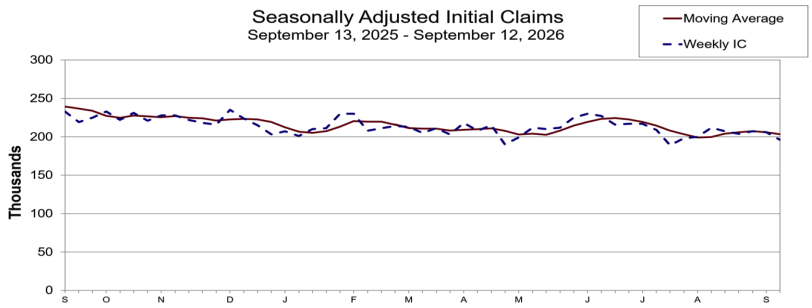
Initial jobless claims fell 10,000 to 196,000 in the week ended Sept. 12, belying expectations for a climb to 207,000. The four-week moving average declined 2,750 to 203,250 and continuing claims also fell by 39,000 to 1.73 million in the week ended Sept. 5 versus consensus expectations for 1.78 million.
Seasonally Adjusted Initial Claims
Source: DOL
The decline suggests that layoffs remain relatively contained. The unadjusted data were similarly firm, with actual initial claims falling 13.9% to 152,286, a larger decline than seasonal factors had anticipated.
Taken together, the claims figures do not point to an abrupt deterioration in labor-market conditions. That matters for the Fed because a resilient labor market gives policymakers more room to keep their attention focused on inflation rather than responding to an immediate employment shock.
Philly Fed shows manufacturing expanding, but hiring cools
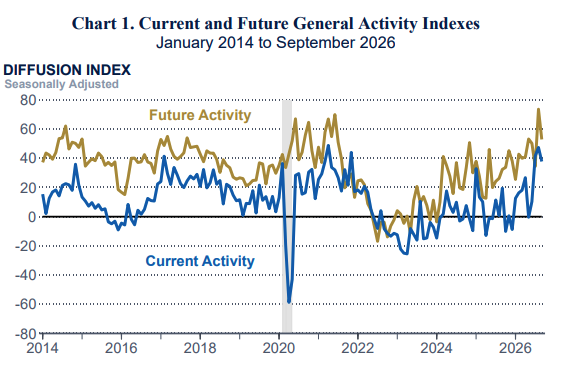
The September Philadelphia Fed Manufacturing Business Outlook Survey provides a more nuanced picture. Regional manufacturing activity continued to expand, with the general activity index at 37.8, down from 47.4 in August but still comfortably positive and above consensus of 31.3. New orders stood at 29.2, while shipments were unchanged at 27.7.
The labor signal was softer. The employment index fell 16 points to 11.8, with 77% of firms reporting no change in employment. The average workweek index also declined, although it remained elevated.
That creates an interesting contrast with the jobless-claims data: layoffs remain low, but the pace of hiring appears to be moderating.
The survey's forward-looking measures nevertheless remained positive. The future general activity index was 52.9, while future employment rose to 50.6, suggesting that manufacturers still anticipate expansion over the next six months.
Source: Philadelphia Fed
The bigger problem for the Fed: prices are moving higher
The inflation component of the Philly Fed survey is potentially more consequential for markets.
The prices paid index jumped to 48.6 from 40.9, while the prices received index climbed to 31.3 from 17.7. Both measures moved higher after declining in August.
The forward-looking price indicators were even stronger. The future prices paid index rose to 71.3, while future prices received climbed to 72.3.
That means the survey is simultaneously showing some cooling in employment momentum and renewed price pressure. For markets, that is an important distinction: softer hiring alone could support expectations for less restrictive policy, but stronger input and selling-price pressures work in the opposite direction.
The survey also found that 72% of firms viewed labor supply as at least a slight constraint on capacity utilization, up from 50% when the question was last asked in June. Meanwhile, 36% expected energy-market impacts to worsen over the next three months.
Housing delivers another mixed signal
The Census Bureau's August New Residential Construction report adds another piece to the puzzle.
Housing starts fell 2.6% month over month to a 1.275 million annualized rate, and were 1.2% below the August 2025 level. Building permits fell 2.7% from July to a 1.394 million annualized rate, although permits were still 3.5% above a year earlier.
The composition of the starts data was more encouraging: single-family housing starts jumped 7.6% to 918,000, partially offsetting weakness in multifamily construction.
However, completions were considerably weaker. Privately owned housing completions dropped 11.9% from July and 27.1% from a year earlier to a 1.128 million annualized rate. Single-family completions fell 10.4%.
The housing numbers therefore do not present a straightforward growth signal. New construction remains constrained, while the sharp drop in completions highlights continued weakness in the flow of newly finished homes.
The economic picture: resilient growth, softer labor momentum and sticky prices
Taken together, the three reports suggest an economy that has not lost significant momentum, but is becoming increasingly uneven.
- Labor market: Jobless claims remain low, pointing to limited layoffs.
- Manufacturing: Philly Fed activity remains strongly expansionary.
- Employment: Manufacturing hiring momentum has cooled.
- Housing: Overall starts and permits softened, although single-family starts improved.
- Inflation: Philly Fed price measures accelerated sharply.
- Outlook: Manufacturers continue to expect growth, but also anticipate higher prices.
That mix is particularly relevant following Wednesday's FOMC decision. The Fed has now delivered a rate hike into an economy that is still showing meaningful activity, rather than one displaying broad-based contraction. At the same time, the latest price data provide another reason for policymakers to remain cautious about declaring victory on inflation.
For NQ futures, the key tension is therefore between resilient growth and renewed inflation pressure. Strong claims and positive manufacturing activity can support the earnings and growth narrative for equities, while rising prices and still-elevated forward inflation measures can keep Treasury yields and the Fed outlook as a source of pressure for long-duration technology stocks.
MarketFramework’s Positioning Edge tool flashes a warning signal. Profitable traders are net short (41.4% long), while unprofitable traders are heavily long (67.1% long), a 26-point gap. It appears that unprofitable money chased the overnight recovery, while profitable traders are fading the rally. Unless the rally attracts stronger buying, the setup leaves the market vulnerable to a reversal.