The Session In One Line
Wall Street bought back Wednesday’s Fed-day drop. U.S. stocks posted their strongest gain in six weeks as falling Treasury yields and softer oil prices calmed inflation nerves a day after the Federal Reserve’s first rate hike since 2023.
The Nasdaq led, jumping around 1.37%, with the S&P 500 up 1.14% and the Dow adding 0.61%. Chip stocks did the heavy lifting, a key semiconductor index rose about 3%. As Robert Conzo, CEO of The Wealth Alliance, put it, “The market’s reaction could be kind of summed up in one word: relief.”
What Drove It
Three tailwinds lined up.
First, yields fell. The 10-year Treasury yield dropped about 7 basis points to 4.93%, back below the 5% line, snapping an eight-session run of increases from its highest level since 2007. Lower “risk-free” yields make shares easier to own.
Second, oil eased. US crude closed at $101.91 and Brent settled below $105 after Saudi Arabia reportedly freed up extra cargoes for Asian refiners via ship-to-ship transfers near Oman’s Sohar port, cooling supply-shock fears.
Third, and biggest, big tech ran. Intel jumped about 7%, Nvidia and Amazon rose more than 2% each, Microsoft added 1.5% and Qualcomm gained 2%, a broad bid for the AI trade that powered the whole semiconductor complex.
Nasdaq (NQ) Technical Read: A Clean Round-Trip
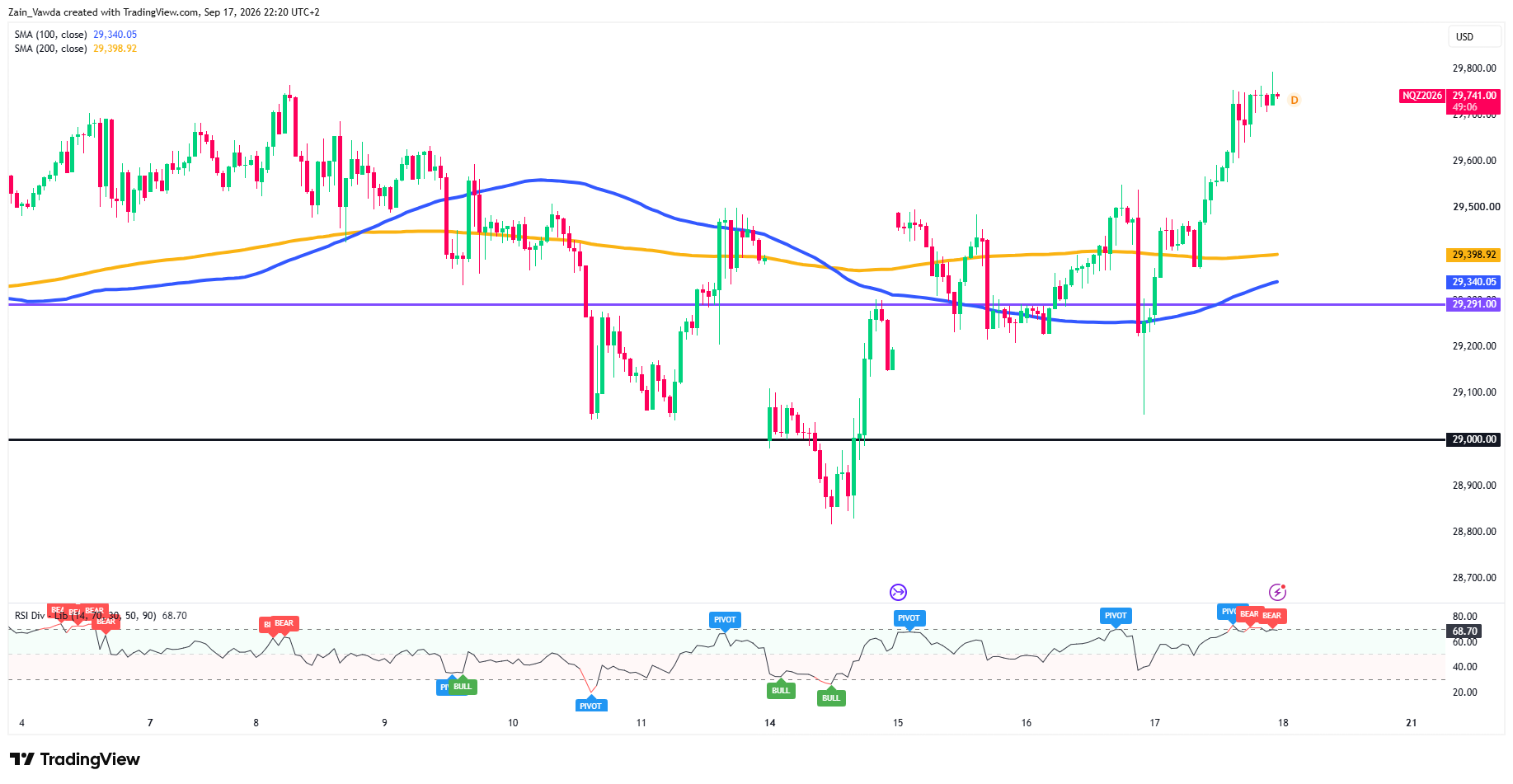
The Nasdaq-100 future (NQ, December contract) tells the story cleanly.
After diving toward the 29,000 floor last week on AI-slowdown jitters, and again on the Fed shock, NQ ripped back to roughly 29,741, a full V-shaped recovery that reclaimed both its 100- and 200-period averages (about 29,340 and 29,399) and left the 29,000 line and the recurring 29,291 pivot intact below.
Nasdaq 100 (NQ) One-Hour Chart, September 18, 2026
Source: TradingView
The catch is that momentum is stretched: RSI is up near 69 and already flashing bearish divergence at the highs (price making new highs while momentum lags), a yellow light, not a red one.
The line that matters now is the 29,800 ceiling: clear it and the August high near 30,343 comes into view; stall there and a pullback toward the 29,340– 29,399 averages, then 29,291 and 29,000, is the risk.
The Look-Ahead: Two Central Banks and One Wildcard
Friday belongs to central banks. The Bank of England already steadied its bond market on Thursday by overhauling how it sells down the gilts it bought over the past decade.
Next is the Bank of Japan, widely expected to raise rates on Friday which would mark its most closely spaced hikes since 1990, keeping the yen (around 155– 156) and global bond yields in focus.
The bigger wildcard is the one Conzo flagged: the Middle East. If oil stays elevated, he warned, higher prices feed through to retailers and consumers and make inflation harder to slow, the exact problem the Fed is now hiking to fix.