The Close: A Broad but Orderly Retreat
US stocks ended the first session of Fed week in the red, though well off their worst levels.
The S&P 500 fell 0.48% to close at 7,619.98. The tech-heavy Nasdaq dropped 0.71% to 29,179.41, and the Dow Jones Industrial Average lost 152 points, or 0.29%, to 52,421.20.
It could have been worse: at their lows, the S&P 500 was down 0.8%, the Nasdaq down around 1.8%, and the Dow off almost 300 points before buyers trimmed the damage into the bell.
Three forces set the tone, a rout in semiconductor (computer chip) stocks, a fresh climb in oil, and government bond yields sitting just under 5% as traders brace for the Federal Reserve on Wednesday.
The Chip Rout: AI’s Own Leaders Call for a Slowdown
The day’s biggest story came from inside the AI industry itself. Over the weekend, Anthropic CEO Dario Amodei published an essay arguing that AI firms should slow the pace at which they build their most advanced models, warning about the risk of the technology moving beyond human control.
His call drew public support from OpenAI’s Sam Altman and Elon Musk, while Microsoft’s AI researchers separately published new principles limiting their own cutting-edge work. Altman also said a stock-market listing (IPO) this year would be “ill-advised,” cooling the pipeline of AI market debuts.
Investors sold the chipmakers that have powered the AI trade. Nvidia fell 3%, Broadcom and AMD dropped more than 4%, Intel slid more than 5%, and Marvell shed more than 7%, sending a key semiconductor index down 5.9% and pulling the Nasdaq 100 down 0.8%.
Not everyone read the news as bad. “This feels exactly what the markets want,” said David Wagner, head of equity at Aptus Capital Advisors, arguing that if AI firms spend less building data centres, near-term earnings might dip but free cash flow, the cash a company has left after paying its bills and making its investments would likely rise, which can support higher share valuations.
Still, Wagner cautioned that the market is entering a seasonally weak stretch, and with midterm-election noise building, stocks may “continue to take a breather.” President Trump pushed back on the slowdown calls, arguing that holding US development back would only benefit China.
Banks, Oil and a Yield Flirting with 5%
The pressure was not limited to tech. Bank of America fell about 5% after CEO Brian Moynihan told a conference that third-quarter investment-banking fees could drop more than 10% from a year earlier, with trading revenue roughly flat. He said the wider market for investment-banking activity is down around 10% and that BofA would likely be “a bit more than that,” though he added that the underlying economy and the bank’s business remain strong.
Oil kept climbing. WTI crude rose 1.34% to settle at $101.39 a barrel and Brent gained 1.02% to $105.68, after Saudi Arabia shut a key pipeline that bypasses the Strait of Hormuz, though both came off their intraday highs.
The 10-year Treasury yield touched its highest level since October 2023 before easing back to 4.987%, up about one basis point on the day. (A yield is the return a bond pays; when it rises, safe government bonds become more competitive with stocks and borrowing gets more expensive across the economy.)
Fed funds futures now price roughly a 92% chance the Fed raises rates on Wednesday, a hike, not a cut.
S&P 500 Technical Picture: Coiling Below the Averages
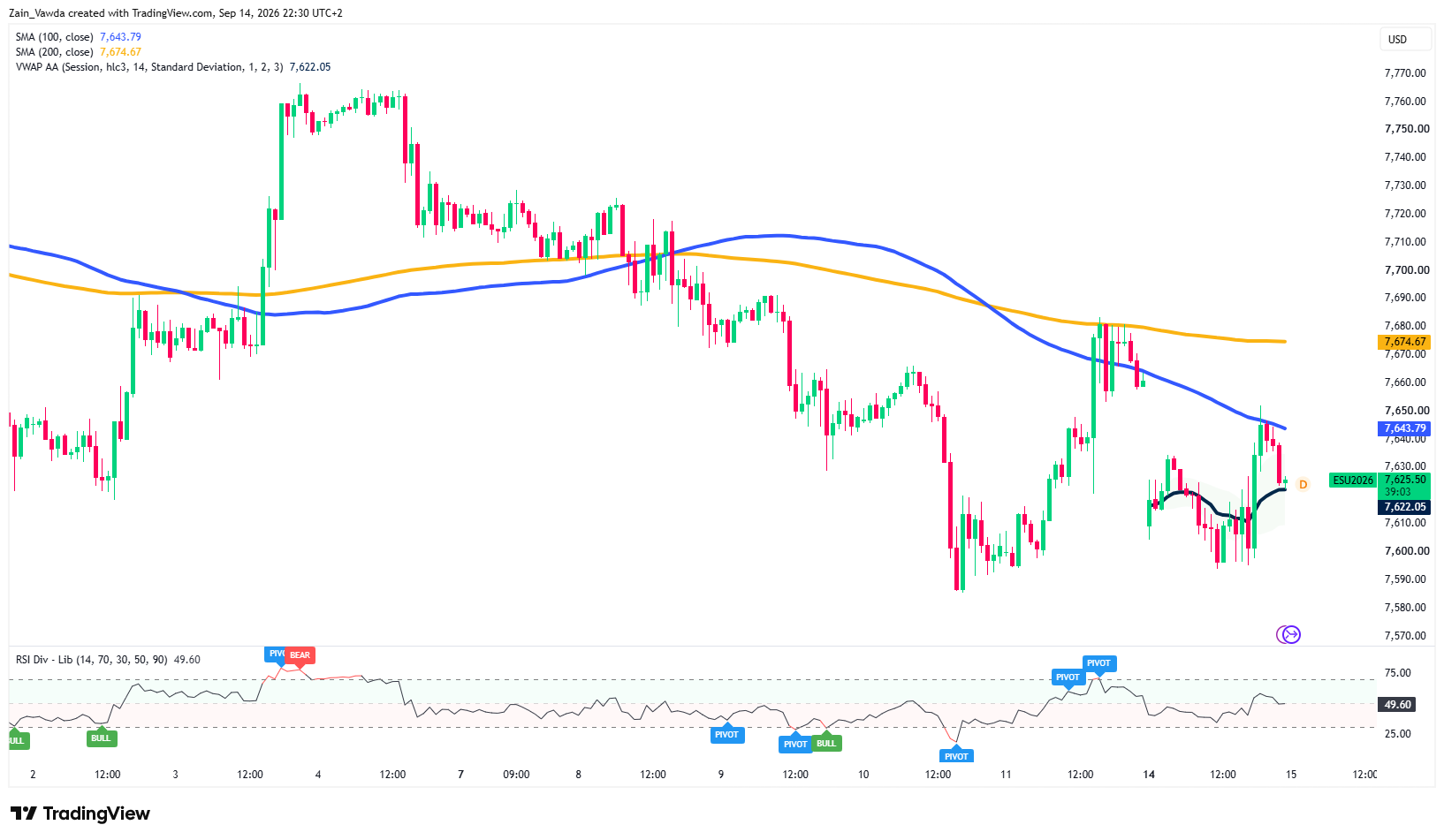
The hourly chart of the S&P 500 futures (ES) shows a market winding tighter ahead of the decision. After sliding from around 7,765 in early September, price has spent the past week grinding lower and is now consolidating in a narrow band around 7,620.
S&P 500 (ES) One-Hour Chart, September 14, 2026
Source: TradingView
The two moving averages overhead tell the trend story. The 100-period average (blue, 7,643.79) sits below the 200-period average (orange, 7,674.67), a bearish alignment and price is trading under both.
That makes 7,644 the first ceiling and 7,675 the second; a push above them would be the first real sign the sellers are losing their grip. VWAP, the average price paid during the session, sits at 7,622.05, right where price is hovering, and the round 7,600 level is the first floor beneath it. Lose 7,600 and the recent swing low near 7,585 comes back into view.
Momentum is dead neutral: the RSI reads 49.60, sitting right on the 50 midline with no edge either way. In plain terms, the market is coiled and waiting, textbook behaviour before a big event, when traders are reluctant to commit size in either direction until the Fed shows its hand.
What to Watch
Everything now points to Wednesday. With a hike almost fully priced, the market’s reaction will hinge less on the decision itself than on the tone of the statement and the updated projections, whether the Fed signals this is a one-off or the start of more tightening.
Until then, expect the S&P to keep coiling between 7,600 support and the 7,644–7,675 moving-average ceiling, with oil and yields the two wild cards that could break the range early.