
Markets are heading into the weekend with a lot left unresolved. The bond market is still setting the tone, oil is swinging on every Middle East headline, and the biggest risk event of all, a possible U.S.-Iran deal, could land while futures are closed.
That makes this a weekend where traders need to think about gaps, not just levels.
Where Markets Stand Heading Into the Weekend
Friday’s U.S. data painted a mixed picture. As our data recap this morning showed, University of Michigan consumer sentiment fell to a four-month low of 48.1, while year-ahead inflation expectations jumped to 4.6%, the highest since June. Durable goods orders were flat, but business investment orders rose 1.6%, and the Atlanta Fed’s GDPNow still tracks third-quarter growth at 5.1%.
In plain terms: households feel worse, but the economy is still running hot and inflation worries are climbing. That pushed yields higher again. The 10-year Treasury yield rose to about 5.22% and the 30-year to about 5.53%. Futures now price roughly a 66% chance of a Fed rate hike in October, according to the CME FedWatch tool, up from about 58% a week ago.
Stocks are close to flat, with the Dow holding a modest gain but still on track for a fourth straight losing week, while the Nasdaq is on course for a weekly gain.
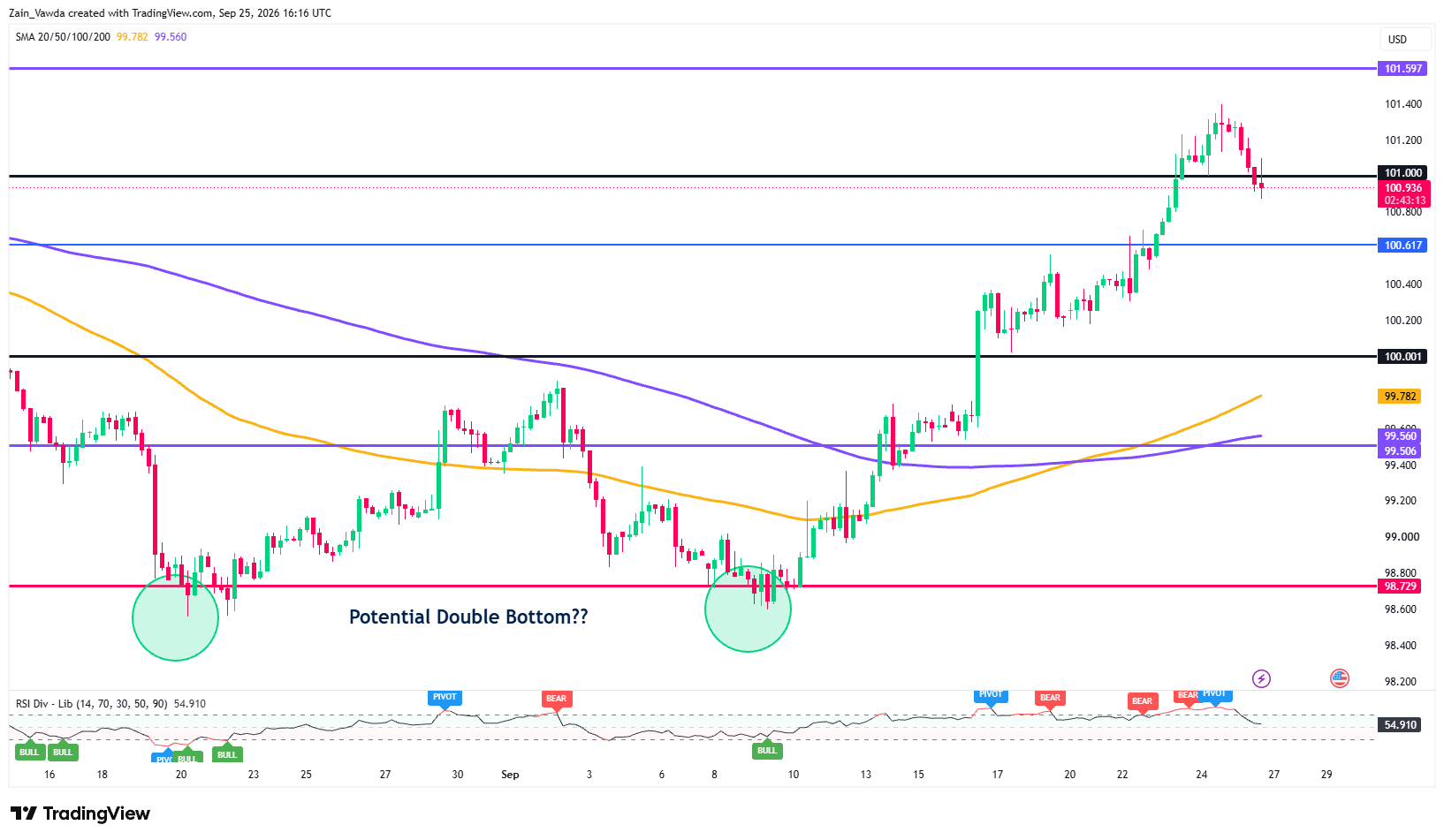
The dollar index is holding around 101.
US Dollar Index DXY Four- Hour Chart, September 25, 2026
Source: TradingView
Oil: Caught Between Peace Talks and Missiles
Oil has had a wild week. Brent surged to about $108 on Thursday after Iran-backed Houthi militants fired missiles at Saudi Arabia, then gave back gains after reports that U.S. and Iranian negotiators in New York are discussing a phased deal.
Under that framework, Iran would reopen the Strait of Hormuz and the U.S. would lift its naval blockade.
On Friday, Iran’s Foreign Minister Abbas Araghchi said Tehran had proposed a seven-day plan to end the conflict, reopen the strait under certain conditions and restart nuclear talks. Secretary of State Marco Rubio, however, said the New York talks were not a breakthrough, and Iranian officials have listed seven conditions the U.S. must meet before the strait reopens.
There is also a U.S.-specific twist. Talk of a possible ban on U.S. diesel exports has pushed WTI to a discount of more than $12 a barrel to Brent, the widest since May. The idea is that if diesel can’t be exported, U.S. refiners would process less crude, leaving more American oil unused.
That is why WTI is on track for a weekly loss while Brent is up on the week.
The White House has denied a report of a 90-day ban, but President Trump said earlier this week he backs the idea, so the issue is far from settled.
What Could Cause a Gap on Sunday’s Open?
A gap happens when a market reopens at a very different price from where it closed, skipping the levels in between. CME futures stop trading on Friday afternoon and reopen Sunday evening U.S. time. Any major news in between gets priced in all at once.
Here are the main weekend risks:
- A U.S. reply to Iran’s seven-day plan. Any sign Washington is engaging, or confirmation of a phased Hormuz deal, would likely knock the war premium out of oil and cause a gap lower. It would probably lift stocks and ease yields too.
- Talks stalling or collapsing. A firm U.S. rejection, or Iran hardening its conditions, would likely push oil higher at the open.
- More attacks on Gulf energy sites. Saudi Arabia intercepted ballistic missiles aimed at Taif and the Yanbu area on Thursday. A successful strike on oil infrastructure or tankers over the weekend is the biggest upside gap risk for crude.
- A diesel export ban decision. A weekend announcement could hit WTI and widen its discount to Brent further.
Looking a week ahead, seven OPEC+ countries meet on Sunday, October 4 to review output, setting up another weekend gap risk next week.
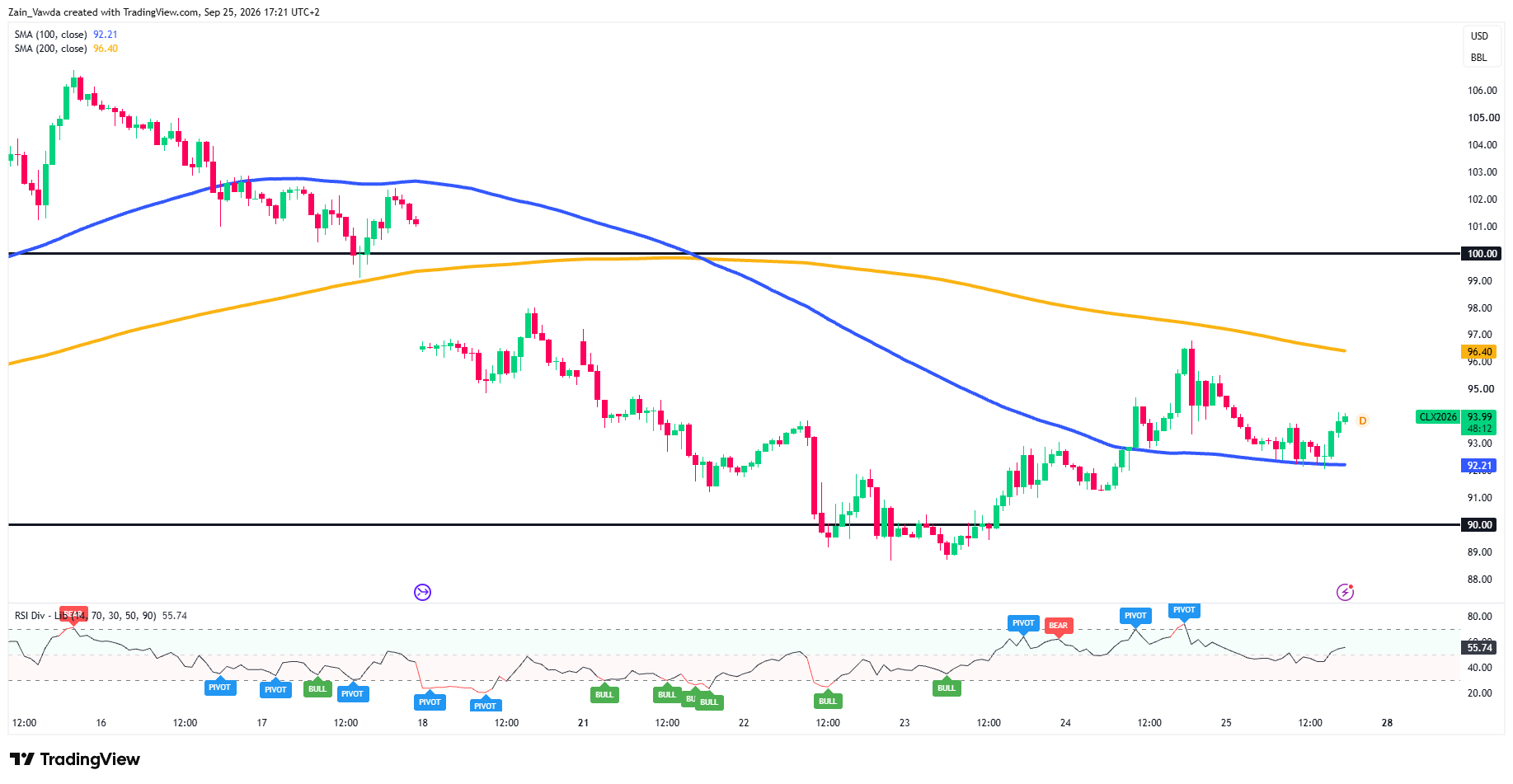
Oil One-Hour Chart: Holding the 100-MA Floor
Oil Futures (CL) One-Hour Chart, September 25, 2026
Source: TradingView
On the one-hour (H1) chart, oil is trading near $94. The bigger picture is still weak.
Price fell from above $100 in mid-September to a low near $88.70 on Wednesday, and the 100-period moving average ($92.21) has crossed below the 200-hour ($96.40), which is usually a bearish signal.
The bounce since Wednesday has been strong, though. Thursday’s spike ran into the falling 200-period average and topped out near $96.80. Price then slid back to the 100-period average, which held several times today.
RSI is about 56, neutral, so neither side is in control.
Resistance sits at $95, then the 200-hour average at $96.40 and Thursday’s high near $96.80. Above that, $100 is the big level. Support is the 100-hour average at $92.21, then $91 and the $90 round number, with Wednesday’s low near $88.70 below that.
Outlook: Sunday’s Reopen
With price sitting between two key averages, the chart is not the main driver right now. The headlines are. Traders holding positions into the weekend should remember that a stop-loss does not protect you from a gap. If the market opens beyond your stop, it fills at the next available price, which can be far worse.
Consider reducing size, and check your account’s rules on holding positions over the weekend.
Potential Weekend Scenario Matrix
| Weekend Outcome | What Happens | Potential Oil Open | Knock-On for Other Markets |
|---|---|---|---|
| Deal Progress | U.S. engages with Iran’s seven-day plan or a phased Hormuz deal is confirmed | Gap lower toward the 100-hour SMA at $92.21, then $91 and $90 | Stocks bid, yields ease, hike bets cool; gold may also rise on lower rate fears |
| Status Quo | Talks continue with no clear result, no major attacks | Opens near Friday’s close; range $92.21–$96.40 | Focus shifts to next week’s data and the bond market |
| Escalation | Talks stall, fresh Houthi strikes on Saudi oil sites or tanker attacks | Gap higher through $95 toward $96.40–$96.80, then $100 | Stocks lower, yields and the dollar higher, October hike odds rise |
| Diesel Ban (Wildcard) | White House confirms a U.S. diesel export ban | WTI pressured even as Brent rises; Brent-WTI spread widens further | Refiners hit; global fuel prices and inflation worries climb |
Markets are overall delicately balanced heading into the weekend. There is a possibility the weekend could fall either way at this point leaving traders in no mans land with a lot to consider.