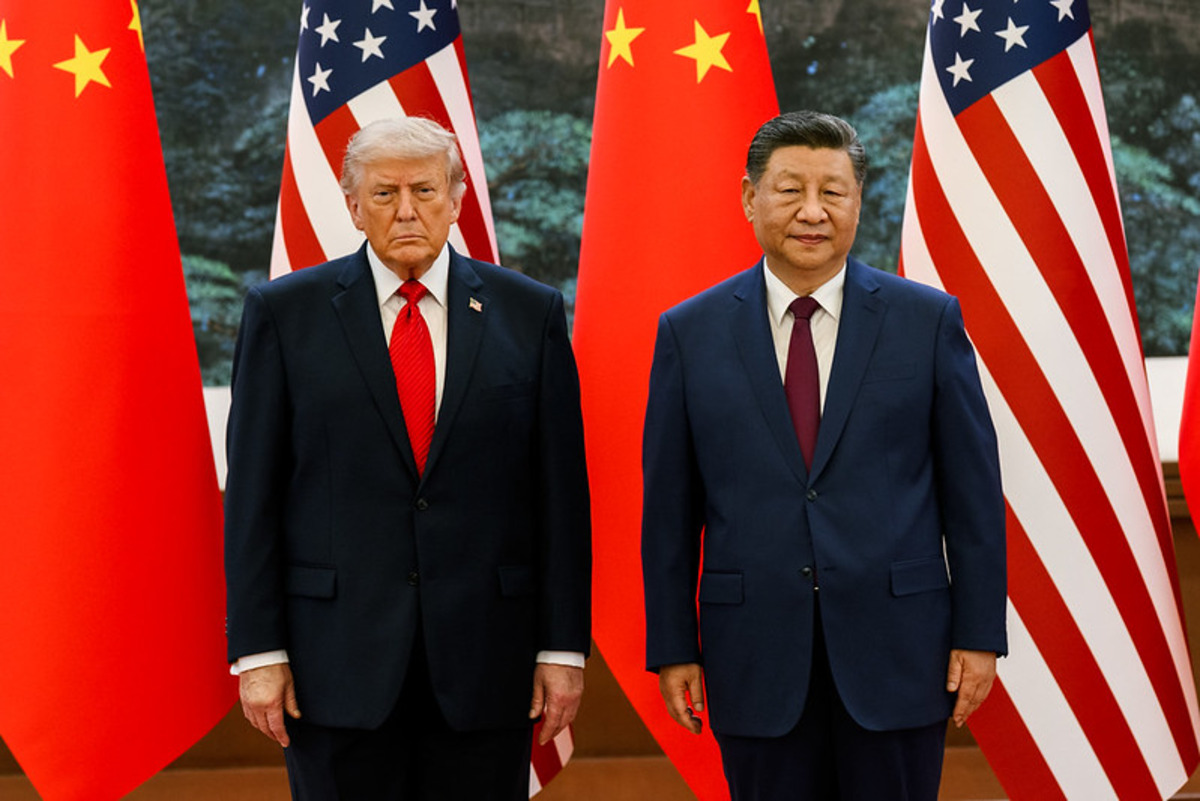
The Trump-Xi summit comes at a crucial juncture for U.S. markets, with investors already balancing elevated Treasury yields, stretched technology valuations and renewed uncertainty over the future of U.S.-China trade.
Chinese President Xi Jinping arrived in Washington on Wednesday for his first U.S. visit in more than a decade. He is scheduled to meet President Donald Trump at the White House on Thursday, with trade, tariffs, rare earths, artificial intelligence (AI), Taiwan and Iran among the issues expected to feature in the discussions.
That creates an unusual setup for equity traders: the Dow and Nasdaq could respond very differently to the same summit headlines.
Rather than treating the meeting as simply a risk-on or risk-off event, traders could watch the Dow Jones futures (YM) versus Nasdaq 100 E-mini futures (ES) spread for a relative-value signal.
Xi's Washington Itinerary: What Happens Thursday?
Xi arrived in Washington on Wednesday and was greeted by Trump at Joint Base Andrews, ahead of the main events of the state visit.
The White House says Trump and First Lady Melania Trump will host Xi and Peng Liyuan for a formal state arrival ceremony, including remarks by both presidents, followed by a military review. The two couples will also attend a state dinner Thursday evening.
The economic agenda is broad. The two sides have been working toward extending their trade truce, while negotiations also cover agricultural purchases, tariffs, rare earths and critical minerals. AI has emerged as another important area, although the two countries remain strategic competitors in advanced technology.
That means traders will be looking beyond the ceremonial aspects of the visit for concrete signals on:
- Tariffs and the trade truce
- U.S. agricultural purchases
- Rare-earth and critical-mineral exports
- Advanced semiconductor and technology restrictions
- AI cooperation and safeguards
- Taiwan
- China's relationship with Iran
Treasury Secretary Scott Bessent said Wednesday that Washington and Beijing had agreed to extend the existing tariff truce until January 10, providing additional time to work toward a broader agreement.
That reduces the immediate binary risk of a return to escalating tariffs, but it also raises the bar for the summit: markets may need more than another extension to sustain the recent optimism.
Why NQ Could Be More Sensitive Than the Dow
The Nasdaq 100 (NDX) and by extension the Nasdaq E-mini futures (NQ) is unusually exposed to the areas where the U.S.-China relationship is becoming more strategic rather than merely commercial.
Semiconductors, cloud infrastructure, AI hardware, software and other technology companies sit directly in the crosshairs of discussions over export controls, advanced chips and AI.
The summit therefore has the potential to generate larger valuation swings in NQ even if the broader equity market reaction is relatively modest.
That sensitivity is already visible in the market. The NDX recently reached a record, helped by continued optimism surrounding AI adoption and corporate earnings, while the Dow moved lower on the same session.
At the same time, rising Treasury yields have been pressuring technology stocks. U.S. stock futures were lower Thursday morning, with Nasdaq 100 futures declining more than Dow futures as yields moved higher ahead of the summit.
That creates two separate transmission channels for NQ:
- China/technology channel: Any deterioration in technology restrictions, semiconductor access or AI cooperation could hit the Nasdaq disproportionately.
- Discount-rate channel: Higher Treasury yields increase the discount rate applied to future cash flows, putting greater pressure on richly valued long-duration technology and AI stocks.
The second channel is particularly important because the summit is arriving after a powerful AI-led rally. A disappointment does not necessarily need to trigger a broad market selloff to hurt NQ; a modest reduction in technology risk appetite could be enough.
Why the Dow Could React Differently
The Dow's composition gives it a different set of sensitivities. Industrial companies, financials, healthcare companies and consumer-facing businesses make up a larger portion of the index than the highly concentrated technology exposure found in the Nasdaq 100.
That does not make the Dow immune to a deterioration in U.S.-China relations. Companies with global supply chains and international revenues can still be affected by tariffs, currency movements and weaker Chinese demand.
But the transmission mechanism is different.
A trade truce, reduced tariff uncertainty and stronger expectations for global industrial activity could support Dow components without requiring a fresh expansion in technology valuations.
Conversely, if the summit produces disappointing headlines specifically around chips, AI or technology restrictions, the Nasdaq could potentially absorb more of the immediate equity-market reaction.
This is why the more interesting trade may not be simply long or short U.S. equities.
It may be the relative performance of Dow futures versus NQ futures.
The Pair-Trade Setup
The thesis is not that the Dow must rise while Nasdaq falls. Instead, the trade expresses the view that Dow futures could outperform NQ if the summit produces an outcome that is neutral-to-positive for traditional cyclicals but fails to deliver a fresh catalyst for technology valuations.
Three scenarios are particularly important.
Trump-Xi Scenarios Traders Should Watch
| Outcome | YM Futures | NQ Futures | Relative Implications |
|---|---|---|---|
| Improved relations+tariff relief | Positive | Positive | NQ outperformance may return |
| deal extension without tech breakthrough | Potentially supported | More vulnerable to valuation/yield pressure | Dow/NQ spread could widen |
| New technology & trade confrontation | Negative | Potentially more sensitive downside | NQ could underperform |
| Broad industrial/economic agreement | Potentially supportive | Positive, but dependent on yields | Monitor cyclicals vs. AI leadership |
The important caveat is that a strong China deal could actually favor NQ initially if investors interpret it as reducing technology supply-chain risk and improving the outlook for global growth. So the pair trade should be viewed as a scenario framework rather than a one-directional bet.
Both YM and NQ futures carry a Strong Short 7-day lean, but the positioning data shows a notable difference in performance. MarketFramework's Top Traded Contracts tool shows that YM traders are 67% short, while NQ traders are 57% short, making the Dow contract more heavily skewed toward shorts.
The crowd split also offers a useful distinction: 56% of winning YM traders are long, compared with 72% of losing traders who are short. In NQ, winners are 52% short and losers 55% short, showing much less separation between profitable and unprofitable positioning.
The Bigger Variable May Still Be Treasury Yields
The summit is arriving at a difficult point for long-duration equities. Even if Trump and Xi strike a constructive tone, higher Treasury yields could limit the upside response in technology stocks. That matters because the Nasdaq's sensitivity to the discount rate is greater than that of many Dow components.
In other words, the summit can deliver good geopolitical news while NQ still struggles if yields continue climbing.
If positive Trump-Xi headlines arrive alongside falling yields, NQ could receive a double boost: lower geopolitical risk and a lower discount rate. If the summit produces only a modest extension of the trade détente while yields remain elevated, the Dow/NQ relative trade becomes more interesting.
Bottom line
Treasury yields remain a valuation headwind, and technology stocks have more event risk tied directly to the U.S.-China relationship. That makes Long Dow futures, Short NQ a potentially useful relative-value framework for traders who expect traditional cyclicals to absorb a Trump-Xi outcome better than richly valued technology stocks. But the trade's performance will ultimately depend on whether the summit changes the outlook for tariffs and technology restrictions and what happens to Treasury yields after the headlines hit.