Silver has broken below $64, extending its retreat from the upper-$60s as a stronger U.S. dollar, rising Treasury yields and a hawkish repricing of Federal Reserve policy weigh on precious metals.
The move marks an important shift from the setup outlined earlier this week. Silver futures had been coiling between roughly $65 and $68 after August's 15% rally, with buyers repeatedly defending the mid-$60s and sellers emerging near $67-$68. A sustained break above $68 was expected to reopen the path toward $69-$70 and the August high near $71.16. Instead, silver failed at the upper boundary and has now fallen through the lower end of that consolidation.
The question now is not simply whether silver can rebound, but why it is losing ground faster than gold and where buyers could return.
From $66-$68 Compression to a Test of $63
The September consolidation initially looked like a digestion of August's powerful advance rather than a clear trend reversal. Silver had surged from the low-$60s to an August high of $71.16 before ending August at $66.22. Through Sept. 22, the $65-$66 area had repeatedly attracted buying interest, while $67-$68 capped rallies.
That structure has now weakened.
The failure to reclaim $67-$68 followed by a break below $65-$66 shifts attention toward the $63-$65 support zone identified in the previous analysis. A sustained recovery back above $64 would be the first indication that buyers are attempting to stabilize the decline, while a break below $63 would undermine the September range more decisively.
The technical picture therefore has changed from a breakout-versus-consolidation setup to a support-and-recovery test.
Why Silver Is Underperforming Gold
The divergence between gold and silver becomes important here because the two metals respond differently to the same macro shock.
Gold has a much stronger monetary and reserve-asset role. Central-bank demand, investment demand and its use as a defensive asset give gold a broader source of demand when investors become concerned about geopolitics, inflation or financial-market risk.
Silver has that monetary component too, but a much larger share of its demand comes from industry. The World Gold Council describes silver's industrial-heavy demand profile as making it more cyclical than gold, while gold's investment and central-bank demand can provide greater support during periods of market stress.
That difference matters when markets begin to price higher-for-longer interest rates.
When yields rise, both metals can face pressure because neither generates income. But silver can suffer an additional channel of weakness if higher borrowing costs and tighter financial conditions raise concerns about industrial activity.
In other words, silver is being asked to absorb both the precious-metals headwind and the industrial-cycle headwind, whereas gold has a larger defensive demand base.
Dollar and Yields Are Amplifying the Divergence
The macro backdrop has also deteriorated for silver since the previous analysis.
The Fed raised rates by 25 basis points on Sept. 16, and subsequent comments from policymakers have kept attention on the possibility of additional tightening as inflation remains elevated. Stronger U.S. economic data have reinforced that repricing, pushing Treasury yields and the dollar higher.
Silver is particularly sensitive to this combination. A stronger dollar raises the effective cost of dollar-denominated silver for overseas buyers. Higher yields also increase the opportunity cost of holding a non-yielding metal.
Gold is not immune. Gold has also been pressured by expectations for prolonged restrictive Fed policy and dollar strength. But gold's broader safe-haven and reserve-asset demand can cushion some of that pressure.
Silver has fewer such buffers when macro traders simultaneously reduce exposure to cyclical and non-yielding assets.
The Industrial Story Has Not Disappeared
The underperformance should not be interpreted as a collapse in silver's longer-term industrial thesis.
Silver remains important to electronics, solar and other industrial applications, and long-term demand expectations can provide fundamental support. The current weakness is more about the near-term macro transmission mechanism: tighter monetary conditions, a stronger dollar and higher yields can overwhelm industrial-demand optimism in the short run.
That distinction is important because it explains why silver can fall sharply without necessarily invalidating the broader demand story.
It also helps explain the metal's higher volatility relative to gold.
Gold tends to attract capital when investors want monetary protection or liquidity. Silver often needs a combination of precious-metals demand and supportive growth/industrial expectations to sustain a powerful advance.
Where Could Silver Buyers Step In?
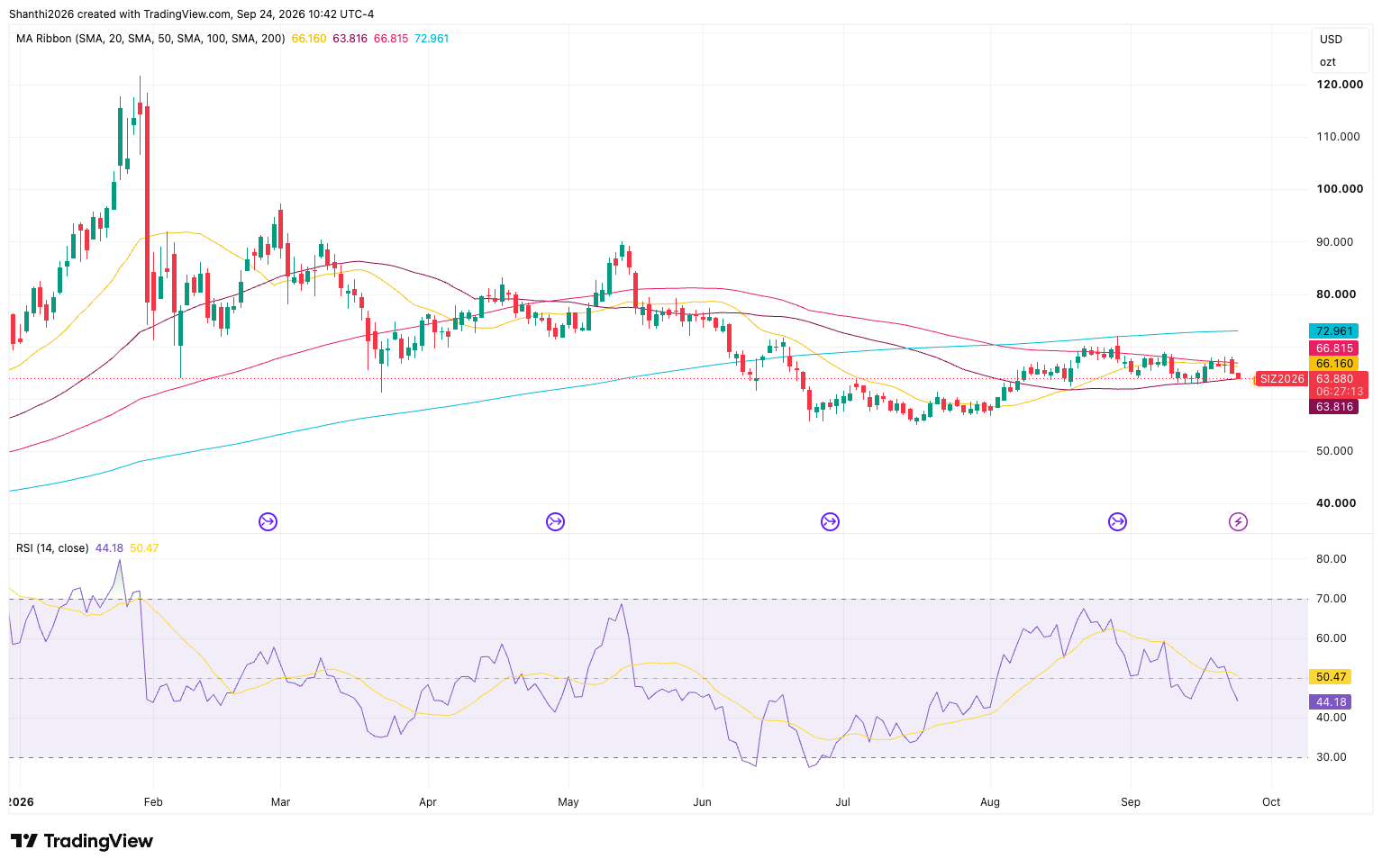
Buyers have the clearest technical reason to step in around the $63.80-$64 area, where the 50-day simple moving average (SMA) and the mid-September lows overlap and where the December silver is trading right now. If that zone gives way on a daily close, the next area to watch is the low $60s, roughly $60-$62, where the August breakout began and where the round-number level may attract dip buyers.
Source: TradingView
Below that, the $55-$58 June-July lows form the major base, and a drop there would erase the entire August recovery. With the relative strength index (RSI) at 44, momentum has room to weaken further before a bounce signal appears.
These are levels where buyers have shown up before but not guarantees. That said, the dollar strength, and rate-hike bets could override them.
Positioning Has Also Changed
Positioning, however, has not turned bearish. MarketFramework's Top Traded Contract tool shows a Strong Long seven-day lean in SIL, with 60% of traders long and 40% short. The position has generated +$44.8K over the past seven days, including a $9K gain Thursday. Winning traders are currently balanced, while 60% of losing traders are short, suggesting that bearish positioning has so far been less effective than the broader long bias.
That creates an important test near the $63-$64 support zone. If buyers defend the area while the Strong Long positioning persists, silver could attempt to reclaim $64 and then $65-$66. But a decisive break below support would put the current bullish positioning under pressure and could trigger further position adjustment.
The backdrop remains challenging: a stronger dollar and surging Treasury yields are weighing on non-yielding metals, with silver particularly sensitive to the rate shock.
That makes the current breakdown worth watching from a positioning perspective.
The Setup Has Shifted, Not Broken
Silver's move below $64 changes the short-term technical picture, but it does not by itself erase the broader advance that began in August.
The previous setup was defined by a $66-$68 compression range and a battle between renewed momentum and consolidation. The failure at $67-$68 has now pushed the market toward the opposite side of that range.
For bulls, $63-$65 is the area that needs to attract demand. For the broader recovery to regain traction, silver eventually needs to reclaim $65-$66 and then challenge $67-$68.
The bigger macro question remains the dollar and Treasury yields. If yields and the dollar continue higher, silver's industrial and high-beta characteristics leave it more exposed than gold. If those pressures ease, the metal's sharp August advance and still-supportive industrial-demand backdrop could give buyers a reason to return.
For now, the market has moved from waiting for a breakout above $68 to waiting for evidence that $63-$65 can hold.