Crude oil futures began to run up sharply in late August as the Middle East conflict re-escalated and remained on a strong upward trajectory until the middle of last week. Since then, oil has given back some of its gains. To be clear, front-month crude futures have lost more than 14% since reaching a near-term peak of $106.75 last Tuesday.
The sell-off in the futures contract occurred in just four sessions, underscoring the fickleness of oil's move amid the U.S.-Iran conflict, with the commodity reacting to nearly every headline that hits the tape.
Conflict Premium Starts to Unwind
The sharp reversal suggests that at least part of the geopolitical premium built into crude prices is being unwound. Oil had surged as traders priced in the risk of supply disruptions tied to the U.S.-Iran conflict, but shifting headlines around the conflict have repeatedly changed expectations for how long those disruptions could last.
The speed of the decline also highlights how quickly speculative positioning can reverse when the market's assessment of supply risk changes. CFTC’s Commitment of Traders report for the week ended Sept. 15 showed speculators were still long, heading into the sell-off. Managed Money held 221,896 long contracts against 115,617 shorts, a net long of roughly 106,000 contracts. This represented a 5,500-contract decline week over week, as funds added shorts faster than longs.
With crude having rallied sharply into last week's high, traders who bought into the geopolitical surge now face increasing pressure to protect profits as the risk premium fades.
Fundamental Forces Driving Crude Prices Lower
ING strategists attribute Monday’s plunge to profit-taking after recent gains, and the upcoming Trump-Xi meeting.
The latest selloff is also being driven by signs that the physical supply shock may not be as severe or prolonged as feared. Saudi Arabia has increased crude shipments through the Strait of Hormuz, while Aramco is working to restore part of its East-West pipeline, providing the market with additional supply flexibility.
At the same time, hopes for renewed U.S.-Iran diplomacy during the United Nations General Assembly are reducing some of the geopolitical premium embedded in crude prices. Reports of potential contact between Washington and Tehran have encouraged traders to price a lower probability of a prolonged disruption, even though the conflict and risks to shipping remain unresolved.
The combination of recovering Saudi flows, potential pipeline restoration and hopes for U.S.-Iran talks gives crude bears a much more specific fundamental catalyst than simple profit-taking. The key question now is whether these improvements in supply flows persist.
Technical Damage Raises Risk of Deeper Pullback
The technical picture has also deteriorated after the latest sell-off. Crude has fallen sharply from the $106.75 area, putting the focus on whether buyers can defend the next major support levels.
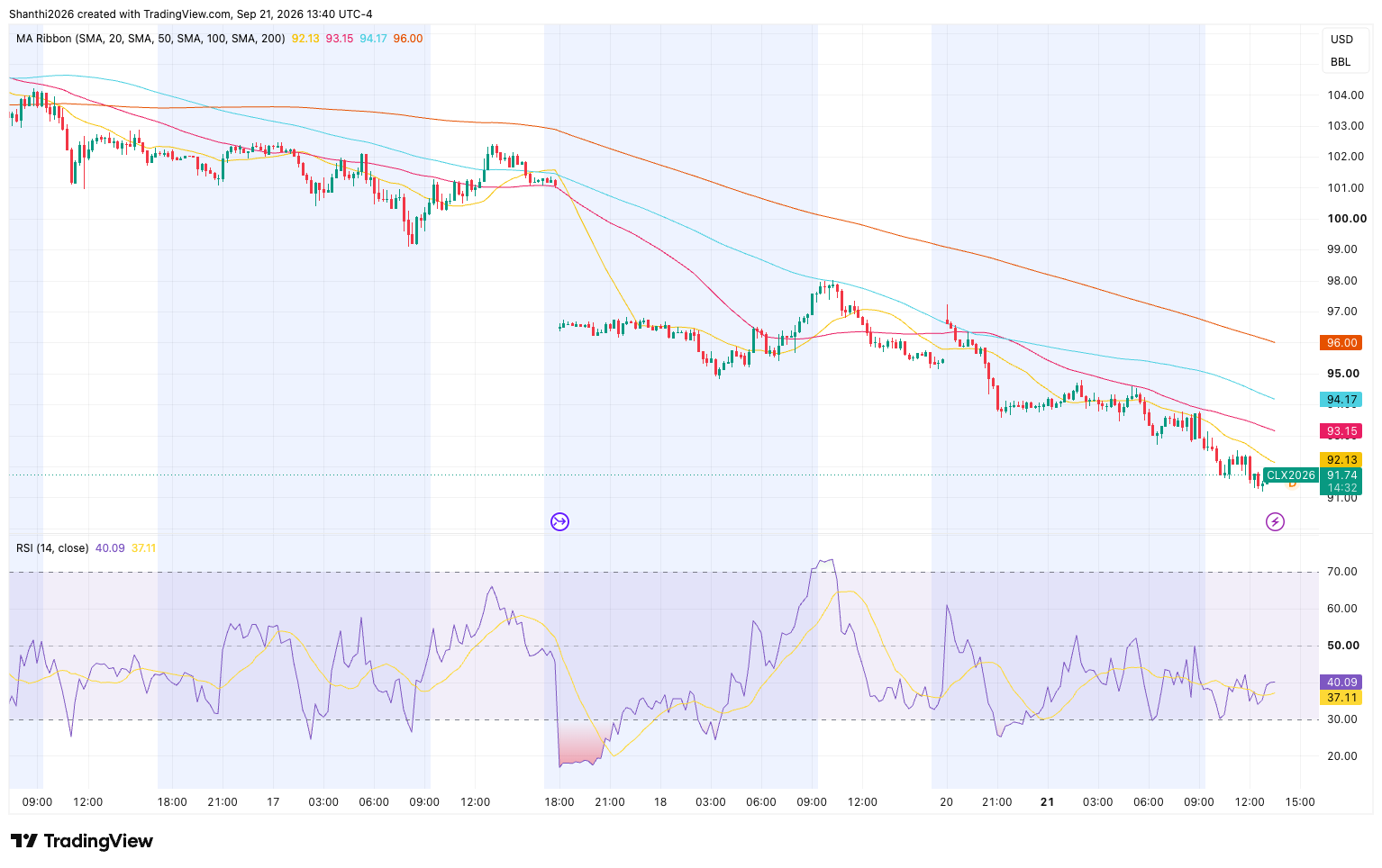
The 15-minute price chart for the crude oil contract displays a multi-day bearish downtrend, dropping steadily from high levels near $104.00 down to current trading around $91.74. Price action remains firmly aligned below all major simple moving averages, namely the 20 SMA ($92.13), 50 SMA ($93.15), 100 SMA ($94.17), and 200 SMA ($96.00), which are stacked in a classic bearish order and acting as dynamic overhead resistance levels.
Meanwhile, the momentum indicator RSI (14) stands at 40.09 (with a signal line at 37.11), sitting in a lower neutral zone following a consolidation near recent lows, indicating persistent selling pressure without currently entering deep oversold territory.
Source: TradingView
The speed of the four-session decline makes the market vulnerable to short-term oversold conditions, so a bounce cannot be ruled out. However, a recovery that stalls below former support could instead create another selling opportunity for bears.
Headlines Remain the Biggest Catalyst
Fundamentals remain closely tied to developments in the U.S.-Iran conflict. Any indication of easing tensions could further reduce the geopolitical premium embedded in crude, while renewed threats to supply or transportation routes could quickly reverse the recent decline.
That leaves oil traders particularly sensitive to headlines, with price swings likely to remain elevated as the market reassesses the balance between geopolitical risk and physical supply conditions.
MarketFramework's Top Traded Contracts tool shows a strong short bias in WTI futures, with traders positioned 75% short versus 25% long. The bearish stance is also reflected in the seven-day lean, which remains Strong Short.
The crowd split provides an additional nuance: 67% of winning traders are long, while 64% of losing traders are short. That means the more profitable side of today's positioning is not uniformly bearish, despite the broader market lean toward shorts. It could indicate that some traders have successfully bought the sharp dips even as the overall positioning backdrop remains defensive.
For futures traders, the key question is whether the latest decline represents a temporary unwinding of the conflict premium or the start of a deeper correction. Holding the next major support zone could stabilize prices, but a decisive breakdown would increase the risk of another leg lower.