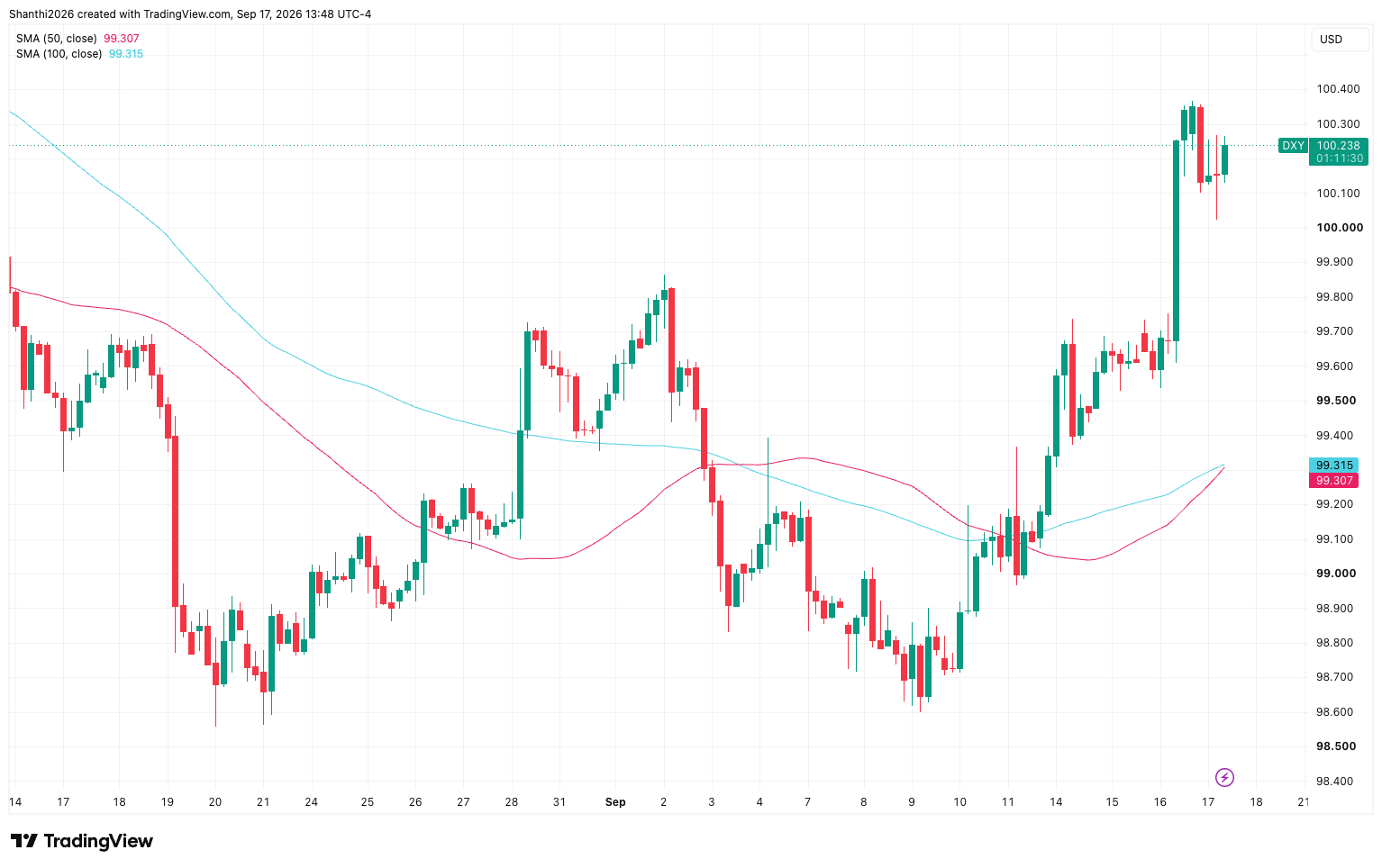
The U.S. Dollar Index (DXY) has broken above the psychologically important 100 level following the Federal Reserve’s first rate hike in more than three years, but the breakout is still in its early stages. After surging 0.7% Wednesday, DXY reached 100.31 before easing back toward 100 on Thursday, leaving traders to determine whether the move represents the start of a sustained advance or a short-lived spike.
The technical setup is complicated by stretched short-term momentum. On the 4-hour chart (H4), the relative strength index (RSI) is at 71, just about entering into overbought territory, while price remains above its 50- and 100-period moving averages.
Source: TradingView
Fed Hike Pushes Dollar Through 100
The catalyst for the dollar's breakout was Wednesday's FOMC decision. The Fed raised its target range by 25 basis points to 3.75%-4%, while policymakers continued to signal concern about persistently elevated inflation.
The dollar initially benefited from the combination of higher U.S. rates and expectations for another hike later this year. The move also pushed short-term Treasury yields higher, strengthening the rate differential that supports the greenback.
However, the Fed's projection of only one additional hike in 2026 leaves some room for the market to question how much further the dollar can run without a fresh catalyst.
By mid-session in New York, DXY was trading flat with negative bias, even as Treasury yields and oil prices retreated.
ING strategists Francesco Pesole and Frantisek Taborsky said the dollar’s near-term risks remain tilted to the upside, even though they expect the currency to stabilize around current ranges after the recent monetary-policy boost has been absorbed. They said the hawkish Fed message leaves markets with room to fully price an October move if incoming data run hot or oil prices rise further.
Pesole and Taborsky also noted that the Fed’s commitment to monetary discipline raises the bar for a renewed “debasement trade,” while elevated oil prices continue to provide a supportive external backdrop for the dollar. Their broader baseline calls for the dollar to stabilize first and weaken toward year-end, but that outlook depends heavily on de-escalation in the Gulf. As long as oil remains supported, they said, it is difficult to argue against the dollar’s bullish momentum.
The Euro Forex futures (6E) positioning backdrop provides another tailwind for DXY. According to MarketFramework’s Top Traded Contracts tool, the 6E contract is showing a strong short bias, while long euro positions account for 63% of losing trades, suggesting bearish euro positioning is currently better aligned with recent price action. Since the euro carries the largest weight in the DXY basket, continued weakness in 6E could help the dollar defend the 100 level.
100 Becomes the Immediate Line in the Sand
The 100 level now becomes important from a technical perspective. A sustained hold above it would provide evidence that the breakout is gaining acceptance rather than simply reflecting the immediate post-Fed surge.
Thursday's price action is therefore important. DXY traded as high as 100.37 before pulling back. For bulls, the immediate objective is to establish 100 as support. Failure to do so would raise the risk that the latest move above the round number was a false breakout.
Overbought Momentum Creates a Confirmation Test
The strongest argument for caution comes from short-term momentum. An RSI reading above 70 is traditionally considered overbought/ That does not automatically mean DXY must reverse. In a strong trend, an overbought RSI can remain elevated while prices continue to climb. Instead, it means the market may need to consolidate or pull back before attempting another sustained leg higher.
The key question for traders is therefore not simply whether DXY can trade above 100, but whether it can hold above 100 after the initial post-Fed surge fades.
What DXY Traders Are Watching Next
A sustained move above 100 would strengthen the breakout case and shift attention toward the next upside levels. Conversely, a decisive move back below 100 would weaken the breakout and could signal that the dollar needs to consolidate its recent gains.
The broader fundamental backdrop remains supportive of the dollar as long as markets continue to price a relatively hawkish Fed and elevated U.S. rates. But with DXY already stretched on some short-term momentum measures, 100 is now the key test of whether the breakout has staying power.