West Texas Intermediate (WTI), the U.S. crude benchmark, topped the $106 psychological threshold by midday in New York as the Middle East conflict broadened beyond the original U.S.-Iran confrontation, raising fresh concerns about disruptions to Saudi oil infrastructure, Red Sea shipping and regional supply routes.
Saudi-Houthi Escalation Widens Oil Supply Risk
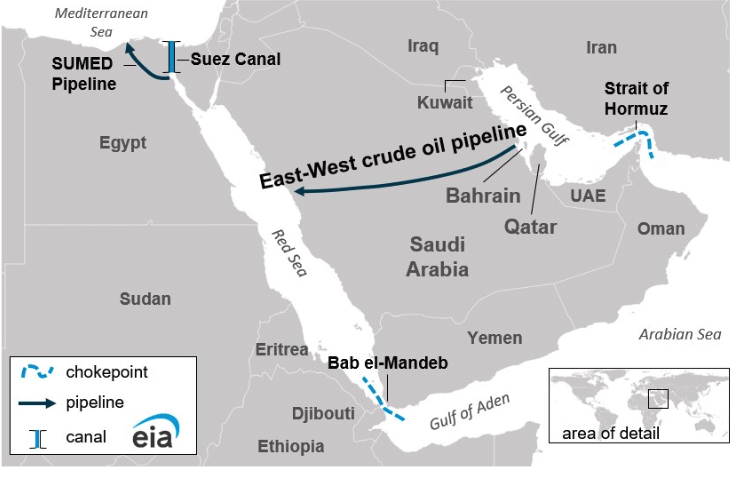
The conflict is beginning to pressure multiple Saudi export routes simultaneously: Hormuz is already severely disrupted, the East-West pipeline is offline, and Houthi advances are bringing the Bab el-Mandeb/Red Sea corridor further into the conflict.
The Saudi-Houthi conflict has added another layer of risk to the already strained Middle East oil supply picture. The Houthis have launched a fresh wave of missile and drone attacks on Saudi Arabia, including targets around Khamis Mushait, Abha and Taif, prompting Riyadh to vow a “firm” response and intensify strikes on Houthi positions in Yemen.
At the same time, Houthi advances along Yemen’s Red Sea coast, including control of Perim Island near the Bab el-Mandeb, are raising concerns over another critical shipping chokepoint. The risks are particularly significant for crude because Saudi Arabia’s East-West oil pipeline remains offline following an attack, while the Red Sea port of Yanbu has come under heightened security alerts. With Hormuz flows already severely disrupted, further pressure on Saudi Arabia’s alternative export routes could tighten the global supply picture and add to crude’s geopolitical premium.
Major Arabian Peninsula Maritime Chokepoints
Source: EIA
Media reports say Saudi Arabia has suspended crude shipments to Europe after damage to its East-West pipeline disrupted loadings at the Red Sea port of Yanbu. The pipeline provides a key alternative route for Saudi crude when shipments through the Strait of Hormuz are disrupted. With that route impaired and Houthi forces tightening their grip around the Bab el-Mandeb, Saudi Arabia is facing fewer options for moving crude to international markets. The disruption is already prompting European refiners to seek alternative supplies, while Brent crude has moved sharply higher as traders assess the potential duration and scale of the outage.
WTI Extends Breakout as Geopolitical Premium Builds
WTI crude futures completed a retracement of the March geopolitical spike when prices revisited the $67 area, a level that ultimately became a major floor for the market. After a prolonged correction, crude established another important low near $68-$70 in early July, setting the stage for a renewed advance.
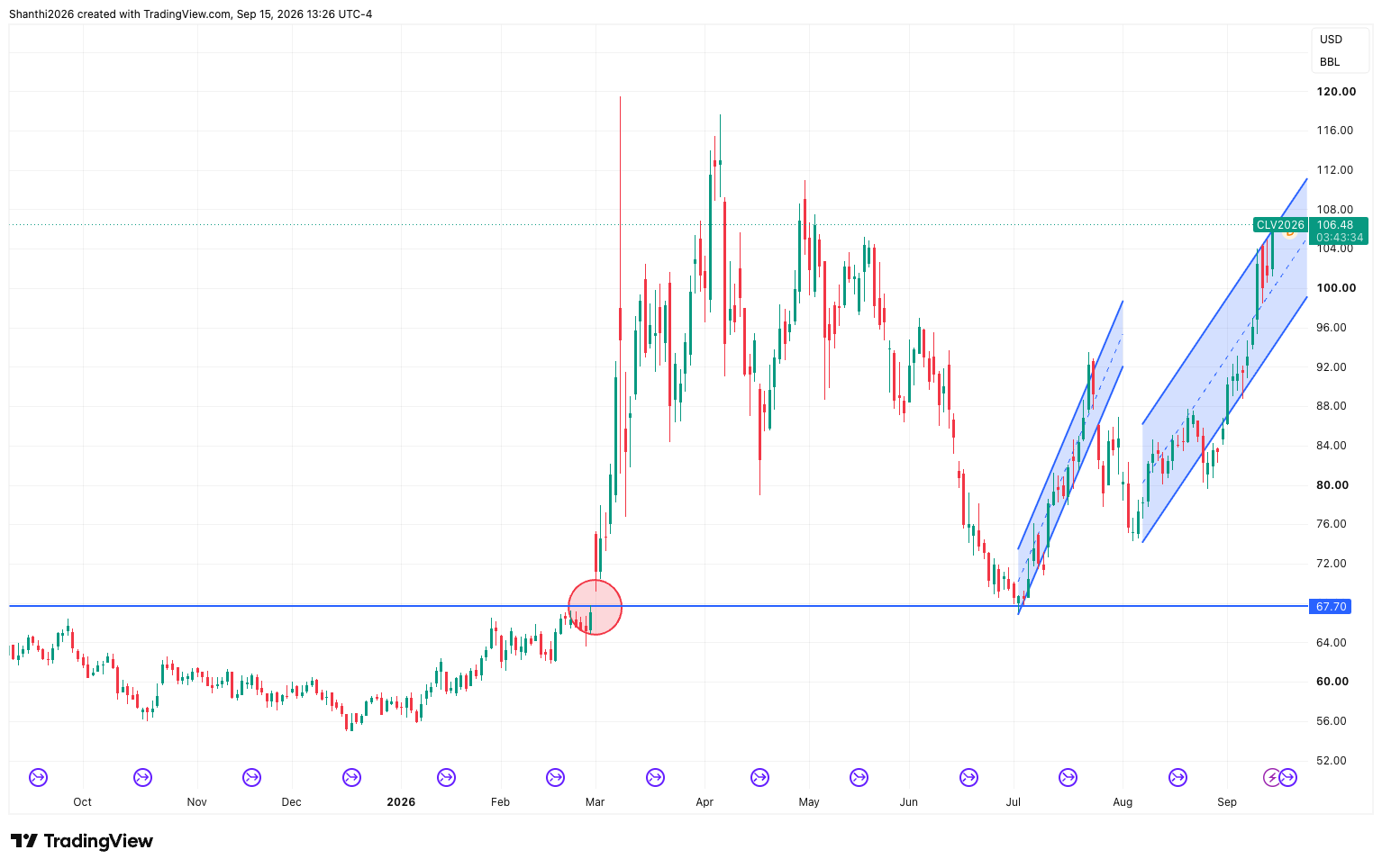
Source: TradingView
The recovery initially carried WTI to roughly $93 in late July before profit-taking triggered a pullback. However, the re-escalation of tensions in the Middle East provided a fresh catalyst for buyers, reigniting the uptrend and driving crude from around $74 in early August to above $100, extending the series of higher highs and higher lows that has defined the rally over the past two months.
Key Levels Come Into Focus Above $100
With WTI above $106, the immediate question for traders is whether crude can sustain the breakout rather than simply how far prices can extend.
The $100 level is now the first major psychological pivot. A sustained hold above it would reinforce the bullish structure and keep the market focused on the next upside targets, while a decisive move back below $100 could indicate that some of the geopolitical premium is beginning to unwind.
The $102-$102.50 area is another important zone. This region corresponds with the recent higher-low structure and could become a key test if prices experience a pullback. As long as WTI remains above that zone, the sequence of higher lows remains intact.
A deeper correction toward the mid-$90s would represent a more meaningful deterioration in the short-term technical picture, particularly if accompanied by easing geopolitical tensions or improving physical supply flows.
How Much of the Supply Shock Is Already Priced In?
The biggest risk to the bullish crude thesis is that the market may be moving faster than the underlying physical disruption.
WTI has climbed from roughly $74 in early August to above $106, meaning a substantial geopolitical premium is already embedded in prices. Any evidence that Hormuz flows are improving, the East-West pipeline is being restored or Saudi export routes are reopening could trigger aggressive profit-taking.
Higher crude prices could also begin to weigh on demand expectations. If oil remains above $100 for an extended period, consumers and businesses face higher energy costs, potentially increasing inflation while weakening economic activity.
For now, however, the supply side remains the dominant focus. With Hormuz severely disrupted and Saudi Arabia's alternative routes facing new threats, traders have a growing list of potential supply constraints to price.
WTI's Next Test: $106 and Beyond
WTI's move above $106 marks a significant extension of the latest geopolitical advance, but the durability of the breakout will depend on whether physical supply disruptions continue to worsen.
The market is increasingly pricing not just the risk of a Hormuz disruption, but the possibility of a broader regional shock involving pipelines, ports and major maritime corridors. If those risks persist, crude could continue commanding a substantial geopolitical premium.
For traders, the key question is therefore no longer simply whether WTI can reach another new high. It is whether prices can hold above $100 and maintain the higher-high, higher-low structure as the market determines how long the disruption to Middle East oil flows will last.
CL positioning is neutral, with the crowd split evenly at 50% long/50% short, according to MarketFramework’s Top Traded Contracts tool. That suggests traders are not showing a strong directional conviction despite crude’s recent rally. The more interesting signal comes from performance: 59% of winning traders are long, while 63% of losing traders are short. That creates a contrarian bullish tilt: longs are currently outperforming shorts, while the larger share of losing traders is positioned short. A sustained move above recent highs could force losing shorts to cover, potentially adding fuel to the rally.