
The Question that Keeps Coming Back
The S&P 500 has spent most of 2026 climbing, and bond yields have climbed right along with it. For a long time, traders treated rising yields as background noise. That is getting harder to do.
The 10-year Treasury yield is now just under 5%, its highest level since 2023. At that level, a simple question moves back to the front of the desk: why pay up for expensive stocks when a government bond hands you almost the same return with far less risk?
This piece looks at the reward stocks are supposed to offer over bonds, the “equity risk premium” and why that reward has nearly disappeared. It also looks at a second problem arriving at the same time: the artificial-intelligence (AI) growth story that helped justify high stock prices is suddenly under question.
What the “Equity Risk Premium” Actually Means
Start with one term, because the rest of the article depends on it.
The earnings yield is just the price-to-earnings (P/E) ratio flipped upside down. If the S&P 500 trades at 22 times expected earnings, you are paying $22 for every $1 of future profit. Flip that ($1 ÷ $22) and you get about 4.5%. That 4.5% is the earnings yield, a rough measure of what the index “pays” you in profit for each dollar you put in.
Now compare that to a 10-year Treasury note, which is about as close to risk-free as markets get. It currently yields close to 4.96%.
The gap between the two, the stock earnings yield minus the bond yield is the equity risk premium. In plain terms, it is the extra reward you get for taking on the risk of owning stocks instead of parking money in a safe government bond.
Right now, that gap is roughly zero. On some measures it is slightly negative. In other words, stocks are paying you about the same as bonds, or a little less, for taking on a lot more risk.
The Cushion In Numbers
| Measure | Level |
|---|---|
| S&P 500 forward P/E | 22x |
| S&P 500 forward earnings yield | 4.5% |
| S&P 500 trailing earnings yield | 3.9% |
| 10-year Treasury yield | 4.96% |
| Forward equity risk premium (earnings yield minus bond yield) | -0.5% (near zero to negative) |
The message is the same however you slice it. Using past earnings, bonds clearly win. Using hopeful future earnings, stocks scrape a tiny edge but only if those earnings actually show up.
A Double Hit to Stock Prices
Here is why this matters now, and not six months ago. Two forces are pushing on stock prices at the same time, and both push the same way, down on how much investors will pay per dollar of earnings.
- The discount rate is rising. A company’s future profits are worth less today when you can earn 5% risk-free just by holding a bond. That is not opinion; it is arithmetic. The higher the “risk-free” yield, the less investors will rationally pay for a dollar of profit that lands years from now. Higher yields, lower fair multiple.
- The growth premium is wobbling. For the past two years, investors accepted a thin or non-existent risk premium because they believed AI would supercharge future earnings. That belief is the thing holding the high multiple up. Over the weekend, the heads of Anthropic and OpenAI both argued the industry should slow the pace of AI development. Whatever the safety merits, the market read it as a growth warning. If the AI payoff is slower or smaller than priced, the rich multiple gets harder to defend.
So the denominator (the discount rate) is going up while the story behind the numerator (future growth) is being questioned. That is an unusual squeeze from both sides at once.
When Has 5% Mattered Before?
The 5% level on the 10-year is not a magic red line, but history says it is roughly where the “ignore the bond market” trade tends to stop working.
The last time the 10-year reached about 5% was October 2023. Stocks had been sliding into that level for weeks. When yields finally turned back down, equities bounced hard. Before 2023, you have to go back toward 2007 to find the 10-year this high.
The more useful lesson is about why yields are rising. When yields climb because the economy is genuinely strong, stocks can usually cope. When they climb because of sticky inflation, an oil shock, and heavy government borrowing all at once, which is the mix today, the pressure on valuations is harder to wave away.
The Other Side of the Trade
This is a compression risk, not an automatic crash signal, and the bulls have fair points worth stating plainly.
First, on forward estimates, the S&P’s earnings yield still edges just ahead of the 10-year, so stocks are not clearly “cheaper to avoid,” as long as profits keep coming through.
Second, longer-run measures that smooth earnings over many years still show a positive premium, and one that sits a long way from the extremes seen at the dot-com peak.
Third, the largest companies in the index generate enormous cash and carry little debt, so higher borrowing costs hurt them less directly than they would a smaller, more indebted business.
In short: expensive is not the same as doomed. But expensive with no cushion leaves far less room for error when a shock arrives.
What it means for ES into the Fed
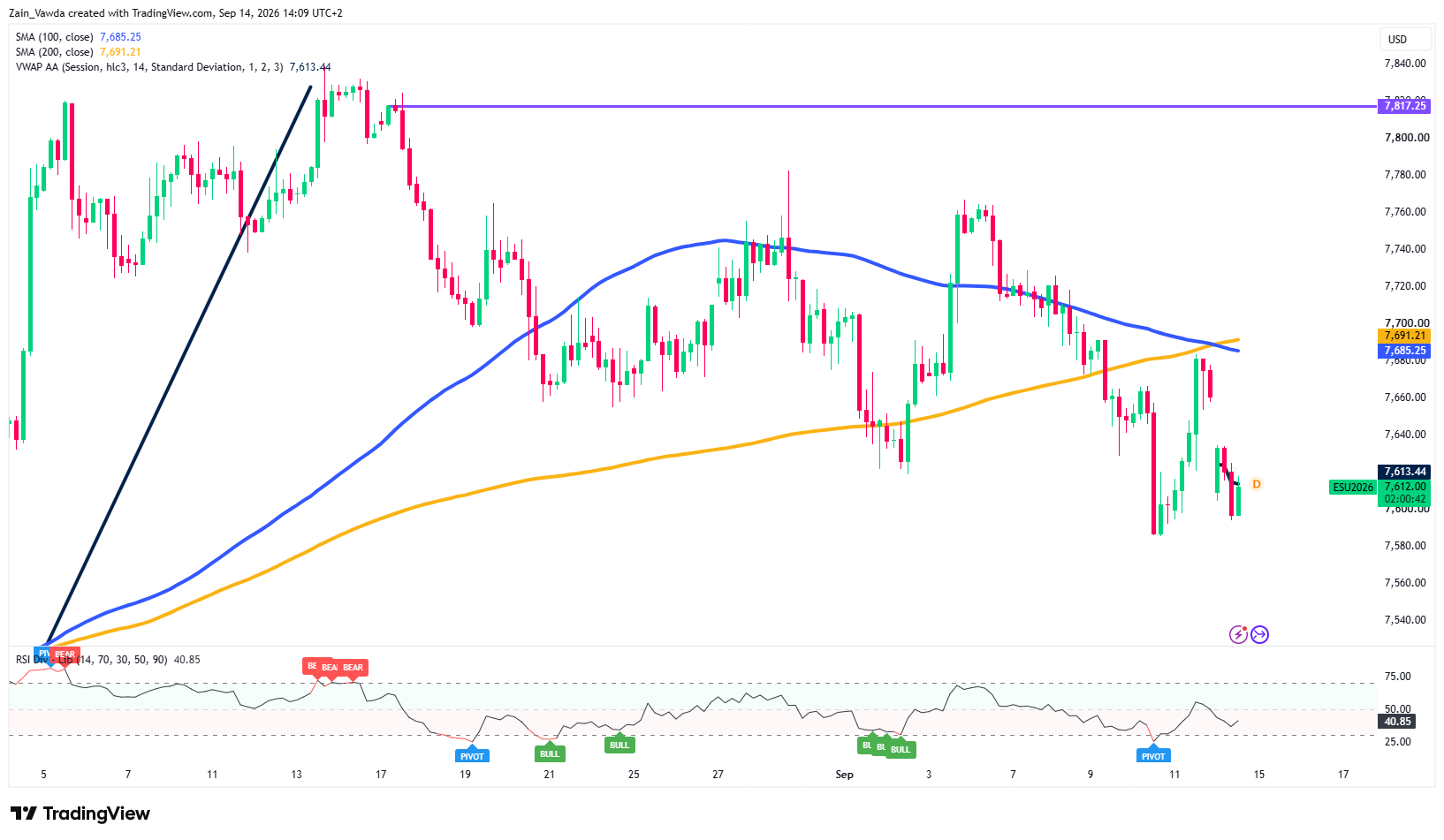
S&P 500 (ES) Four-Hour Chart, September 14, 2026
Source: TradingView
The practical takeaway for anyone trading the S&P 500 E-mini (ES) is that the index now has less slack to absorb bad news. With the risk premium near zero, valuation is no longer a shock absorber, it is a pressure point.
ES was trading near 7,600 early Monday, just under Friday’s 7,659.50 close. Into Wednesday’s Federal Reserve decision, the setup is simple to frame:
- If the Fed hikes and signals higher-for-longer, the discount-rate screw tightens further, and the valuation math gets less forgiving.
- If yields pull back on a more balanced Fed message, or a de-escalation in oil, the pressure eases quickly, because a lot of the strain is coming from the bond market, not from earnings.
That is the real point. In this tape, the ceiling on stocks is being set by bonds, not by profits. Watch the 10-year yield as closely as you watch the index.
The key trigger to track is whether that yield breaks and holds above 5%, the level where historically, the market has finally stopped shrugging.
Looking for an Edge?
Data is an extremely important part of trading. For those looking to add a further edge to their trading strategy, take a look at trade positioning data using the MarketFramework Positioning Edge Tool.