
Oil prices are swinging sharply as a fresh disruption to China's fuel exports pushes Brent crude back toward the $100-a-barrel threshold, offsetting the bearish impact of returning Saudi supply.
The conflicting developments leave the market caught between renewed concerns over product availability and expectations that additional Saudi barrels could eventually ease crude-market tightness.
China Fuel Export Halt Revives Supply Concerns
China's decision to halt fuel exports has injected a fresh bullish catalyst into oil markets, with traders focusing on the potential impact on regional supplies of refined products.
The move is significant because China is a major exporter of refined fuels to markets across Asia. A reduction in Chinese exports can tighten regional product balances even if global crude production is rising.
That creates an important distinction for the oil market: the immediate concern is not necessarily a shortage of crude, but tighter availability of fuels such as diesel and gasoline.
If refiners elsewhere respond by increasing runs to replace lost Chinese supplies, crude demand could receive additional support.
Brent Returns to the $100 Threshold
The export halt has helped push Brent back toward $100 a barrel, underscoring how quickly supply-related headlines can reverse bearish momentum in the oil market.
The move also highlights the sensitivity of crude prices to refined-product disruptions. Even when additional crude supply is returning, tighter fuel markets can keep pressure on prices by raising refinery margins and encouraging refiners to compete for available barrels. For traders, the question is whether the move toward $100 represents a temporary risk premium or the beginning of another sustained supply-driven advance.
Saudi Supply Restart Offers a Counterweight
The bullish impact of China's export halt is being challenged by the return of Saudi supply. Reports indicate that Saudi Arabia has resumed tanker loadings at its Yanbu Red Sea terminal following the near-complete restoration of operations along the East-West Pipeline.
As Saudi production and exports normalize, the additional barrels should improve crude availability and potentially reduce some of the tightness premium embedded in prices.
That creates a tug-of-war between more crude supply from Saudi Arabia and tighter refined-product availability following China's export halt.
The timing is particularly important. If Saudi barrels return quickly enough to offset the loss of Chinese fuel exports, the rally in crude could struggle to extend. If the Chinese disruption proves persistent, however, the market may continue to price in tighter regional fuel balances despite higher Saudi output.
Brent Faces Key $100-$100.50 Resistance
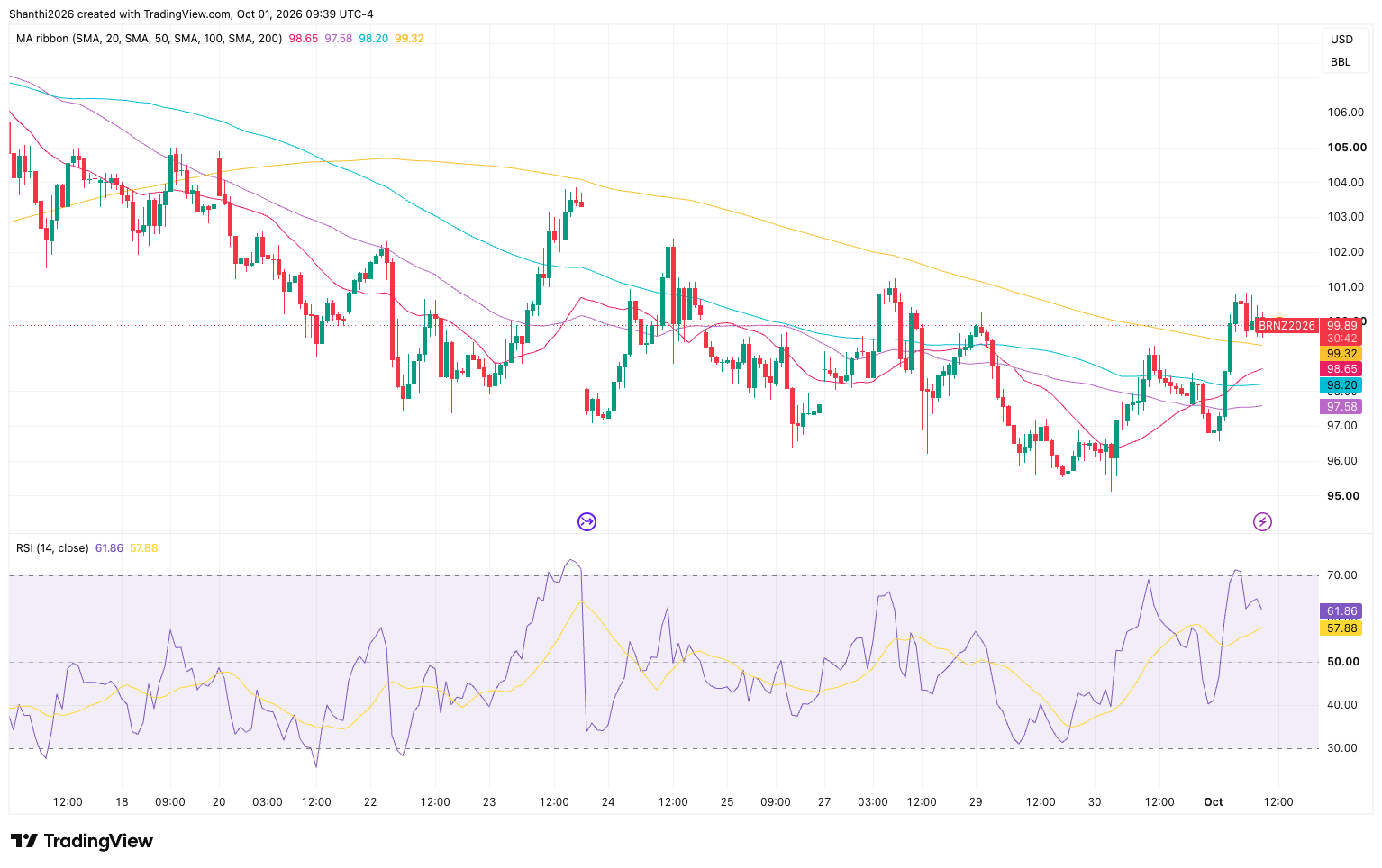
The broader chart remains bearish-to-neutral, but the late-September double bottom near $95.00 has established a firm base. The rebound reclaimed the 20-SMA at $98.65 and 100-SMA at $98.20, bringing price into the declining 200-SMA around $99.32-$100.00, a major resistance zone.
Source: TradingView
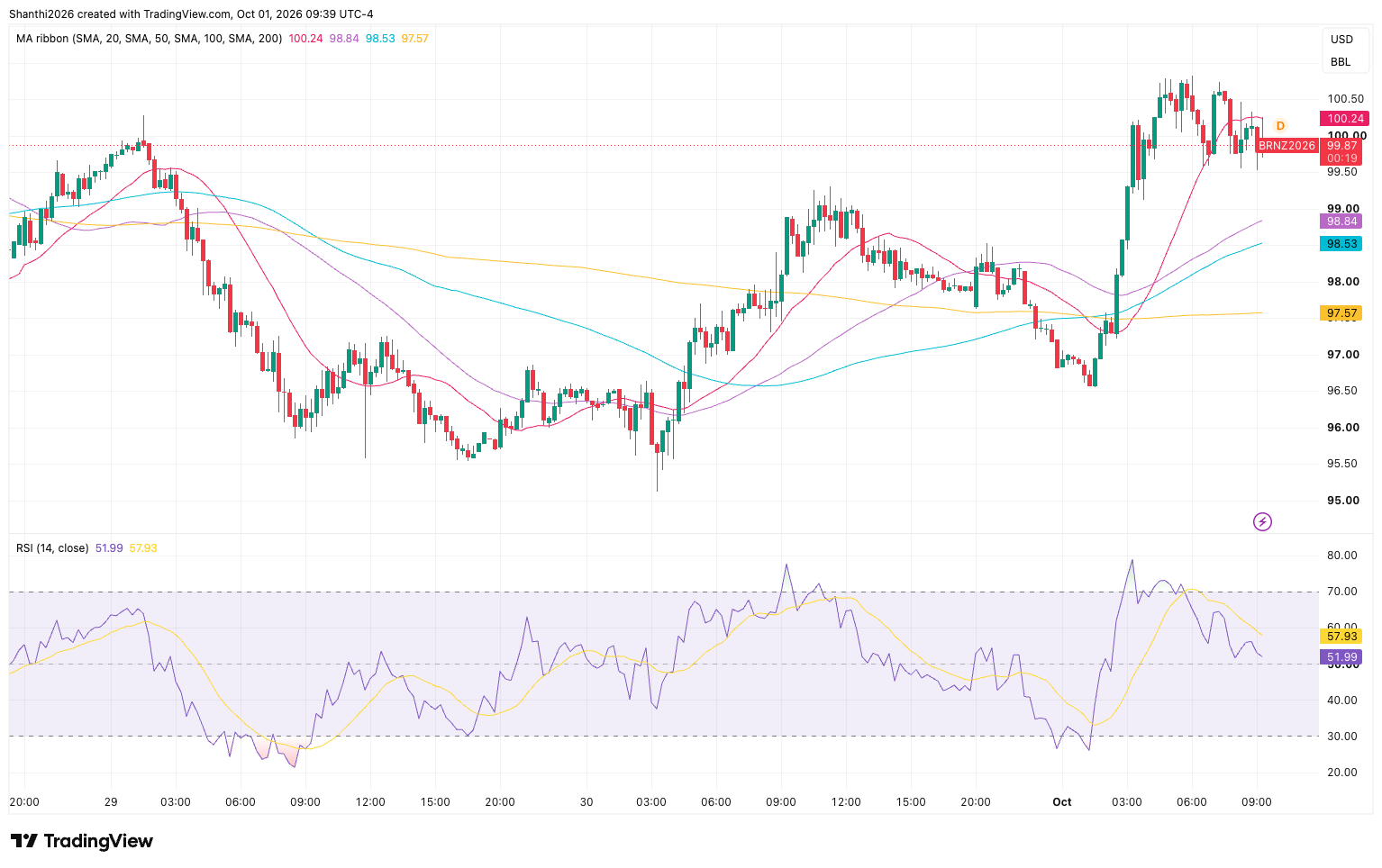
On the lower timeframe, the rebound from roughly $96.00 to $100.50 produced bullish alignment across the 20-, 50-, 100- and 200-SMAs. Price has since consolidated near $99.87, with the 20-SMA at $100.24 now acting as an immediate pivot.
Source: TradingView
Momentum has cooled after the rally. Higher-timeframe RSI eased from above 70 to 61.86, while lower-timeframe RSI fell from around 80 to 51.99, signaling short-term profit-taking.
A sustained break above $100.00-$100.50 would strengthen the recovery, while a break below $99.00 would expose $98.50 support.
MarketFramework’s Top Traded Contracts tool shows positioning remains Moderate Short in Micro WTI crude oil (MCL) contract, with the 7-day lean generating +$41.9K despite today's -$4.4K loss. Current positioning is relatively balanced at 47% long versus 53% short.
The trader split is less directional: 57% of winners are long, while 55% of losers are also long. That suggests the recent rebound has offered opportunities on the long side, but positioning has yet to fully turn bullish.
Oil's Next Move Depends on Which Shock Wins
The latest price action leaves Brent at a critical fundamental crossroads.
A prolonged Chinese fuel-export halt could keep refined-product markets tight and support crude prices by encouraging higher refinery demand. Meanwhile, sustained Saudi supply restoration could gradually pressure prices by improving the underlying crude balance.
That means traders are likely to watch physical fuel availability, refinery utilization, Saudi export flows and the duration of China's restrictions for clues about whether Brent can sustain its return toward $100.
For now, the market is being pulled in opposite directions: China is tightening the fuel side of the equation just as Saudi Arabia adds barrels back to the crude side.