
U.S. consumer sentiment weakened in September as inflation expectations jumped, while durable-goods demand and a closely watched Atlanta Fed growth tracker pointed to continued economic resilience. The combination leaves markets weighing softer household confidence against persistent inflation pressures and strong underlying growth.
Consumer Sentiment Hits Four-Month Low
The University of Michigan's final September reading showed the Index of Consumer Sentiment falling to 48.1 from 51.7 in August, its lowest level in four months and about 15% below January's reading. Nevertheless, it represented a small upward revision from the preliminary reading of 47.8.
The Index of Consumer Expectations came in at 46.3, upwardly revised from the mid-month reading of 45.8, although down from the August reading of 51.5. The Current Economic Conditions Index slipped to 50.9 from 51.9.
Consumers continued to express concern about high prices, while the short-term outlook for business conditions deteriorated amid worries that elevated fuel prices and renewed trade disputes could weigh on the broader economy.
Inflation Expectations Move Higher
The inflation component added another concern for policymakers. Year-ahead inflation expectations jumped to 4.6% from 4.0%, the highest reading since June. Long-run expectations edged up to 3.4% from 3.3%.
The increase suggests that households continue to see price pressures as persistent, particularly amid higher energy costs and renewed trade tensions.
For the Federal Reserve, that creates a difficult combination: weaker consumer confidence points to potential pressure on spending, while higher inflation expectations could make policymakers more cautious about easing policy.
Durable Goods and GDPNow Point to Resilient Growth
The weakness in sentiment has yet to translate into a clear deterioration in business demand. Durable-goods activity provides a firmer signal.
August durable-goods orders were virtually unchanged at $338.6 billion, following a downwardly revised 0.9% increase in July. However, orders excluding transportation rose 0.3%, missing expectations for 0.6% growth and slower than August's upwardly revised 0.7% increase
Non-defense capital goods orders excluding aircraft, a closely watched proxy for business investment, jumped 1.6% in August after an upwardly revised 0.6% increase in July, pointing to continued strength in corporate equipment spending.
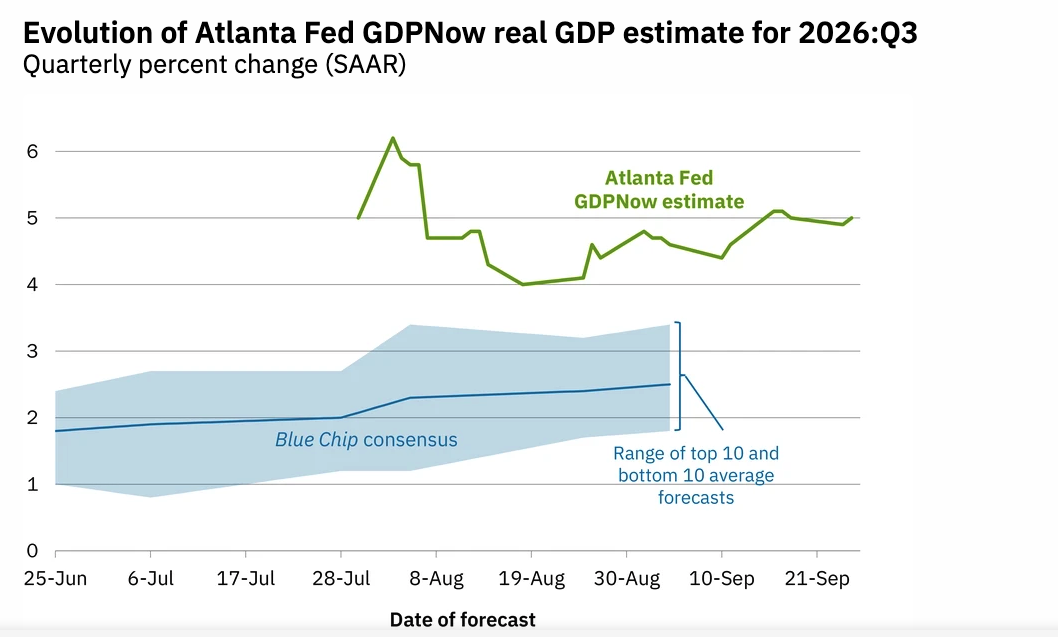
Meanwhile, the Atlanta Fed's GDPNow model kept its estimate for third-quarter real GDP growth at 5.1% annualized on Sept. 25, unchanged from its Sept. 17 update.
Atlanta Fed GDPNow Q3 Real GDP Forecast
Source: Atlanta Fed
GDPNow is a model-based nowcast rather than an official forecast of the Atlanta Fed, the Federal Reserve or the FOMC. It incorporates incoming economic data, including manufacturing, retail sales, housing and durable-goods reports, as they become available.
The 5.1% estimate therefore provides an important counterpoint to the deterioration in consumer sentiment. Households may be growing more pessimistic even as the broader economy continues to expand at a strong pace.
Market Implications
- Treasury yields: Strong growth and higher inflation expectations exerted upward pressure on yields, with the 10-year rising 6.1 basis points to 5.223% and the 30-year up a steeper 6.5 bps to 5.527%.
- Dollar: A resilient economy combined with persistent inflation reinforce expectations for a cautious Fed stance, supporting the dollar. The U.S. Dollar Index (DXY) held at the psychological barrier of 101, although easing from Thursday's close.
- Equities: Strong GDP growth provides a growth cushion, but higher yields and inflation expectations could remain a headwind for rate-sensitive technology stocks. Reflecting the mixed outlook, the major equity indices traded nearly flat, although theDow Jones Industrials Average fared better with a modest gain.
- Gold: Higher inflation expectations supported gold, which temporarily overlooked elevated yields and a firm dollar.
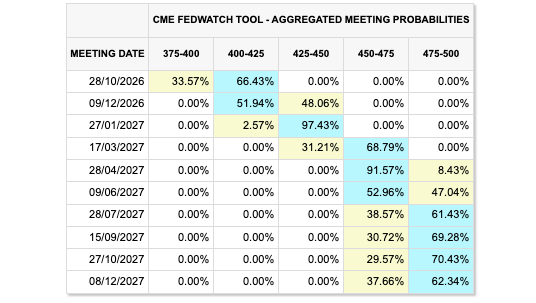
- Fed policy: The data complicate the case for rapid easing. Weak sentiment points to downside growth risks, but strong real-time growth and elevated inflation expectations argue for caution.
CME FedWatch tool puts the probability of an October hike (quarter-point) at 66.4%, up from 57.6% a week ago.
Aggregated Fed Meeting Outcome Probabilities
Source: CME Group
Bottom Line
The latest data point to a divergence between consumer mood and underlying economic activity. Households are becoming more cautious and inflation expectations are rising, but durable-goods demand and the Atlanta Fed's 5.1% GDPNow estimate indicate that growth remains resilient. For markets, that keeps the focus on whether stronger activity eventually feeds into more persistent inflation or whether weaker confidence begins to weigh on spending.