
Micron Technology (MU) is about to give the artificial intelligence (AI) trade another reality check. The memory-chip maker is scheduled to report fiscal fourth-quarter results after the U.S. market closes on Wednesday, with investors looking beyond the headline numbers for evidence that AI-driven demand can continue supporting elevated memory prices, margins and capital spending.
The timing is important. U.S. stock futures started Monday under pressure, with Nasdaq-100 futures down about 0.9% in early trading as oil prices climbed and Treasury yields moved higher. The 10-year Treasury yield reached around 5.23%, while Brent crude rose above $108 a barrel, adding to concerns about inflation and interest rates.
That leaves Micron reporting into a market that is already becoming more sensitive to the cost of capital and the sustainability of aggressive AI spending.
The Numbers Are Already High
Micron itself guided for fiscal fourth-quarter revenue of $50 billion, plus or minus $1 billion, adjusted gross margin of approximately 86%, and adjusted EPS of $31, plus or minus $1.
Consensus expectations have moved slightly above that guidance range, with analysts, on average, expecting revenue of $51.32 billion and consensus estimate of $50.86 billion in revenue and $31.65 in adjusted EPS, implying year-over-year revenue growth of roughly 353% and EPS growth of about 945%. That creates a particularly important distinction for the stock. A strong quarter may not be enough if the outlook fails to keep pace with elevated expectations.
The market is therefore likely to focus heavily on management's fiscal 2027 commentary, particularly pricing, supply conditions, margins and demand visibility.
Previewing Micron’s Q4 print, Morgan Stanley analyst Joseph Moore said he sees upward revisions to earnings on the print, but less so than prior quarters./tools/positioning-edge
We see the debate shifting from ‘how good can it get’ to "how long can it stay good" which can take longer to play out.
Moore, however, remains constructive on the memory cycle, arguing that the industry is likely facing several years of exceptionally tight supply-demand conditions rather than a near-term peak. According to the analyst, AI infrastructure deployments continue to be constrained by DRAM availability, with hyperscalers and system builders showing relatively little price sensitivity as they race to secure memory needed for compute expansion. Even efforts to reduce memory requirements often shift demand elsewhere within the ecosystem, limiting the overall impact on consumption.
Moore also downplayed concerns about Chinese memory suppliers significantly altering the supply outlook, noting that shortages in China are currently as severe as those seen elsewhere. While memory producers continue to increase capital spending, Morgan Stanley's industry checks suggest that supply-demand balances could become even tighter in 2027 and 2028. The firm believes the current upcycle is more likely to end if AI spending slows materially rather than because of a surge in memory supply, reinforcing a favorable backdrop for companies such as Micron.
HBM Is the Key AI Read-Through
The most important part of Micron's story is increasingly high-bandwidth memory, or HBM, which is used alongside advanced AI accelerators to provide the memory bandwidth needed for intensive workloads.
Micron said in its latest quarterly update that HBM4 had entered high-volume shipments for its lead customer's platform, while qualification samples had been shipped to multiple other customers. The company also said HBM4E development was underway, with volume production expected in calendar 2027.
That makes Micron's commentary relevant well beyond the memory industry.
If HBM demand remains strong and supply stays constrained, it would provide another data point supporting the broader AI infrastructure spending cycle. Conversely, signs of slowing orders, weaker pricing or pressure on margins could revive questions about whether expectations surrounding AI hardware investment have become too aggressive.
Micron Earnings: Scenario Analysis
| Scenario | Q4 Print | 2027 Guidance | HBM/Margins | Potential Market Reaction |
|---|---|---|---|---|
| Bullish | Beat | Upward revision | Strong | MU higher; SOXX higher; NQ higher (potential short-covering) |
| Neutral | Broader beat/in-line | Unchanged | In-line | Initial gains could fade due to elevated expectations |
| Bearish | In-line/Miss | Weak | Margin pressure and/or cautious HBM/AI outlook | MU lower; SOXX lower; NQ lower; reinforcing existing bearish positioning |
Technical Picture Remains Constructive Despite Pullback
Nasdaq 100 futures (NQ) are pulling back modestly after testing the 31,000 area, but the broader technical structure remains firmly bullish. The contract continues to trade comfortably above its rising 100-day moving average near 29,584 and 200-day moving average around 27,510, underscoring the strength of the longer-term uptrend. The recent retreat has so far failed to inflict any meaningful damage to market structure, with prices holding well above key trend support levels established during the August rebound.
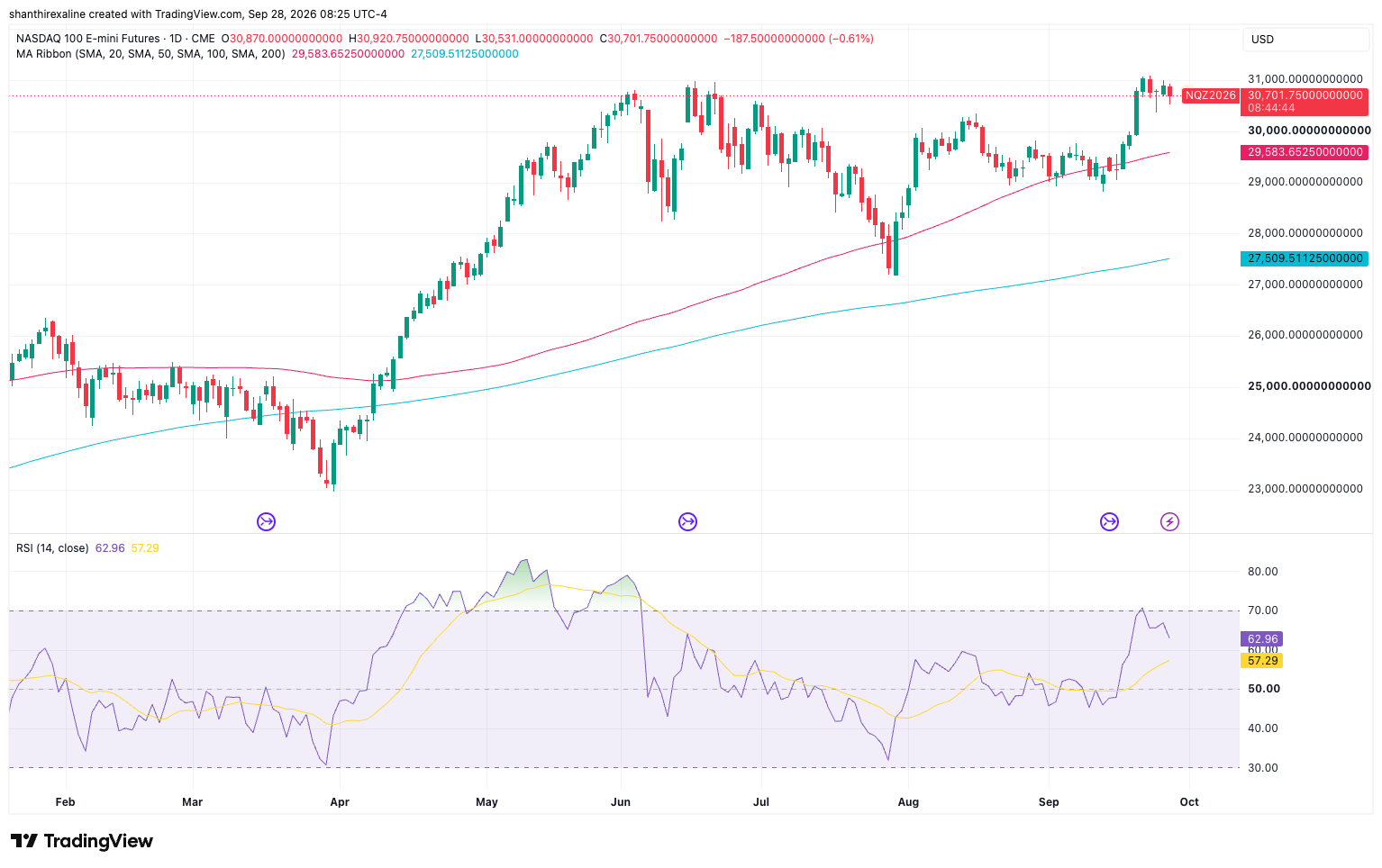
Source: TradingView
Momentum has cooled from overbought conditions, with the RSI slipping to the low-60s after briefly approaching 70, suggesting some consolidation rather than a trend reversal. As long as NQ remains above the 100-day moving average and recent breakout zone around 30,000, bulls retain control. A sustained move back through the 31,000 region would keep the focus on further upside extension, while a deeper pullback would likely find initial support near the rising 100-day average.
NQ Positioning Adds a Contrarian Signal
The Sept. 22 CFTC positioning report shows leveraged funds maintaining a decisively bearish exposure to Nasdaq-100 E-mini futures (NQ). Leveraged funds held 54,033 long contracts versus 84,716 short contracts, leaving them with a net outright short position of 30,683 contracts. Including spread positions, their net exposure remains substantially bearish.
The weekly change is particularly notable. Leveraged funds added 25,649 short contracts while increasing longs by only 1,353. That shifted their outright net position 24,296 contracts further toward the short side from the previous week. At the same time, spread positions declined by 14,262 contracts.
MarketFramework’s Positioning Edge tool confirms the bearish disposition toward the NQ contract. Profitable traders were only 41% long, versus 72.5% long among unprofitable traders. That means profitable traders were roughly 59% short, while the less-successful cohort was heavily positioned long.
The setup does not predict the earnings reaction, but it shows that the more successful trader cohort is positioned defensively into a major technology catalyst.
What to Watch After the Print
The headline EPS and revenue numbers will be important, but the forward-looking details may matter more.
Investors will likely focus on:
- HBM demand and customer commitments
- DRAM and NAND pricing
- Gross-margin trajectory
- Fiscal 2027 revenue and EPS outlook
- HBM4 production and HBM4E development
- Capital expenditure and capacity expansion
- Management's assessment of AI-server demand
Micron's report therefore arrives at a sensitive point for technology markets. The question is no longer simply whether AI is generating demand for memory chips. The bigger question is whether that demand is strong enough to justify the increasingly high earnings expectations already embedded across the semiconductor complex.
With Nasdaq futures under pressure and NQ positioning tilted heavily short among profitable traders, Micron's report could become an important test of whether the recent technology pullback is merely a rate-driven wobble or the beginning of a deeper reassessment of AI expectations.