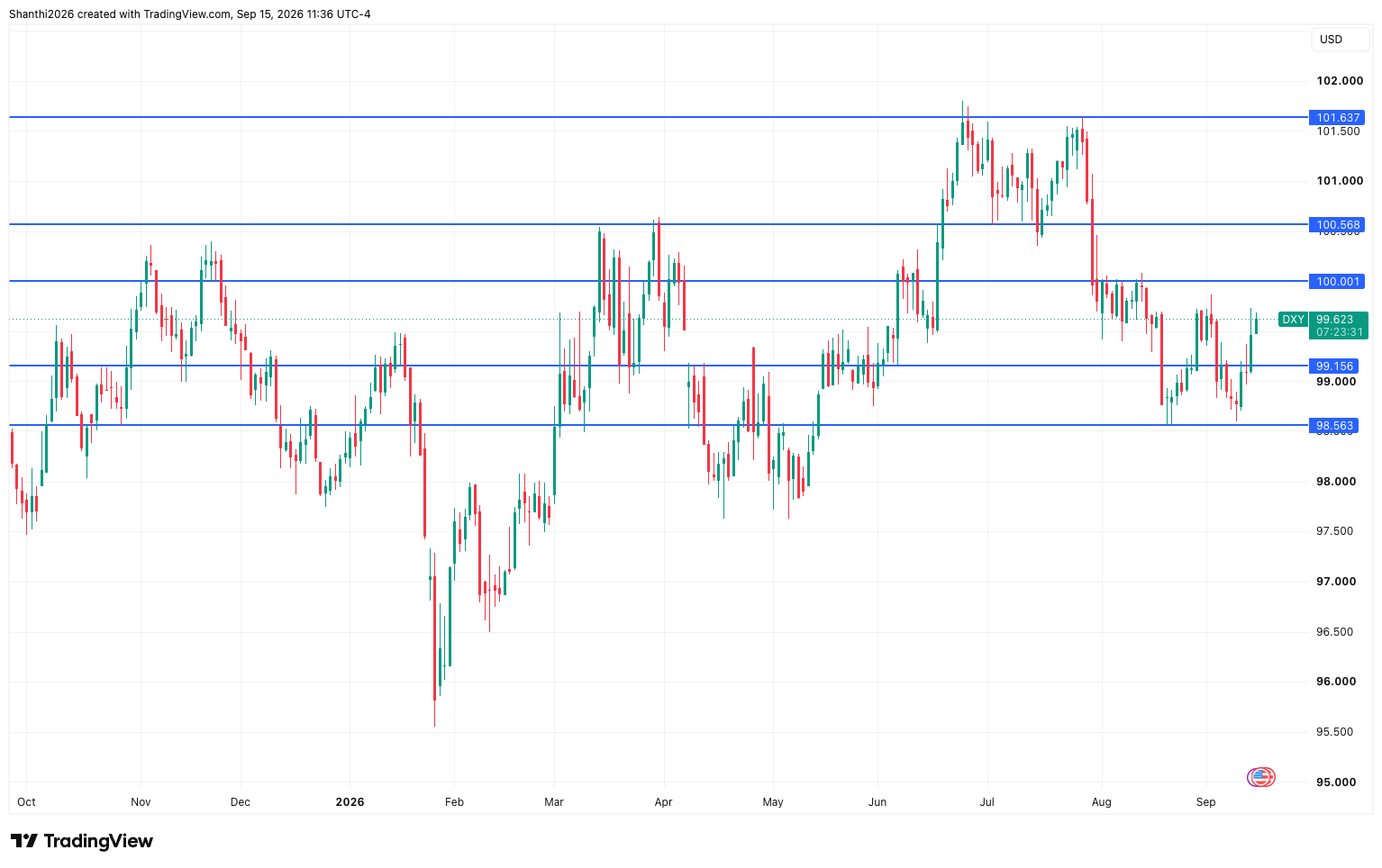
The U.S. dollar is heading into Wednesday’s Federal Reserve decision with momentum building, but DXY still has something to prove. After slipping to 98.56 in late August, the index has rebounded and is now approaching the psychologically important 100 level.
The move has been supported by a sharp repricing of monetary policy expectations, rising Treasury yields and renewed inflation concerns following the latest consumer and producer price inflation (CPI) data. Markets are now assigning roughly a 92% probability to a quarter-point Fed rate hike.
Fed Funds Target Rate Possibilities
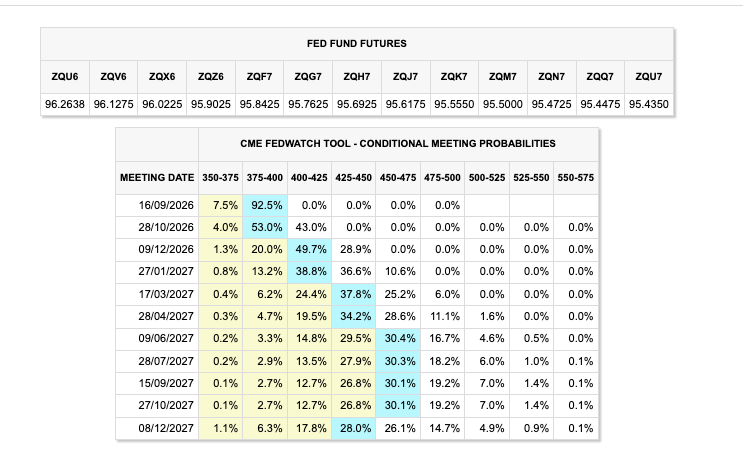
Source: CME Group
Yet the dollar’s recovery remains relatively modest in the broader picture. DXY is essentially back around its mid-August levels and is roughly flat on a month-over-month basis. That makes the approach toward 100 less a fresh breakout story than a test of whether the recent rebound has enough strength to turn into a more durable advance.
Fed Decision Takes Center Stage
With a 25-basis-point hike increasingly priced into markets, Wednesday’s decision itself may have limited surprise value for currency traders. The dollar may see little reaction, or even a sell-the-news move if the Fed delivers the widely anticipated hike without signaling a meaningfully more hawkish path.
The bigger question is what comes alongside the rate increase. The Fed’s policy statement, updated economic projections and rate path could provide clues about how policymakers view persistent inflation, elevated energy prices and the outlook for future policy.
A hawkish message would reinforce the recent rise in rate expectations and potentially give the dollar another leg higher. Conversely, if policymakers signal that the latest inflation pressures are insufficient to justify a prolonged period of restrictive policy, the greenback could struggle to hold its recent gains.
That makes the post-decision reaction in Treasury yields particularly important for DXY. If yields rise alongside the Fed’s guidance, the dollar could gain the momentum needed to challenge 100. If yields retreat, a sell-the-news reaction could pull DXY back toward nearby support.
Rising Yields Give the Dollar a Tailwind
The dollar is entering the Fed meeting against a backdrop of unusually elevated Treasury yields. The 10-year note yield climbed past the 5% threshold, its highest level in nearly two decades, before easing modestly, increasing the relative attractiveness of U.S. assets.
That yield move has helped alter the macro backdrop facing the greenback. Higher borrowing costs and expectations for tighter monetary policy can support the dollar by reducing expectations for near-term rate cuts and widening yield differentials.
Still, DXY’s relatively restrained rebound despite the jump in yields is notable. It suggests that the dollar may need a stronger policy signal from the Fed before it can decisively escape its recent range.
Oil Adds Another Inflation Variable
Crude oil has become another important piece of the dollar equation.
With WTI trading above $100 and Brent also elevated, energy prices have introduced a fresh inflation risk just as the Fed prepares to communicate its policy outlook. A sustained oil shock could complicate the central bank’s efforts to bring inflation closer to target.
For currency traders, that creates a potentially dollar-positive combination: higher oil prices keeping inflation risks elevated while Treasury yields rise in anticipation of tighter policy.
But the effect is not necessarily straightforward. Persistent energy inflation can also raise concerns about economic growth, creating a tension between the dollar’s support from higher rates and potential risk-off pressure from weaker growth expectations.
DXY Faces a Key Test Around 100
From a technical perspective, 100 is now the level to watch.
The index has recovered from its late-August low near 98.55 and is approaching the 99.6–100.0 area. A decisive move above 100 would strengthen the case that the recent rebound is evolving into a broader recovery.
Above that threshold, the next area to monitor is around 100.35–100.65, where previous resistance and moving-average levels could challenge further upside. A sustained break there could put the 101.25–101.65 region on the radar.
On the downside, failure to clear 100 would leave the recent rebound vulnerable to a reversal. Initial support comes around 99.15, followed by the 98.96–98.55 area. A return below those levels would weaken the bullish case and suggest that the recent move was primarily a corrective rebound.
Source: TradingView
DXY is approaching 100 while euro positioning is heavily short, according to MarketFramework's Top Traded Contracts tool. Incidentally, the euro carries the largest weighting in the DXY index, making the heavily skewed euro positioning particularly relevant to the dollar’s outlook. That means the dollar needs more than a Fed hike that is already priced in. It may need a hawkish surprise to overcome the risk of a euro short squeeze.
Three Fed Outcomes for the Dollar
| Fed Outcome | Potential DXY Reaction |
|---|---|
| Hawkish hike | Break above 100 likely as yield, rate expectations rise |
| Hike with balanced guidance | DXY struggles to extend gains, with traders taking profits on priced-in move |
| Dovish hike | Dollar could retreat toward 99 or below as markets look beyond immediate rate increase |
The key distinction is that the hike is increasingly priced in; the guidance is not. A policy path that keeps rates elevated for longer could provide the catalyst DXY needs to break through 100.
Can the Rebound Become a Breakout?
The dollar’s rebound has repaired much of the damage from its late-August decline, but it has not yet produced a convincing trend change. DXY remains roughly around its mid-August level, making the 100 threshold an important test of whether buyers can turn a recovery into a sustained move higher.
Wednesday’s Fed decision could provide that catalyst
If policymakers emphasize persistent inflation risks, elevated energy prices and the need to maintain restrictive policy, the combination of higher yields and tighter rate expectations could push DXY through 100. If the Fed instead delivers a largely anticipated hike without a stronger hawkish signal, the dollar may find it difficult to sustain the move.
For traders, the reaction around 100 and not simply the size of the Fed’s rate move, could offer the clearest signal of DXY’s next direction.