
Nasdaq E-mini futures (NQ) initially tumbled to an intraday low of 28,763.75 following Wednesday’s Federal Open Market Committee (FOMC) decision, but the contract quickly reversed course and settled marginally higher. NQ has since completed a full round trip, climbing back above Wednesday’s intraday high and moving toward the key technical and psychological barrier at 29,800.
From June Recovery to a Tight Trading Range
After bottoming near 27,196 in late June, NQ embarked on a recovery that carried the contract to 30,343 in mid-August. That advance subsequently stalled, leaving the futures contract largely confined to a 28,900-29,800 range.
Wednesday’s FOMC decision triggered a sharp test of the lower end of that range. The Federal Reserve, led by Chair Kevin Warsh, raised its target range by 25 basis points to 3.75%-4%. The hike itself was widely anticipated, making the initial selloff in equities more notable.
The adverse reaction appeared to stem more from the Fed’s messaging and projections than from the rate increase itself. The statement emphasized the Committee’s commitment to returning inflation to its 2% target and removed the July reference to supply shocks in “certain sectors, including energy” as a factor behind elevated inflation.
The updated dot plot also pointed to a higher-for-longer rate path. Most policymakers raised their rate projections from the June meeting, while the median projection indicated one additional hike before year-end. A majority of policymakers also saw the federal funds rate ending 2027 between 4% and 4.5%.
Energy Prices Could Determine the Next Fed Move
The outlook for energy prices now stands out as a key variable for monetary policy. Fifth Third Commercial Bank Chief U.S. Economist Bill Adams said the trajectory of gas and diesel prices could determine whether the Fed delivers additional rate hikes.
“The most important known-unknown to influence monetary policy over the next few Fed decisions will be the energy price shock,” Adams said. “The higher gas and diesel prices go, and the longer they stay up, the more the Fed will hike. Alternatively, a breakthrough unlocking energy supply from the Mideast could allow the Fed to refrain from further hikes.”
That leaves energy markets as an important transmission channel for NQ. A sustained increase in fuel prices could reinforce inflation concerns, keeping pressure on Treasury yields and potentially weighing on rate-sensitive technology stocks. Conversely, an easing of the energy shock could reduce pressure for additional tightening.
Hawkish Signals Keep the Fed Risk Alive
Morgan Stanley Chief U.S. Economist Michael Gapen also interpreted the Fed’s communication as leaning hawkish. He pointed to the repeated language around removing accommodation, references to geopolitical risks and the upward revision of the neutral rate in the projections.
Gapen now expects two additional hikes, in December and March 2027, which would take the target rate to 4.25%-4.50%.
For NQ traders, however, the immediate question has shifted back to price action. The contract has absorbed the initial hawkish Fed shock and returned to the upper portion of its established range. A sustained move through 29,800 would put the August high near 30,343 back in focus, while failure to clear the ceiling could leave NQ vulnerable to another retreat toward the lower end of the range.
NQ Bulls Defend 29,400 as Momentum Builds Toward 29,800
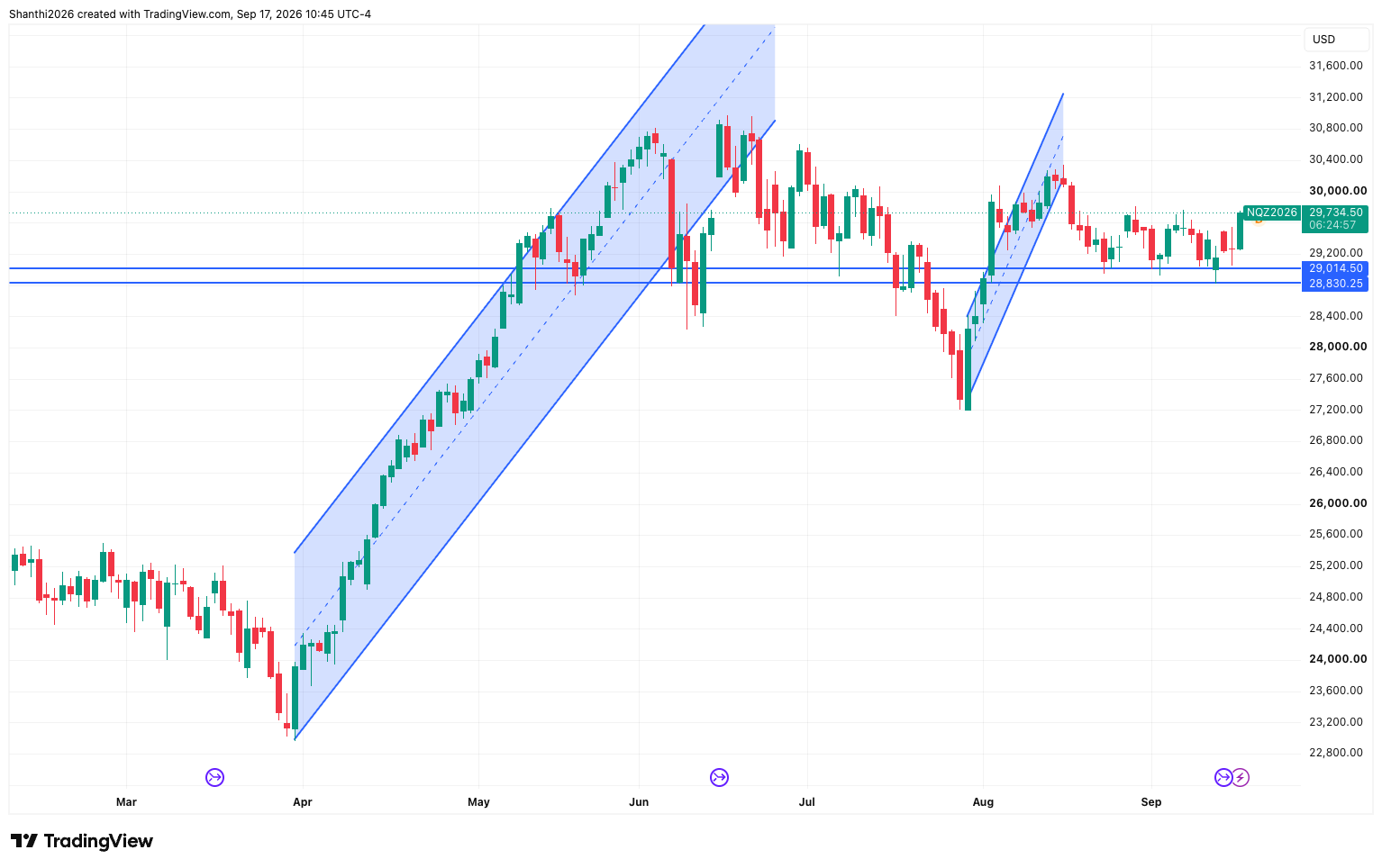
The daily chart shows the market is currently in a macro consolidation phase following a high-volatility expansion from the 23,000 low up to the 31,000 peak. Price action shows a strong V-recovery off the early August bottom at 27,200, creating a secondary peak near 30,200 before settling into a higher-low consolidation pattern throughout September. The structural foundation between 28,800 and 29,000 continues to serve as the critical line for bulls, keeping the broader uptrend intact with a primary target toward 30,000 and the previous highs.
Source: TradingView
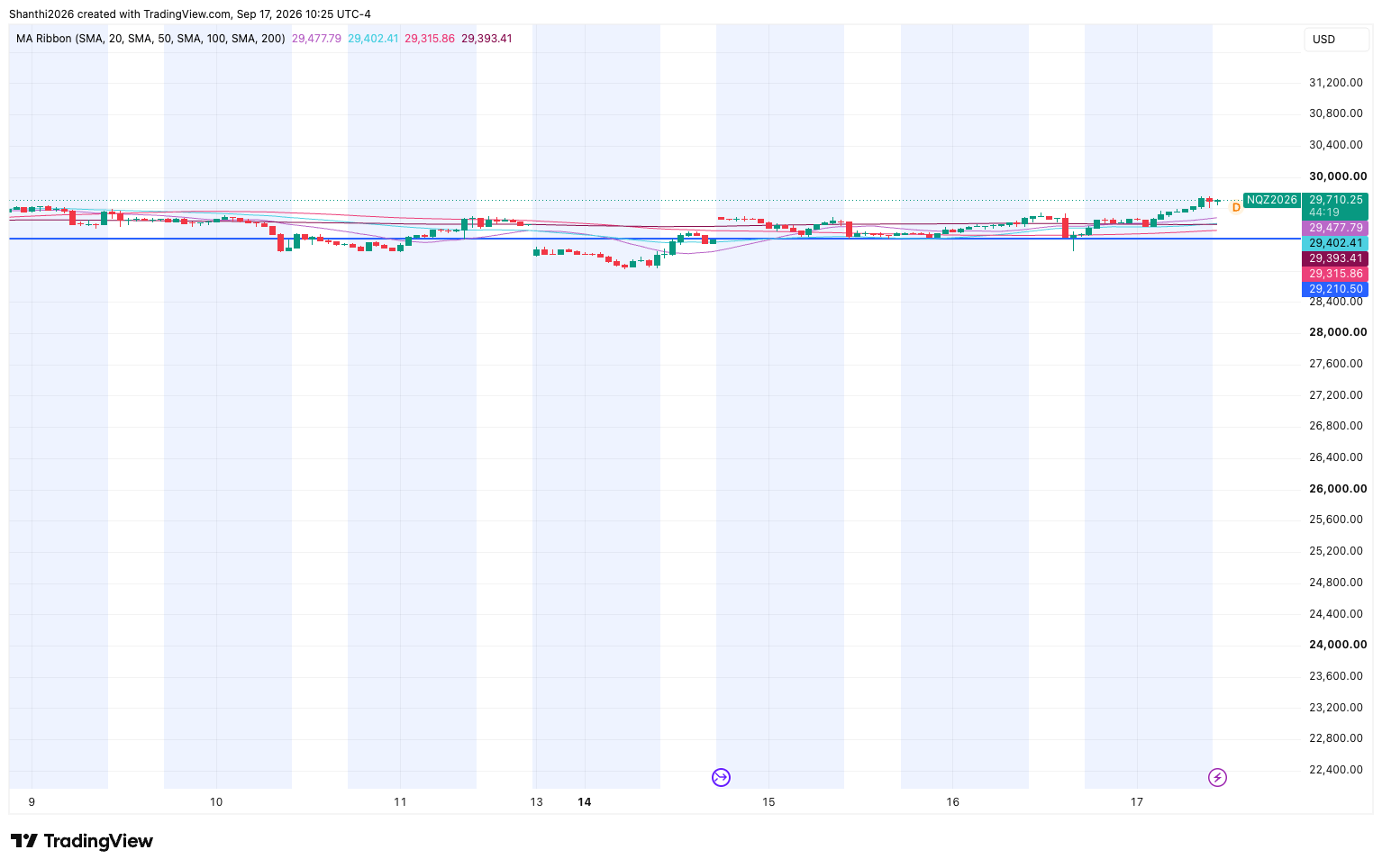
H1 Timeframe The intermediate structural trend displays a steady, controlled upward drift out of the 29,200 swing low while remaining anchored above key short-term moving average clusters. Volatility has steadily compressed during this advance, creating a series of higher intraday support levels and higher lows. The immediate pivot level sits around 29,400; as long as pullbacks hold above this zone, the hourly structure remains firmly bullish with eyes set on testing local session highs at 29,800.
Source: TradingView
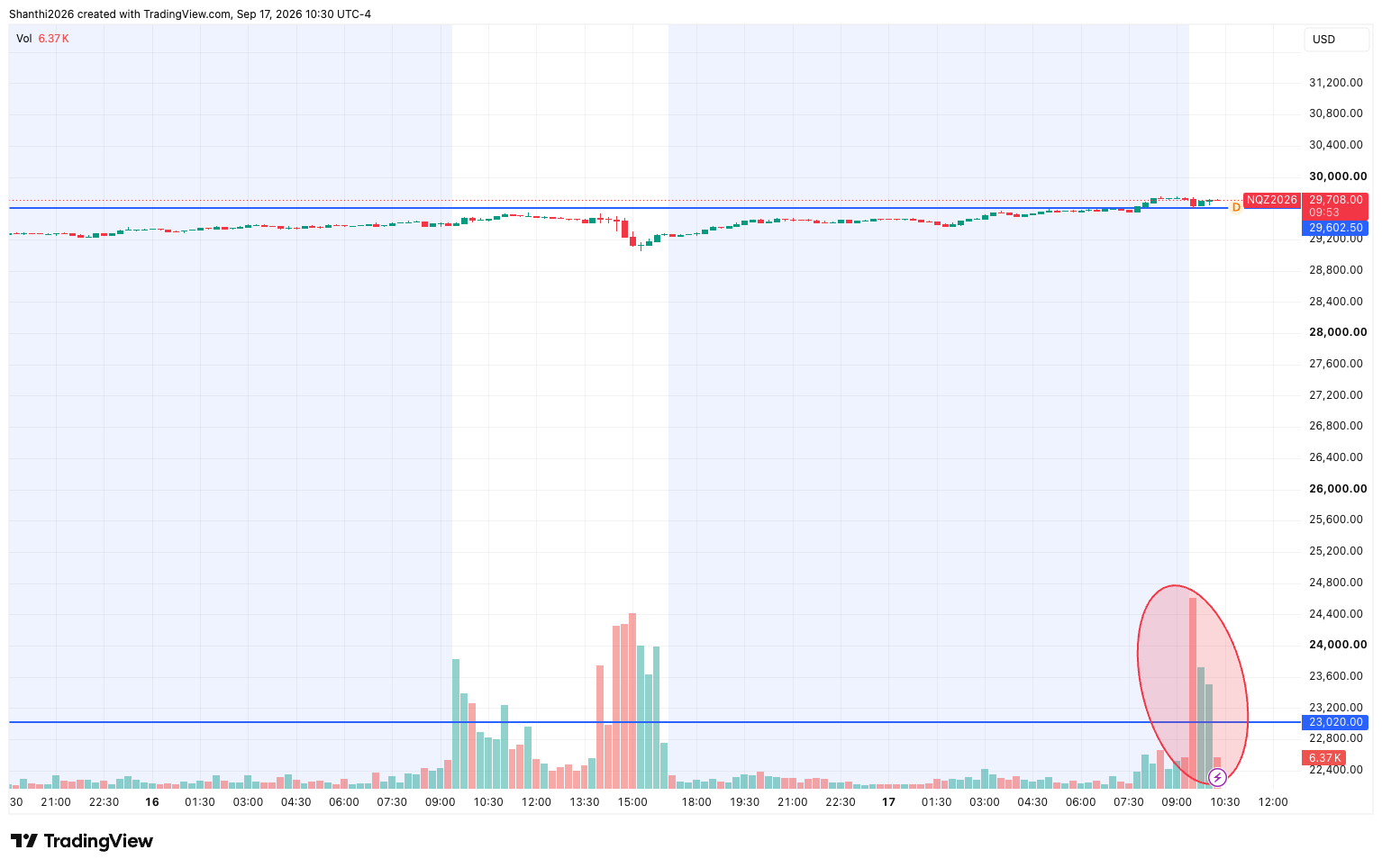
M15 Timeframe Short-term price action depicts a bullish continuation following the U.S. market open. After grinding through overnight consolidation below 29,600, buyers initiated a high-volume breakout, printing new session highs near 29,713. Immediate support has shifted upward to the 29,660–29,680 micro-range, with resistance clear until the next major magnet level around 29,800.
Source: TradingView
Despite the bullish price action on the charts, the MarketFramework Positioning Edge Tool signals a Mild Bearish Divergence, showing that profitable traders are 3% more net-short (52% Short/48% Long) than unprofitable retail traders (50.5% Long). This suggests the rally is not being fully confirmed by the market’s more successful participants.