Wall Street strategists largely agree that the Federal Reserve is heading toward a 25-basis-point (bps) rate hike on Wednesday. The bigger question for markets is whether Chair Kevin Warsh signals that the move is the start of a broader tightening cycle.
With crude oil above $100 a barrel and the 10-year Treasury yield around 5%, investors are entering the decision with two major sources of pressure already weighing on financial conditions. That leaves the September Summary of Economic Projections (SEP), the dot plot and Warsh’s press conference as potential catalysts for a much larger repricing across stocks, bonds and the dollar.
The CME FedWatch Tool puts the probability of a quarter-point hike at roughly 92.5%. With the move largely priced in, Lloyd Financial Chief Investment Officer Colin Symons believes the market reaction will depend primarily on what policymakers say about the next hike.
“A hawkish surprise would be an immediate signal that another hike is very likely,” Symons said, while describing a hold as the dovish surprise.
Fed’s Rate Move Odds
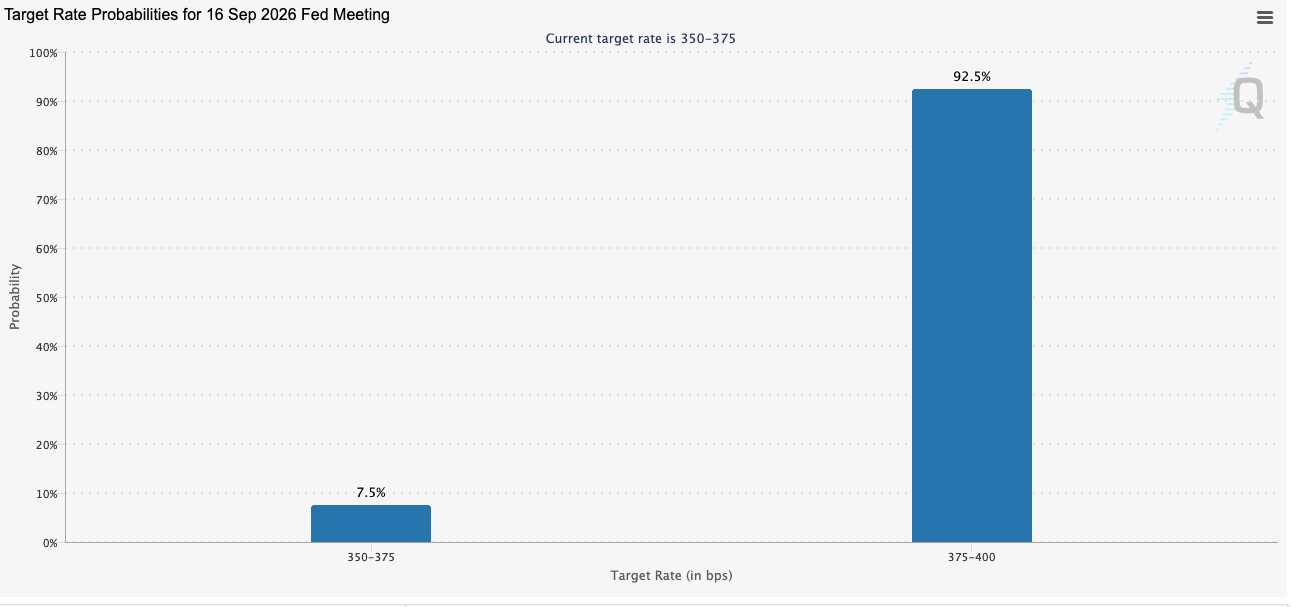
Source: CME Group
That makes Wednesday less about whether the Fed hikes and more about how far it intends to go.
Matt Maley of Miller Tabak flags the possibility of a surprise 50-basis-point cut.
A 50-basis-point rate cut would constitute a hawkish surprise, while no rate cut at all would be the dovish surprise from the market's perspective.
4.1% dot-plot median becomes a key test
The September dot plot could provide the clearest indication of whether policymakers believe the economy requires materially tighter monetary policy.
Symons said investors should focus on where the median forecast lands and how many officials project rates above 4%. A median of 4.1%, he said, would suggest another hike is the most likely outcome.
It'll also be interesting to see how wide the dispersion in dots is and if Warsh submits a dot (likely not.)
Morgan Stanley's forecast is consistent with that view. The firm expects a 25-bps September hike followed by another quarter-point increase in December, taking the target range to 4%-4.25%. It expects the 2026 median policy-rate projection to rise to 4.1%, from 3.8% in June.
Morgan Stanley argues that inflation has continued to decelerate, but not quickly or convincingly enough for the Fed to be comfortable. It points to second-round effects from higher energy prices, resilient demand and artificial intelligence (AI)-related investment as factors keeping inflation pressures elevated.
The firm expects little change in the Fed's growth, unemployment and inflation projections. That would carry an important message: the Committee could be signaling that a higher interest-rate path is necessary to achieve essentially the same economic and inflation outcomes it previously expected.
Warsh’s words could matter more than the hike
The press conference could become the main volatility event.
Symons said Warsh’s previous press conference was “messy,” in part because it was terser than markets expected. He believes that communication style could again leave markets with considerable room to determine the policy path themselves.
Maley similarly expects Warsh to be crucial to the market reaction. He believes the chair would need to sound particularly hawkish to generate a major repricing, especially if he suggests additional hikes remain possible.
Maley sees a possibility that Warsh points toward only one additional hike, rather than the two some investors are beginning to contemplate. Such guidance could trigger a short-term bond rally and pull Treasury yields lower.
But Maley's longer-term concern is different: structurally higher interest rates.
He argues that equities have limited capacity to absorb simultaneous increases in long-term yields and oil prices. While stocks have historically tolerated either pressure individually for periods of time, sustained increases in both have eventually weighed on equities.
Strategists see more tightening ahead
RBC also expects the Fed to come off the sidelines with a 25bps hike, citing stronger inflation pressures and oil prices above $100.
The debate, therefore, is increasingly shifting toward the size and timing of subsequent moves.
Morgan Stanley expects another hike in December. Other strategists see the possibility that the Fed could move more aggressively if energy-driven inflation persists and economic activity remains resilient.
Morgan Stanley lays out policy paths ranging from a one-and-done hike if inflation improves quickly to a 100bps tightening cycle if growth and inflation remain unusually firm.
That spectrum is critical for equities because the market has already absorbed much of the expected September move.
What Investors Should Watch
Fed’s inflation projections and comments regarding sticky inflation (higher for longer) are important cues for near-term policy direction, according to Maley. He also tells investors to keep an eye on “any discussion emphasizing the potential for a prolonged Middle East conflict and its implications for energy prices and inflation” and the degree of consensus within the committee.
A combination of higher inflation projections and a unified Fed could materially shift expectations for the path of interest rates.
JPMorgan maps a wide range of equity outcomes
JPMorgan's five-scenario framework illustrates how dramatically the S&P 500 could respond to different combinations of policy action and guidance.
A no-hike outcome would be the most immediately negative scenario, with the S&P 500 falling 1.25%-1.75% as longer-dated Treasury yields rise on concerns about inflation expectations.
Miller Tabak’s Maley also predicts a very negative stock market reaction if the Fed decides not to raise rates, given inflation has come in hotter than expected.
JPMorgan thinks a 25-bp hike without additional guidance, viewed as the consensus Wall Street outcome, could contain pressure on the back-end of the yield curve and lift the S&P 500 by 0.25%-0.75%.
JPMorgan sees an even stronger equity response if the Fed delivers a 25-bp hike while removing language associated with its 2025 easing. If Warsh signals that the Fed could begin taking back previous rate cuts more quickly, investors could price hikes in October and December rather than December and March. Under that scenario, the S&P 500 could rise 0.5%-1%.
The picture changes if the Fed raises its estimate of the neutral rate, or R-star. JPMorgan argues that investors could conclude that monetary policy remains too accommodative and begin pricing another percentage point or more of tightening. Its S&P 500 scenario under that outcome is a decline of 0.25%-1%.
The most severe scenario involves Warsh signaling that rates need to rise materially higher to bring inflation under control, effectively echoing the 2022-23 tightening cycle. JPMorgan sees the S&P 500 falling 1%-2% in that case.
Heading into the Fed decision, retail sentiment toward the Nasdaq E-mini futures more or less neutral. However, MarketFramework’s Positioning Edge tool shows extreme bullish divergence, with profitable traders 55.2% long compared to unprofitable traders at 43.1% long. The 12-point divergence shows traders with a stronger recent track record are leaning materially more long than the less successful cohort.
However, it doesn't guarantee an upside move. The divergence is most useful as a confirmation signal: if NQ holds firm or breaks higher after the Fed, the profitable-trader positioning could reinforce the move. If the market sells off despite this bullish positioning, it could indicate that the Fed reaction is overpowering the positioning advantage and potentially force those longs to unwind.
Oil and 5% yields raise the stakes
The Fed is therefore approaching Wednesday's meeting at a particularly sensitive point for financial markets.
Oil above $100 is feeding directly into inflation concerns, while a 10-year Treasury yield around 5% raises the discount rate applied to equities and increases pressure on valuations.
Symons believes markets have handled the combination surprisingly well so far because economic strength has remained supportive. But he cautions that resilience has limits.
“New highs in either wouldn't be good news,” he said, referring to oil and rates.
Maley is similarly concerned that the combination eventually becomes harder for equities to absorb. He also sees an additional risk from the enormous capital spending tied to artificial intelligence, arguing that investors may be underestimating how long it could take for those investments to generate adequate returns.
The biggest risk may be a Fed tightening into an energy shock
For Symons, the most important risk markets could be underpricing is a very hawkish Fed confronting an energy shock.
That creates an uncomfortable policy dilemma. Higher oil prices can lift inflation while simultaneously weakening consumer purchasing power and economic activity. Monetary policy can restrain demand, but it cannot directly increase the supply of crude.
Yet if policymakers respond aggressively to the inflation consequences of the energy shock, markets could face a combination of higher short-term rates, elevated long-term yields and weaker equity valuations.
That is why Wednesday's decision could ultimately be less about the initial 25-bp hike than the Fed's answer to a larger question: Is this a single adjustment to address sticky inflation, or the opening move in a renewed tightening cycle?
With the hike already heavily priced, the answer may come from three place: the 4.1% dot-plot median, the distribution of officials' rate forecasts and Warsh's description of what comes next.