
The Russell 2000 has been one of the strongest-performing major U.S. equity benchmarks in 2026, but its rally is running into a powerful new headwind: rising Treasury yields.
The small-cap index has gained roughly 17% through Sept. 11, compared with about 12% for the S&P 500. The outperformance has been fueled by improving earnings expectations, favorable policy developments and optimism that smaller, domestically focused companies will benefit from a resilient U.S. economy. The support lent by earnings is aptly summarized by Wall Street veteran Ed Yardeni:
“FEMO (Fabulous Earnings Momentum) continues to support stock prices despite the latest troubling developments.”
But the bond market is beginning to challenge that thesis.
The 10-year Treasury yield has climbed above 5% for the first time since 2023, raising the stakes for rate-sensitive equities and forcing investors to reconsider how much additional risk they need to take in stocks when bonds are offering increasingly attractive yields.
Small Caps Have Been a 2026 Success Story
The Russell 2000's rally has been supported by several powerful catalysts.
LPL points to expectations for accelerating earnings growth, deregulation, increased merger-and-acquisition activity, capital-investment incentives and enhanced interest-expense deductibility under the One Big Beautiful Bill Act.
The index also has a structural advantage in the current environment. Its constituents tend to generate a larger share of their revenues domestically than the multinational companies dominating the major large-cap indexes. That gives small caps greater leverage to improving U.S. economic activity.
The result has been a significant reversal in market leadership, with investors increasingly betting that the earnings recovery among smaller companies can close the gap with their larger peers.
But that trade becomes more complicated as the cost of money rises.
The 5% Yield Threshold Changes the Equation
The 10-year Treasury yield moving above 5% marks an important psychological and financial threshold. It represents a sharp repricing in the cost of capital and gives investors an increasingly meaningful alternative to equities.
LPL's analysis highlights the sensitivity of small caps to that move. The Russell 2000 has fallen roughly 4% since the 10-year yield broke above 4.75%.
That relationship matters because smaller companies typically have greater exposure to floating-rate borrowing and refinancing needs, while possessing less financial flexibility than their mega-cap counterparts.
Higher yields therefore create a double challenge. They can increase interest expenses for small companies while simultaneously making bonds more attractive relative to equities.
For a market that has rallied on expectations of stronger future earnings, the question is whether those earnings gains can continue to compensate investors for a higher cost of capital.
Morgan Stanley Sees a New Competition for Capital
Morgan Stanley's debt-market analysis adds another dimension to the small-cap debate. The issue may not simply be whether higher yields slow the economy, but whether bonds become attractive enough to compete directly with stocks for investor capital.
That competition was largely absent during the ultra-low-rate era. Today, long-duration Treasuries offer substantially higher yields, while investment-grade corporate bonds can provide yields around 6%.
As fixed income becomes more attractive, investors have more choices for generating income and returns without taking the full risk of equities.
That could be particularly significant for small caps. If investors begin demanding a larger risk premium to hold financially weaker or more rate-sensitive companies, the Russell 2000 could struggle even if the broader economy remains resilient.
In other words, the threat to small caps may not be an economic recession. It may simply be that bonds become good enough to compete with stocks again.
Technicals Are Flashing a Warning
The Russell 2000's technical picture is also becoming less supportive.
The index has broken below its 20-day, 50-day and 100-day moving averages and recently slipped beneath its July lows.
Important support levels now come into focus
- Day’s low around 2,885
- late-April highs near 2,818
- 200-day moving average near 2,759
On the upside, the 100-day SMA around 2,931 and the region around 2,975, where the 20-day SMA has broken below its 50-day counterpart, are likely to serve as resistance levels.
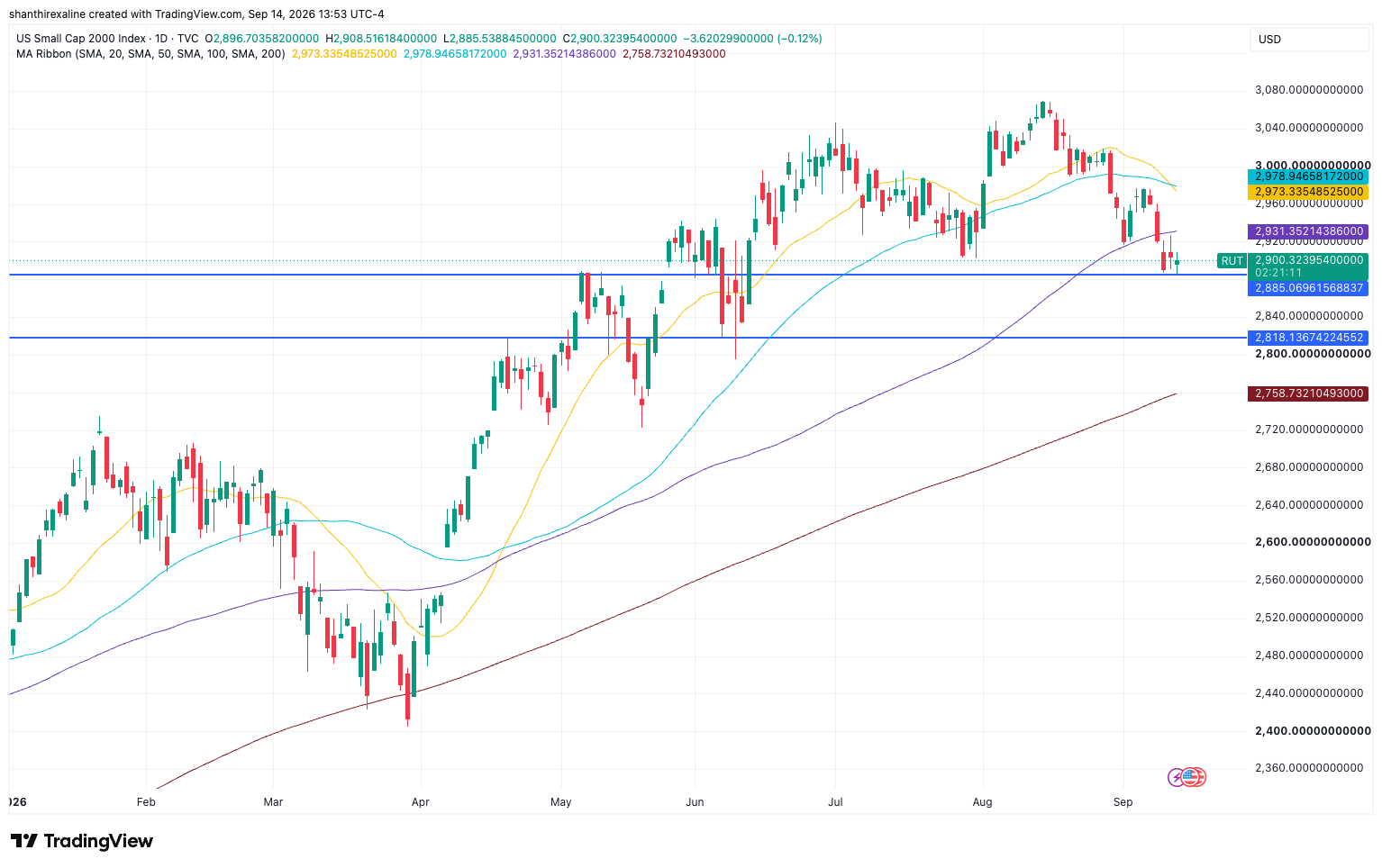
Source: TradingView
The relative-performance picture is equally important.
The Russell 2000-to-S&P 500 ratio has broken below the lower boundary of a year-long rising channel, suggesting that the period of small-cap leadership may be losing momentum.
The timing is notable. The deterioration in relative strength has emerged as Treasury yields have pushed higher, reinforcing the possibility that interest rates are once again becoming a major determinant of equity leadership.
MarketFramework's Top Traded Contracts tool shows that the seven-day lean was 'neutral.' Winners, however, were 80% short, whereas losers were 56% long. The divergence suggests that short positioning has so far been more effective, while traders betting on an upside move have been on the wrong side of the recent price action.
Higher Yields Do Not Necessarily End the Bull Market
The threat from higher yields should not be confused with a prediction that the broader equity bull market is ending.
LPL's historical analysis of Federal Reserve tightening cycles shows that stocks have often continued to rise during periods of elevated interest rates when economic growth and corporate earnings remained healthy.
What tends to change is who leads.
When yields rise, investors typically place a greater premium on companies with strong balance sheets, dependable cash flows and less reliance on external financing. That can favor larger companies over smaller businesses with greater exposure to borrowing costs.
This distinction is particularly important for the Russell 2000. The index can continue to benefit from stronger earnings while simultaneously losing its leadership position if investors decide that the additional risk associated with small caps is no longer adequately compensated.
The Next Test: Earnings Versus the Bond Yield
That leaves the Russell 2000 at an important crossroads.
The fundamental case for small caps remains intact. Earnings are improving, policy support is favorable and the U.S. economy has remained resilient. Those factors could allow the index to regain momentum if Treasury yields stabilize.
But a sustained move higher in yields would raise the hurdle for further small-cap gains.
With the 10-year Treasury yield now above 5% for the first time since 2023, investors have a more compelling alternative to taking equity risk. For small caps in particular, the competition is becoming tougher because higher yields simultaneously increase financing costs and raise the return investors can demand from stocks.
Bottom Line
The Russell 2000 entered 2026 with a powerful combination of earnings momentum, policy support and improving investor sentiment. Its next phase, however, may be determined by something outside the equity market.
The higher Treasury yields climb, the more the small-cap rally must prove that its earnings potential is worth the additional risk.
If yields stabilize, improving fundamentals could allow small caps to resume their leadership. But if the 10-year Treasury yield remains above 5% or moves materially higher, the bond market could increasingly challenge the Russell 2000 for investor capital.
For small caps, the question is no longer simply whether earnings are improving. It is