
Crude oil continues to grind higher as tensions in the Middle East show no signs of easing. The latest escalation came over the weekend, with Saudi Arabia shutting down its East-West crude pipeline following drone attacks, temporarily disrupting a route capable of carrying up to 5 million barrels per day (mb/d). More importantly, the timing for a restart remains uncertain. The development is significant because the East-West pipeline provides a vital alternative route for Saudi oil exports when shipments through the Strait of Hormuz are disrupted.
Against this backdrop, talks on establishing a temporary corridor through the Strait of Hormuz have stalled, with Gulf nations cancelling a meeting scheduled for Monday over a lack of consensus. ING Commodity Strategists Warren Patterson and Ewa Manthey said the delay pushes any prospect of de-escalation “even further out of reach.”
WTI Holds Above $104 as Oil Extends Rally
The deteriorating geopolitical backdrop has provided further fuel for oil’s rally. WTI crude oil futures (CL) climbed to a nearly four-month high of $104.95 during the European session Monday before retreating below the $104 psychological level. Brent crude futures, the global benchmark, traded near $109, up roughly 4%.
The move raises an increasingly important question for traders: Is the oil rally being supported by tightening fundamentals, or is crude simply carrying a growing geopolitical risk premium?
Supply Risks Collide With a Weaker Demand Outlook
The latest weekly Energy Information Administration (EIA) data showed the U.S. Strategic Petroleum Reserve (SPR) falling further to 285.4 million barrels, its lowest level since April 1984. Total U.S. crude oil and petroleum-product inventories were relatively stable, while domestic crude production increased. Net imports of crude oil and petroleum products, however, have moved largely sideways in recent weeks.
The demand outlook provides a counterweight to the supply concerns. In its September monthly oil market report, the International Energy Agency (IEA) cut its 2026 global oil demand forecast, now expecting demand to decline by 2.5 mb/d this year, 940,000 b/d more than its previous forecast. The agency expects the market to rebound in 2027, forecasting demand growth of 2.6 mb/d.
That divergence between oil prices and the demand outlook makes the current rally particularly important. WTI is pushing above $100 even as the IEA expects global oil demand to contract significantly this year.
If crude can sustain prices above $100 despite that weaker demand backdrop, it would suggest that geopolitical supply risks are currently overwhelming the market’s bearish fundamental signals. In that scenario, the market could be repricing the value of reliable supply rather than simply adding a temporary geopolitical premium.
$100 Could Be Shifting From Resistance to Support
For traders, the $100 level is increasingly becoming the key dividing line between a temporary spike and a potentially higher trading regime.
A sustained hold above $100 would keep the bullish structure intact and make the recent $104.95 high the next major test. A decisive break above $104.95 could open the door to another extension higher, while repeated failures around that level followed by a move below $100 would weaken the bullish setup.
The behavior of crude around these levels may therefore be more important than the initial breakout itself. If WTI repeatedly pulls back toward $100 and attracts fresh buying, the market could begin treating the level as a floor rather than a ceiling.
That would represent an important change in market structure: instead of returning to its previous range after each geopolitical headline, crude would be establishing acceptance at materially higher prices.
Speculative Positioning Shows Aggressive Bullish Bets
Managed Money (typically hedge funds and other speculative fast-money traders) turned more bullish on WTI crude during the week. They added 13,660 long contracts, while also reducing 3,790 existing short bets, according to the Commodity Futures Trading Commission’s Commitment of Traders (COT) report, signaling growing conviction in higher prices, rather than merely short-covering.
The resulting net long position of 111,731 contracts indicates speculative positioning remaining skewed bullish. It is worth noting that Managed Money’s short interest, at 5.5% of total open interest, remains meaningfully below its 11.3% long interest. The positioning points to a clear bullish bias among speculative traders, although the relatively modest short exposure suggests that further upside may increasingly depend on fresh long positioning rather than short covering.
Retail Positioning Diverges With Institutional Flow
The overall retail crowd is heavily positioned short (75%) but the traders that actually made money skewed long (60% long), according to MarketFramework’s Top Traded Contracts tool. About 59% of the losers held a short bias, which throws up the possibility of a short-squeeze as the market grinds higher.
The divergence creates the potential for additional short-covering if WTI continues to advance. A break above $104.95 could put further pressure on traders positioned against the rally, potentially adding fuel to the move.
At the same time, the positioning data suggests that the market is not simply being driven by retail enthusiasm. Institutional speculative positioning has also shifted more aggressively bullish, with Managed Money adding longs and reducing shorts.
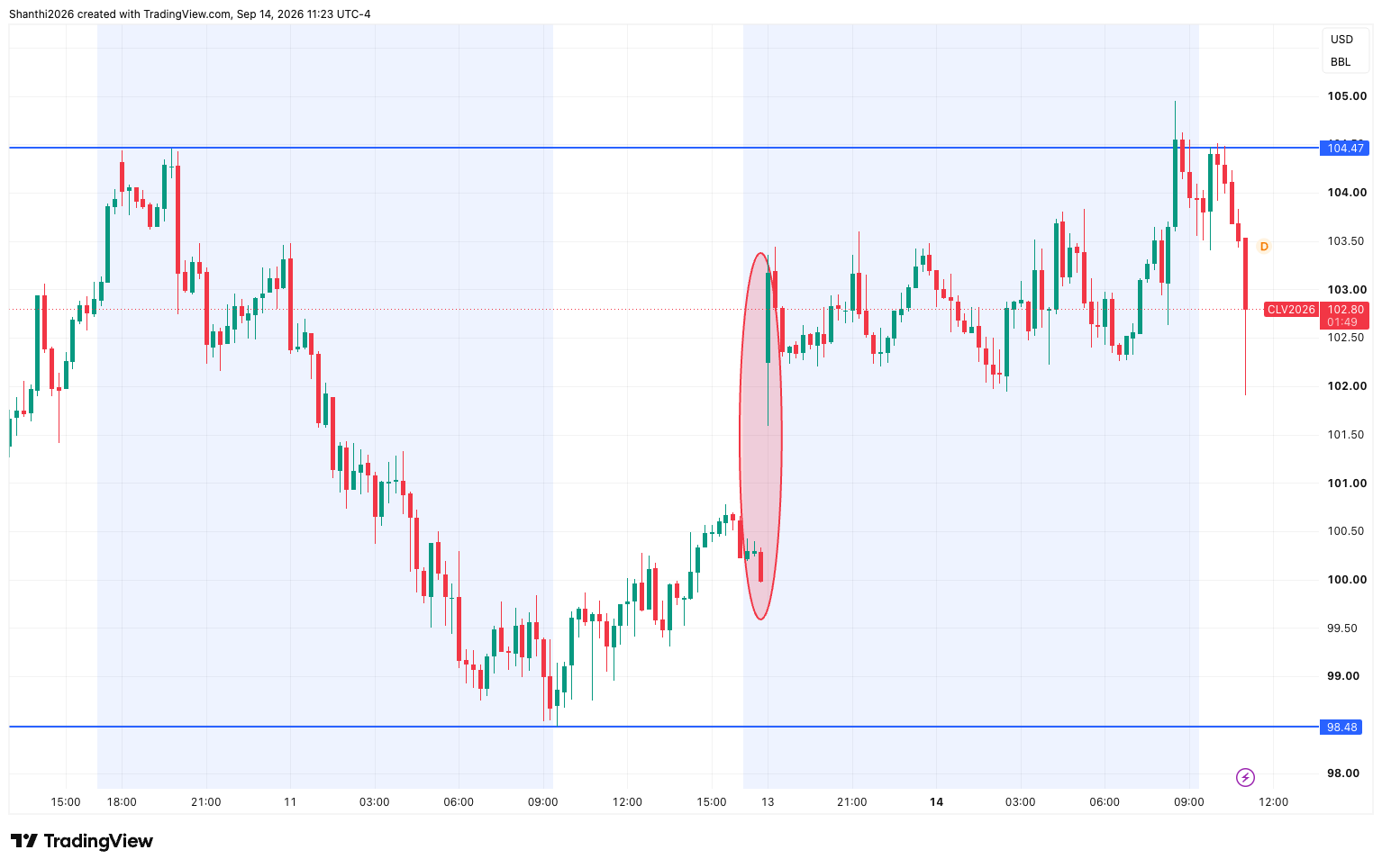
WTI’s Intraday Uptrend Hinges on the $102-$102.50 Support Zone
The M15 charts show WTI in a sharp V-shaped recovery. After topping near $104.50 on 10th, price sold off hard into a low around $98 and built a base and turned higher in a clean higher-low structure, including a clean weekend gap that hasn’t been filled. The move accelerated into a fresh high near $105 before pulling back.
It remains to be seen whether the price holds above the $102-$102.50 higher-low zone. Staying above that keeps the intraday uptrend intact and favors another push toward or above $105. But a break below would undo that structure and open a deeper pullback toward the $99.50-$100.50 base or the $98 swing low.
Source: TradingView
Is Oil Entering a New Trading Range?
The next phase of the rally could determine whether WTI is entering a structurally higher trading range or simply experiencing another geopolitical spike.
The bullish case is becoming clearer if three conditions persist: geopolitical supply disruptions remain unresolved, speculative traders continue adding long exposure, and WTI can repeatedly defend $100 on pullbacks.
Under that scenario, the recent $104.95 high becomes more than just a near-term peak. A sustained break above it could signal that the market is beginning to establish a higher range, with $100 potentially evolving into an important support zone.
The bearish counterargument is that the market is increasingly pricing a severe supply disruption while the underlying demand outlook remains weak. If geopolitical tensions ease, disrupted infrastructure returns to operation and WTI falls back below $100, the recent surge could prove to have been primarily a risk premium rather than a durable repricing.
For traders, the $100–$105 zone is therefore becoming the critical battleground. Holding above $100 would keep the higher-range thesis alive, while a decisive failure below it would raise questions about the durability of the breakout.
With WTI already pressing toward $105, the market’s next move may tell traders whether $100 was simply another resistance level to overcome or the beginning of a new floor for crude prices.