
Japan's central bank on Friday raised its benchmark interest rate by a quarter percentage point, as widely expected, although the decision was split. The Bank of Japan's (BoJ) move comes just days after the U.S. Federal Reserve delivered a quarter-point rate hike of its own.
Effective September 24, the uncollateralized overnight call rate will rise to 1.25%, its highest level in 31 years. The decision passed by a 7-2 vote, with board members Asada Toichiro and Sato Ayano arguing that it was not appropriate to raise the policy rate at this time.
BoJ Benchmark Interest Rate
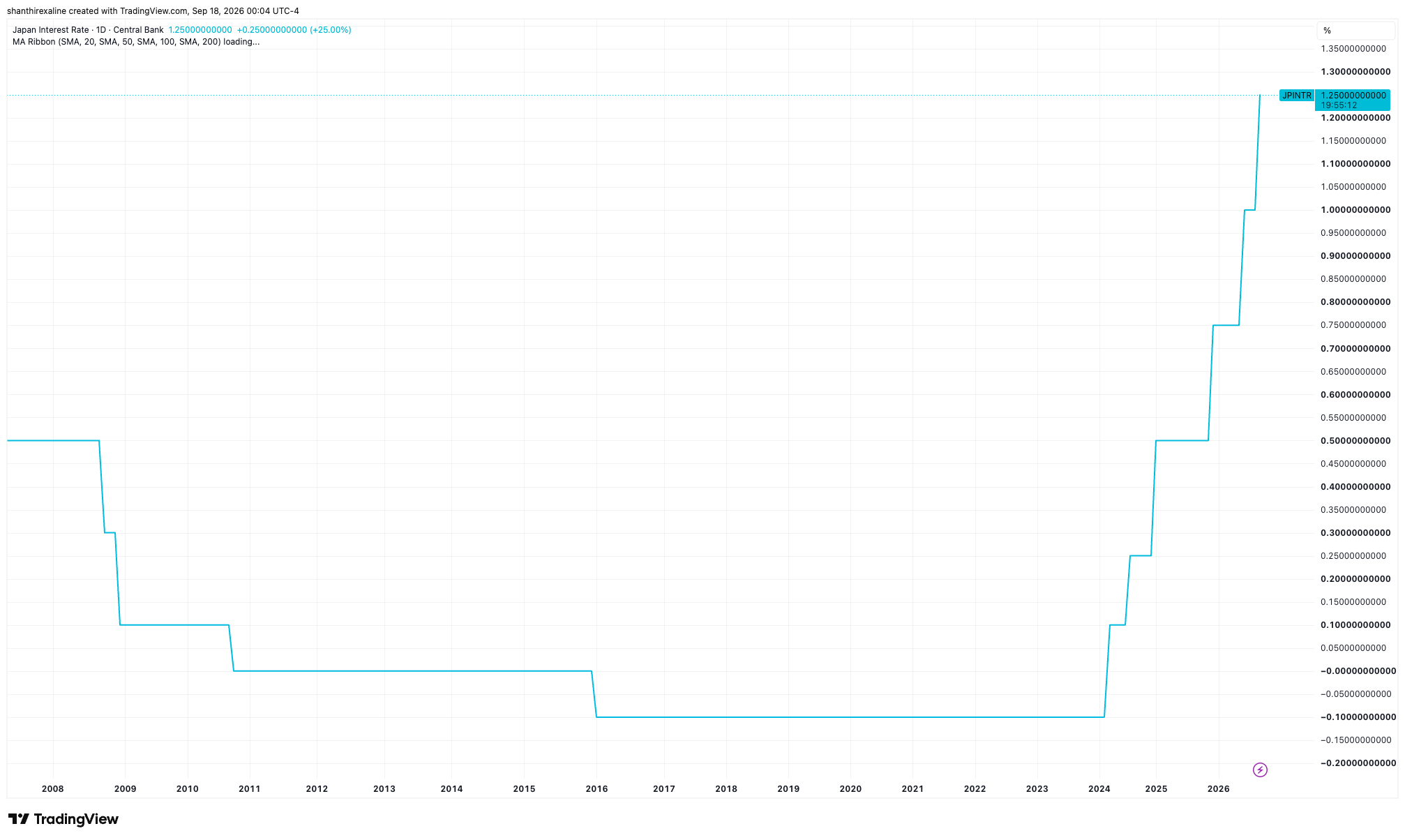
Source: TradingView
Economy Recovering, but Risks Remain
Assessing economic conditions, the BoJ said Japan's economy continues to recover moderately, although some weakness remains, partly reflecting the impact of the Middle East conflict.
The central bank expects growth to continue at a moderate pace, supported by government measures as well as rising global demand related to artificial intelligence (AI).
AI-related demand has also contributed to keeping producer price inflation elevated. Higher energy prices and the yen's depreciation have added to those pressures, while rising business-to-business transaction prices have increasingly begun to feed through to consumer prices.
The BoJ noted that companies continue to pass higher wage costs through to selling prices, helping sustain consumer inflation.
"In this situation, medium- to long-term inflation expectations have continued to rise, and underlying CPI inflation has been approaching 2 percent," the BoJ said.
The central bank also raised the risk that underlying CPI inflation could move above its 2% price stability target.
Fiscal Policy Adds to the Policy Mix
The monetary-policy decision comes as Prime Minister Sanae Takaichi's government pursues an expansionary economic agenda, including investment in strategic sectors such as AI, semiconductors and economic security.
The government's fiscal plans remain sizeable. Requests for Japan's fiscal 2027 budget have reached about 143.1 trillion yen, with the government seeking to shift more measures into the regular budget rather than relying heavily on supplementary budgets. The Finance Ministry said the increase was about 2.5 trillion yen compared with the combined benchmark of the previous supplementary and current-year initial budgets.
The government is also pursuing measures to ease the cost-of-living burden. A recently finalized plan would temporarily reduce the consumption tax on food from 8% to 1% for two years beginning in April 2027, although the funding of the measure has yet to be fully specified.
At the same time, the government has emphasized fiscal discipline, including a goal of keeping new bond issuance around 40 trillion yen and avoiding deficit-financing bonds for the proposed tax cut.
Earlier this week, the Japanese prime minister reshuffled her cabinet to help implementing fiscal policies to promote growth.
The combination of fiscal support and persistent inflation creates an important backdrop for the BoJ. Stronger government spending can support economic activity and investment, while potentially adding to demand-side price pressures. This is one factor markets will watch alongside wages, energy prices, the yen and AI-related investment.
Financial Conditions Remain Accommodative
Despite the latest rate increase, the BoJ characterized financial conditions as accommodative and said they should remain supportive of economic activity even after the policy adjustment.
That leaves the central bank with room to continue normalizing policy while monitoring how higher rates affect growth and inflation.
BoJ Keeps Door Open to Further Hikes
Looking ahead, the BoJ reiterated its intention to continue raising the policy rate and adjusting the degree of monetary accommodation in response to economic activity, prices and financial conditions.
The timing and pace of future adjustments will depend on the likelihood of achieving the central bank's economic and inflation outlook, alongside risks including the Middle East conflict, foreign-exchange developments and the evolution of AI-related demand.
Stocks Hold Gains as Yen Struggles
Despite the monetary tightening and the prospect of further rate increases, Japanese equities continued to trade with notable gains, while the yen failed to gain traction.
The Nikkei 225 average was last seen trading up 1.86% at 65,330, while the USD/JPY pair climbed 0.70% to 157.04. The yen's weakness post the decision comes after a sharply rebound in early September, which briefly fueled intervention speculation. But BoJ account data showed no official yen purchases. While there has been no confirmed direct yen-buying intervention in September, Japanese officials have maintained a heightened focus on excessive currency moves. With the yen slipping back toward 155.50 per dollar, Tokyo has reiterated its readiness to maintain orderly currency markets.
The muted yen response highlights the importance of the BoJ's future guidance. With the policy rate now at a 31-year high, markets will focus increasingly on the pace and timing of the next move rather than the size of Friday's hike.