
Updates with analyst comments and market reaction
A U.S. inflation data, called the Federal Reserve's favorite inflation gauge, came in tamer than expected in August, providing some relief to traders, burdened by elevated bond yields and higher energy prices.
But the benign inflation reading was accompanied by a stronger-than-expected private-sector hiring report, creating a mixed economic picture for the Federal Reserve as it assesses the path of interest rates.
Data released by the Bureau of Economic Analysis on Wednesday showed that headline personal consumption expenditures (PCE) inflation rose 0.3% month over month and 3.4% year over year in August. Both measures were below economists' expectations.
August PCE Vs Expectations
| Metric | August (Actuals) | Consensus | July Reading |
|---|---|---|---|
| Aug. PCE (MoM) | 0.3% | 0.4% | 0.1% (revised down from 0.2%) |
| Aug. PCE (YoY) | 3.4% | 3.7% | 3.4% (revised down from 3.7%) |
| Aug. Core PCE (MoM) | 0.2% | 0.3% | 0.1% (revised down from 0.2%) |
| Aug. Core PCE (YoY) | 3.0% | 3.3% | 3.0% (downwardly revised from 3.3%) |
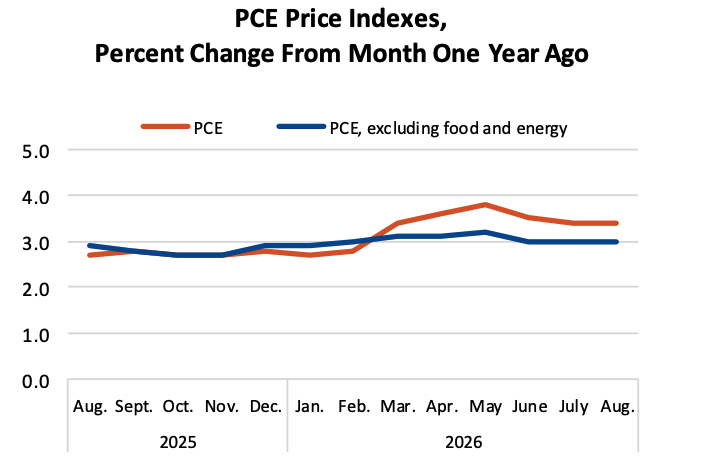
Source: BEA
Consumer Spending Remains Resilient
The cooler inflation data did not point to a sharp loss of consumer momentum. Personal income increased 0.2% month over month to $66.6 billion, while disposable personal income rose 0.3% to $68.6 billion, with the BEA attributing the gains primarily to higher compensation and government social benefits.
Consumer spending remained firm. PCE increased 0.9% to $190.8 billion, including $114.1 billion in goods spending and $76.7 billion in services.
Some categories recorded particularly strong increases. Spending on other nondurable goods climbed 24.7% year over year, while gasoline and other energy goods jumped 20.9%. Food services and accommodations, as well as motor vehicles and parts, also posted spending growth above 20%.
Spending on recreational services, by contrast, declined 10.3% year over year.
The personal saving rate stood at 4.1%, leaving consumers with some cushion even as spending remains relatively resilient.
ADP Shows Labor Market Regaining Momentum
The tame inflation data squares off against a strong labor market reading released earlier on Wednesday. Private-sector employment increased by 90,000 in September, according to ADP, accelerating from a downwardly revised gain of 36,000 in August and exceeding economists’ expectations for a 73,000 increase. The pickup was led by education and health services as well as leisure and hospitality, while financial activities and professional and business services shed jobs.
Median annual pay growth remained at 3.2%, suggesting that wage pressures are moderating but remain relevant to the inflation outlook. The ADP report does not directly measure consumer inflation, but the stronger hiring picture adds another layer to the Federal Reserve’s assessment of whether economic activity and labor demand remain resilient as policymakers weigh the path of interest rates.
Economists See Mixed Signals in Latest Inflation and Jobs Data
Early reactions to Wednesday's data releases highlighted the difficult balancing act facing the Fed While inflation remains above target, economists noted that underlying trends are not uniformly worsening, leaving the path for future rate hikes dependent on upcoming data.
Chris Zaccarelli, Chief Investment Officer at Northlight Asset Management, described the reports as sending "mixed messages" to investors. He noted that the economy continues to expand at a healthy pace while inflation remains uncomfortably elevated. Although monthly inflation readings accelerated, year-over-year measures improved, suggesting progress remains uneven.
In his view, the data support the Fed's recent rate hike, but continued improvement in inflation could allow policymakers to slow the pace of tightening or skip a meeting rather than deliver the string of hikes some market participants fear. Zaccarelli added that equities appear to be waiting for a fresh catalyst, with earnings season likely to play a larger role in determining the market's next major move.
Bill Adams, Chief US Economist at Fifth Third Commercial Bank, characterized the August PCE report as "mixed," noting that inflation was unchanged on a monthly basis while historical revisions lowered the broader trend.
Adams argued that inflation is somewhat closer to the Fed's target than previously reported, but remains well above the central bank's 2% objective. He also pointed to ongoing consumer strain, as price increases continue to outpace income growth despite revisions that lifted the personal saving rate.
From a policy perspective, Adams said the report leaves the Fed's October decision "still in play," with upcoming CPI and PPI releases, energy prices, and geopolitical developments likely to influence the next move. He added that the combination of resilient job growth and steady economic activity keeps the Fed focused on its inflation mandate despite signs of moderation in price pressures.
Inflation Relief Meets Labor-Market Resilience
The August PCE figures provide some evidence that inflationary pressure was less persistent than previously feared, particularly after the downward revisions to July. Core PCE at 3.0% year over year also came in below expectations.
But the data do not eliminate the Fed's policy dilemma.
A resilient consumer, a pickup in private hiring and still-positive wage growth could make policymakers cautious about easing financial conditions too quickly, even as softer inflation creates room to consider lower rates.
That leaves Treasury yields and the dollar particularly sensitive to how markets reconcile the two signals.
For now, the 10-year note yield recouped some of its loss, and yet was down 1.7 basis-point at 5.238%, while the 30-year yield was a tad lower at 5.593%. Gold futures augmented their gains, and were last seen trading up 1.29% at $4,233.60.
U.S. stock futures traded uniformly higher, after trading narrowly mixed ahead of the data. But MarketFramework'sPositioning Edge tool showed extreme bearish divergence for the E-mini S&P 500 futures (ES), with 28-point negative gap in long positions of profitable (35.9%) and unprofitable traders (65.6%).
The next question for investors is whether the cooler inflation data will dominate the stronger labor-market reading or whether continued economic resilience will keep rate expectations elevated.