Updates with additional insights from the BoJ's policy statement and the outlook report (12:24 a.m. ET, on July 31)
The Bank of Japan's (BoJ) Policy Board kept the benchmark interest rate unchanged for a second straight meeting of the Monetary Policy Meeting, according to a statement released by the central bank on Friday.
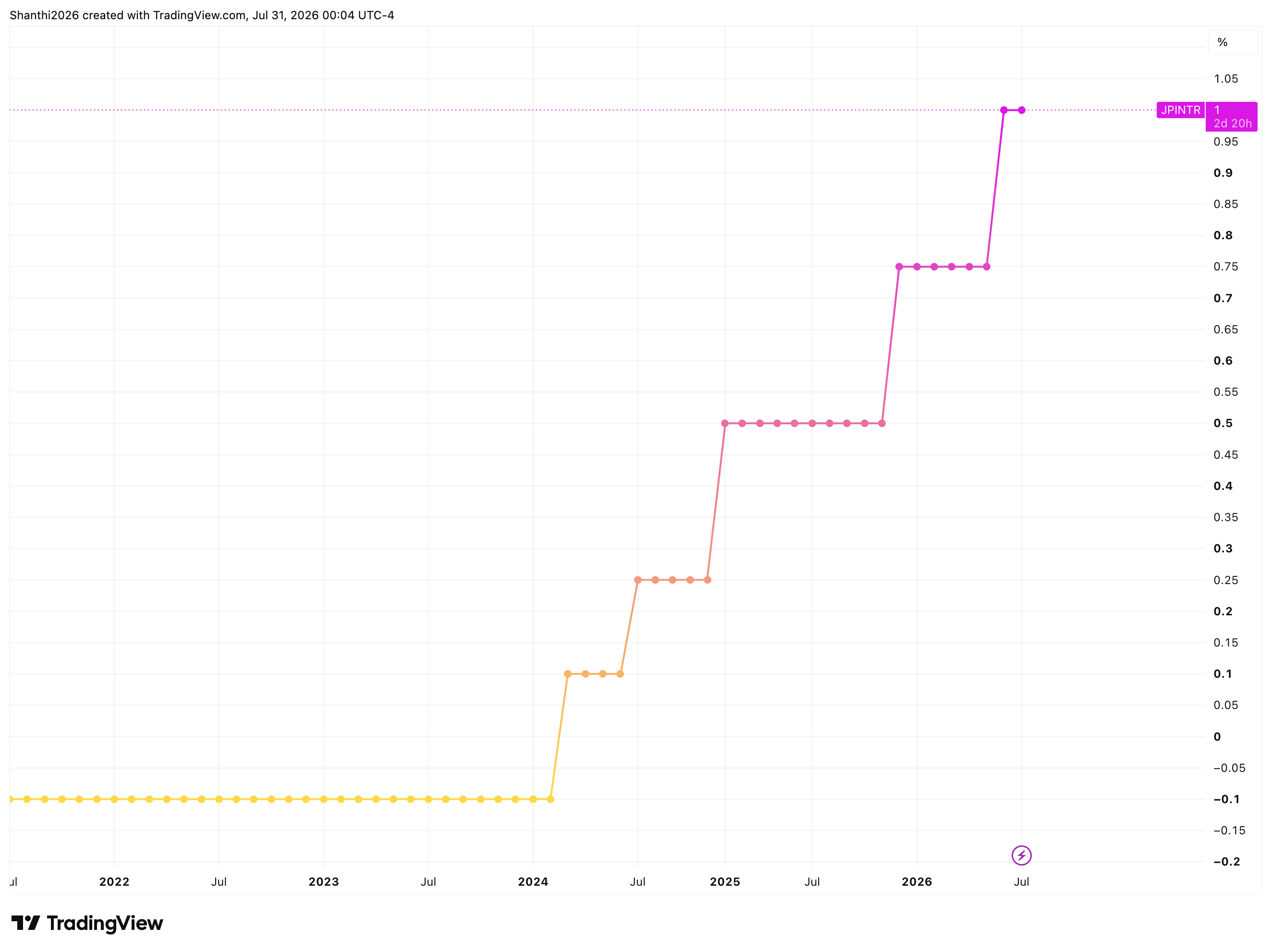
Following the conclusion of a two-day meeting, BoJ held its uncollateralized overnight call rate at 1%, in line with the consensus expectations. The decision was adopted by a 8-1 margin.
Rates on Hold
Source: TradingView
Takata Hajime , the lone dissenter, argued for a quarter-point hike to 1.25%, reasoning that that the situation had shifted to a new phase in which the Bank needs to adopt a nimble approach in response to upside risks to prices caused by demand shocks stemming from overseas developments and to changes in overseas financial conditions.
The central bank stated that it will continue to raise the policy interest rate and adjust the degree of monetary policy accommodation taking into account the economic conditions, prices and financial conditions. The bank based the timing and pace of adjustment on the likelihood of its baseline scenario (growth, inflation, and risks to outlook) being realized.
With this the four major central banks, namely the BoJ, European Central Bank, Bank of England and Federal Reserve have kept rates unchanged at their respective July meeting, preferring to wait and watch.
What Policymakers Forecast
The Bank of Japan struck a cautiously hawkish tone in its latest Outlook Report, saying Japan's economy is likely to continue growing above its potential as accommodative financial conditions support domestic demand. It expects Japan’s core inflation to rise clearly above 2% in the second half of fiscal 2026 as companies continue passing higher wage costs on to consumers. Additional upward pressure is likely from higher crude oil prices, rising semiconductor costs driven by global AI demand, and a weaker yen, which are expected to increase energy, goods, and durable goods prices.
The central bank expects underlying inflation to gradually converge toward its 2% target, with firms continuing to pass higher labor and import costs on to consumers.
The BoJ acknowledged that uncertainty remains elevated, particularly around global trade, overseas economic activity, commodity prices, and financial markets. Even so, it signaled that if the economy and inflation evolve broadly in line with its forecasts, it will continue raising policy rates gradually, reinforcing the view that Japan's tightening cycle is not over despite Friday's decision to hold rates steady.
It tinkered with the growth and inflation forecasts:
- The median year-over-year (YoY) real GDP growth forecast for fiscal year 2026 was nudged up to 0.6% from the 0.5% estimated in late April; FY27 forecast raised to 0.8% from 0.7%, and FY28 forecast unchanged at 0.8%
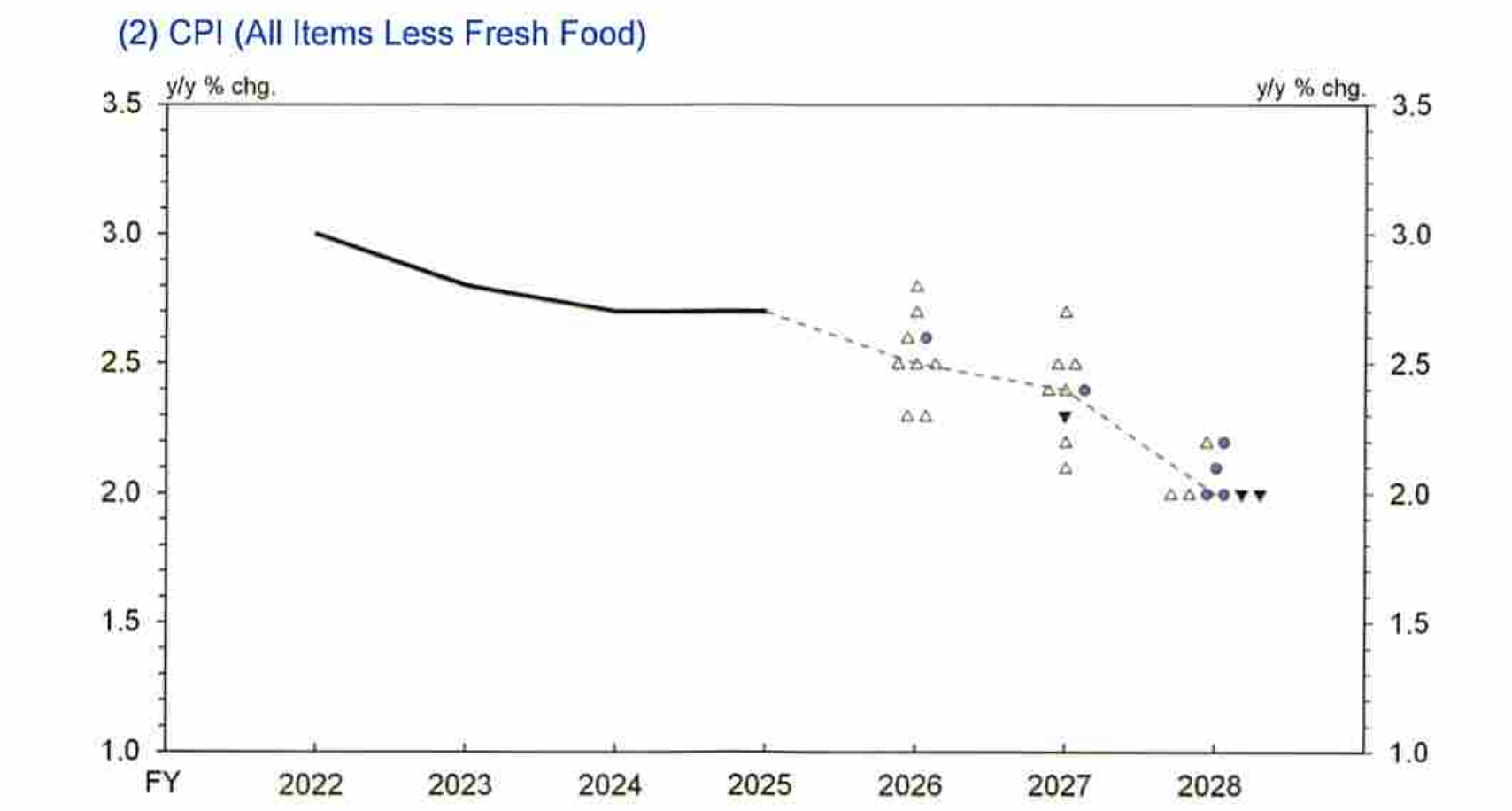
- CPI forecast for FY26 reduced to 2.5% from 2.8%; FY27 estimate raised to 2.4% from 2.3% but FY28 estimate maintained at 2%
- Core CPI forecast reduced to 2.5% from 2.6%; but FY27 and FY28 forecast maintained at 2.6% and 2.2%, respectively.
Japan Core CPI to Cool Off to Target
Source: BoJ
Intervention Rumors Provides Some Respite to Yen
The unchanged stance comes after the yen weakening against the U.S. dollar beyond 160, a level which typically invited intervention in the past. This time around, the bank allowed the yen to depreciate as low as 163.9790, the lowest in nearly 40 years. However, amid rumors of intervention by Japanese authorities, the yen recouped some of its losses on Thursday, strengthening to 157.9940 in the New York session before losing ground.
Market Leaning Short on Yen
MarketFramework's Top Traded Contracts tool. shows that 100% of losing retail positions in Japanese Yen futures (6J) over the past seven days were short — the yen has moved against short bets all week, and retail traders haven't rotated despite the losses.
CFTC data for the week ended July 21 shows professional money leaning the same way. Leveraged funds remain net short 6J (81K long vs. 177K short) and added to that short exposure over the week (+5.8K short, longs roughly flat). Asset managers, also net short (72K long vs. 152K short), trimmed longs while adding shorts. Both institutional cohorts grew more short even as the position lost money — a rare instance where retail and "smart money" positioning are aligned, and both aligned against the recent price action.
How Markets Reacted
The Japanese Nikkei 225 average, which was traded with gains in excess of 3% ahead of the rate decision, benefiting from the resumption of AI rally, pared some of the gains. Yet it trades firmer with substantial gains. The USD/JPY yen was firmer, and rangebound around the 160.70 level.