Tokyo moved first. Hours before the Bank of Japan (BoJ) gathers for a decision markets already expect to be a hold, the yen surged in a manner that screams official intervention — a deliberate one-two setup where the finance ministry does the heavy lifting and leaves Governor Ueda to supply the words on Friday.
The question for USD/JPY traders isn’t whether the intervention worked today. It’s whether anything the BoJ says tomorrow can make it stick.
The Intervention that Reset the Board
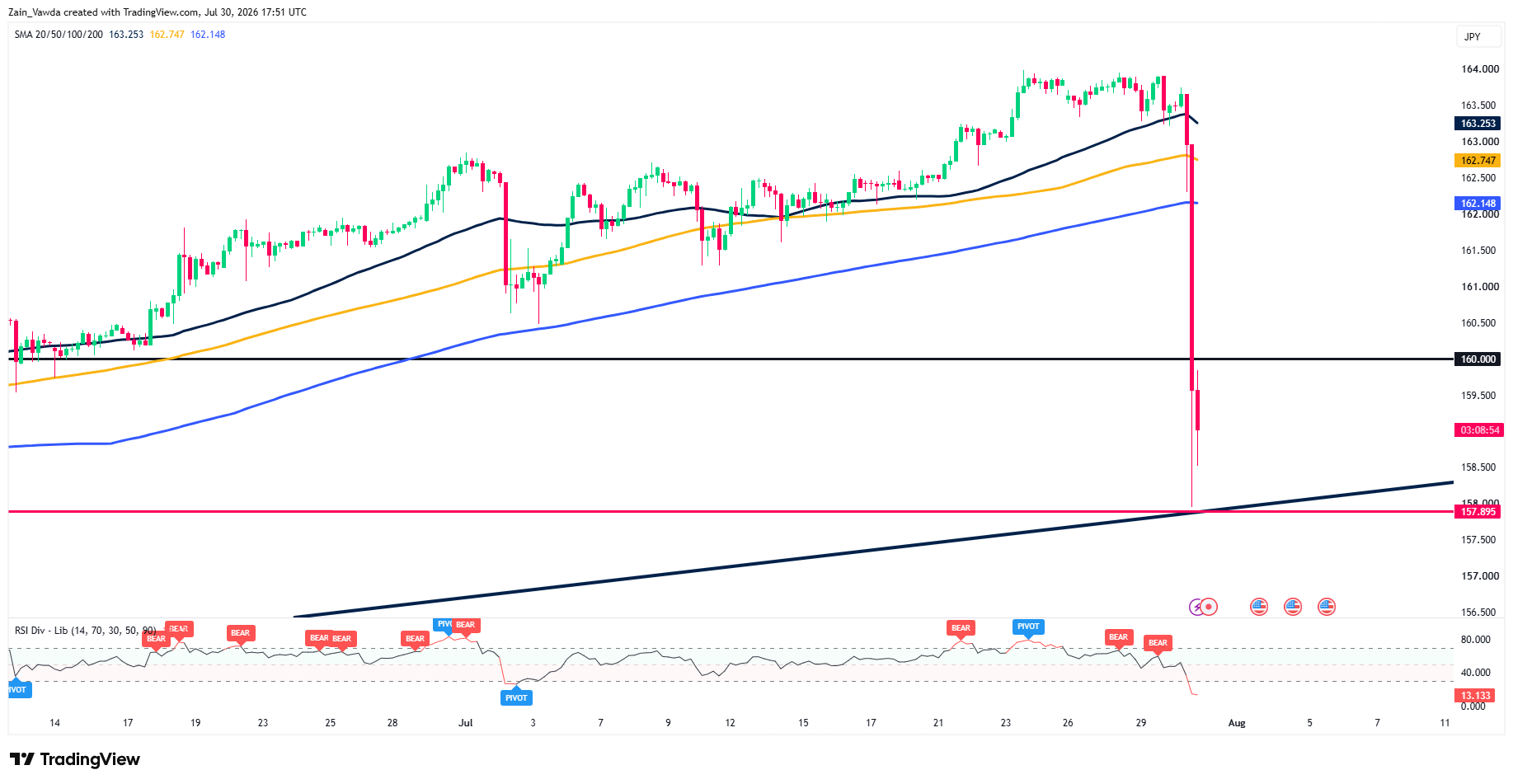
The move was violent and one-sided. USD/JPY fell as low as 157.8 and was last near 158.9, down roughly 2.5% on the day, with the yen also jumping against the euro, sterling and the Aussie — a cross-market surge that points to yen-buying, not a broad dollar wobble.
The price action gave it away: the upside was capped repeatedly before the pair broke lower, a pattern one Tokyo desk called clearly different from a routine rate check. Tactically, the timing was smart.
It would appear that rather than intervene ahead of the Fed as it did in the spring, the MoF waited for a U.S.-negative catalyst — the soft GDP print and post-FOMC dollar softness — and sold dollars into existing momentum. That is a more efficient use of ammunition than fighting the tape.
Friday’s BoJ: A Communication Event, Not a Policy One
The rate line is the least interesting part. Consensus is a hold at 1.00% after last month’s hike, so the weight sits on the quarterly Outlook Report and Ueda’s tone.
The market’s forward view is clear — 86% of a recent Reuters poll expect a 25bp move to 1.25% by year-end, with the next hike seen in October or December and the Takaichi government’s pressure cited as a reason to wait.
So the entire yen reaction hinges on one thing: does Ueda validate October, or does he let the timeline drift? A hawkish nod amplifies today’s intervention; a cautious hold hands the structural bulls their entry back.
Why the Structural Bias Still Points Up
Here is my core view: intervention resets the level, not the trend. Every driver that dragged USD/JPY to 40-year lows is intact — a wide US–Japan rate gap that a hawkish Kevin Warsh Fed just widened, with a September hike still better than a coin-flip, and an energy-import terms-of-trade shock as the Hormuz premium keeps crude bid.
The spring campaign is the cautionary tale: the MoF spent a record ¥11.73 trillion, about $72 billion, and the pair was back above the intervention level within six weeks; the ¥162 line the market once respected was later breached with no response at all.
Firepower isn’t the constraint — reserves sit near $1.09 trillion — conviction and the rate differential are. Unless the Fed turns or Brent rolls over, dollar-yen dips remain structurally supported.
Levels and the Forecast
The post-intervention pivot is 157.8–158.6; below it, 155 is where the market will test whether Tokyo means it.
USD/JPY Four-Hour Chart, July 30, 2026
Source: TradingView
To the upside sit 160 (psychological and the presumed defence zone), the pre-intervention 163–164 shelf, and 165 as the tail. My base case: a volatile Friday, a BoJ hold, and an Ueda cautious enough to disappoint the October-hike camp — leaving USD/JPY to stabilise in a 158–161 band into the decision before the structural bid reasserts and rallies back toward 162–164 get bought over the following weeks.
Scenario Matrix — Keyed to Friday’s BoJ Decision

Source: Created by Zain Vawda Using Canva
I’m structurally bullish USD/JPY; the intervention is a speed bump, not a reversal. What flips that view: a genuinely hawkish Ueda, a sustained MoF defence that holds sub-155, or a real drop in oil — any one of which would let the yen’s recovery finally hold.