Just when equity investors seemed comfortable betting on resilient growth, cooling inflation, and an artificial intelligence (AI)-powered earnings boom, the bond market has reasserted itself.
Treasury yields have been on a volatile round trip since the Fed's July 29 decision. The 10-year jumped to an 18-month high near 4.747% in the days after the Fed held rates steady for a fifth straight meeting. The hold wasn't unanimous, with three regional presidents dissenting in favor of an immediate hike, the first time since September 2016 that three FOMC members have lined up behind the same directional dissent.
The whiplash matters because it's happening while U.S. equities sit near record highs. For months, investors mostly shrugged off rising yields, on the logic that explosive AI-linked earnings growth would more than offset a higher discount rate. That assumption is now being tested in real time, one Fed headline at a time.
Warsh, Cook change the conversation
The latest leg higher in yields traces to a cluster of hawkish signals from Fed officials this week, layered on top of a Committee that was already split.
A Financial Times report, citing people familiar with the matter, said Warsh remains focused on restoring price stability and is prepared to tighten further if inflation doesn't show convincing progress. The FT also reported that Warsh intends to stick with his deliberately brief, low-guidance communication style even after the market backlash that followed the July meeting, despite privately acknowledging some early missteps.
Fed Governor Lisa Cook added to the hawkish tone in an Anchorage speech Wednesday, saying she is ready to support a rate hike if inflation doesn't ease. Cook, who voted for July's hold, said she now sees the risk to the inflation side of the Fed's mandate as greater than the risk to employment, and warned the Fed may not have the luxury of waiting much longer.
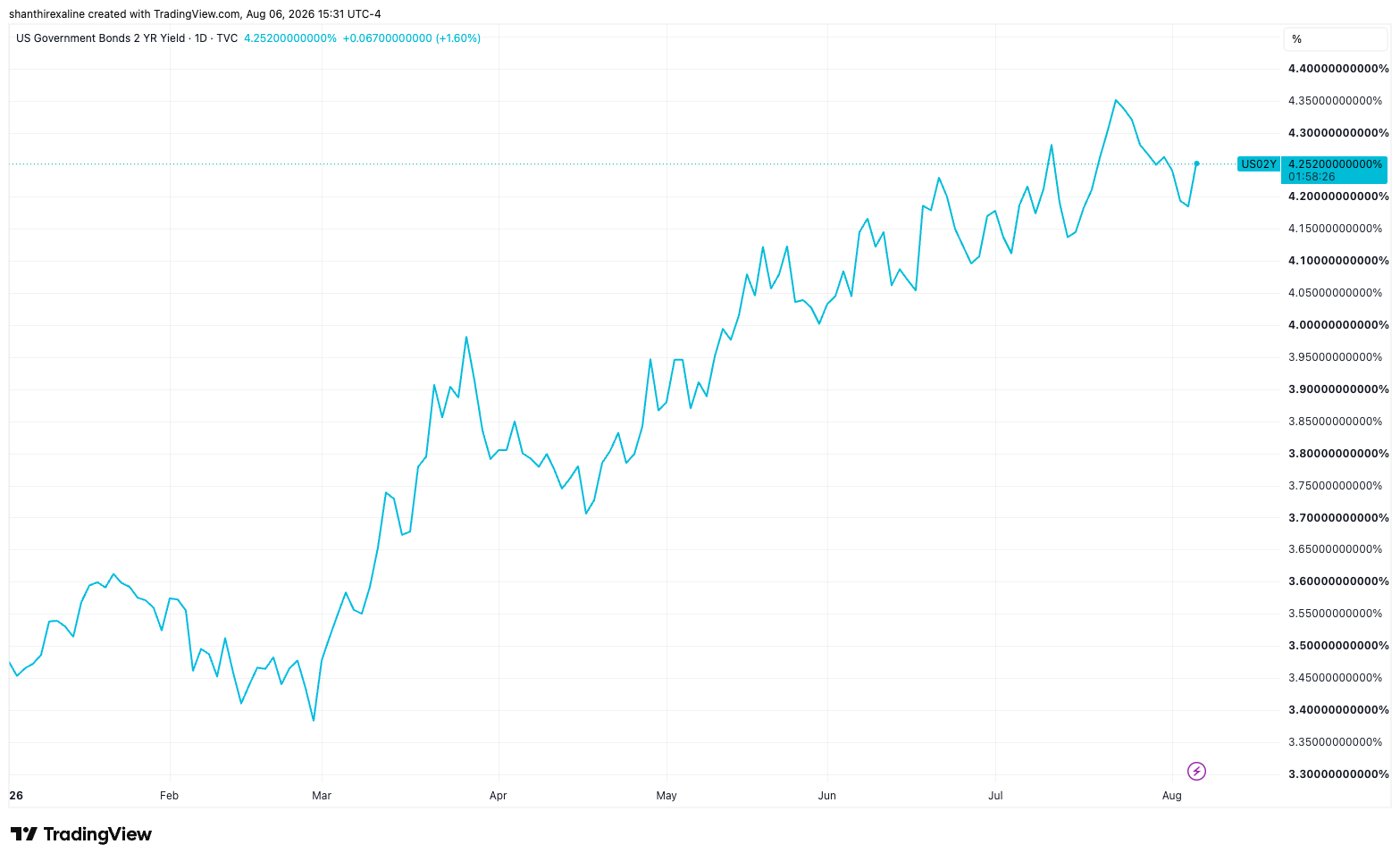
The combination landed in a market already uneasy about inflation. The two-year yield, the part of the curve most sensitive to near-term policy expectations, moved in step.
Source: TradingView
For much of 2025 and early 2026, strong economic data was read as straightforwardly bullish, good for earnings, good for stocks. That relationship is breaking down. Strong data now carries a second, competing implication: it may keep the Fed restrictive for longer.
The AI trade meets its biggest test yet
The timing is inconvenient for the market's biggest winners, and it's landing in the middle of an unusually strong earnings season. More than 60% of S&P 500 companies have reported Q2 results, and FactSet data through July 31 showed the blended earnings growth rate for the quarter at 47.4%, the highest since Q2 2021, with 86% of reporting companies beating EPS estimates, also a post-2021 high. Even stripped of the outsized surprises from Alphabet and Amazon, growth still runs at a healthy 28.8%, and net margins are running at their highest level in more than fifteen years. That's the case bulls are making for why stocks can absorb higher yields: the earnings backdrop has rarely been stronger.
But tech valuations are unusually sensitive to Treasury yields, since so much of their value is priced off cash flows years in the future. As yields rise, those future earnings get discounted harder in present-value terms — a relationship that isn't new, but one that starts to bite more as yields push toward the top of their recent range. Investors become less willing to pay premium multiples for a growth story and start demanding delivered returns instead of a roadmap. Notably, even with blended earnings growth surging, the S&P's forward P/E has actually eased to 19.6 from 20.4 at the end of June — a sign the market is already demanding more earnings per point of multiple, not less.
Put simply: the next phase of the AI trade may hinge less on which company tells the best story and more on which one can show the fastest realized return. As long as earnings keep beating expectations by this margin, equities can absorb higher yields. If profit forecasts start to flatten while yields keep climbing, valuation pressure could show up quickly. And analysts are already projecting growth to decelerate to 27.4% in Q3 and 25.2% in Q4, a reminder that Q2's pace isn't guaranteed to hold.
There's a notable counterpoint to that caution, though. Despite the run-up in oil prices tied to the Iran situation, typically the kind of input-cost shock that gets analysts trimming forecasts, FactSet data published Thursday shows the opposite happening. Analysts raised the Q3 bottom-up EPS estimate for the S&P 500 by 0.3% in July, only the second consecutive quarter that this has happened and the fourth time in five quarters; the historical norm is a decline of roughly 1–2% in a quarter's first month. Full-year 2026 EPS estimates rose 3.2% over the same stretch.
Why Friday's jobs report matters so much
That backdrop is what makes Friday's payrolls report unusually consequential.
A stronger-than-expected print would normally read as good news, a proof the economy can handle higher rates. This time, traders are likely to look at the bond market's reaction first. Robust hiring or firmer wage growth could push yields higher still, reinforcing the case Cook, and now reportedly Warsh have been building for a September hike, and pressuring the highest-multiple tech names in the process.
A softer print could work the other way, easing yields and giving growth stocks a tailwind, much as Wednesday's weak ADP number did before Thursday's Fed headlines reversed the move. But even that relief may prove temporary if inflation data stays sticky and Fed officials keep floating tightening regardless of what payrolls shows.
Heading into payrolls day, the more consequential contest may not be bulls versus bears. It may be earnings versus the bond market.
MarketFramework's Positioning Edge tool shows no clear positioning edge in Nasdaq E-mini (NQ) futures. Both profitable and unprofitable traders are evenly split, each holding 50% long exposure, suggesting neither bulls nor bears currently have a decisive positioning advantage ahead of Friday's payrolls report.


