Premarket weakness in two AI-infrastructure stocks is doing more than punishing a single sector; it's revealing just how little room for error is left in the broader Nasdaq trade heading into one of the most closely watched economic releases of the year.
The Setup: A Beat That Wasn't Enough
SanDisk (SNDK) and Western Digital (WDC) both delivered earnings that, on paper, should have been celebrated. SanDisk's fourth-quarter revenue beat consensus by roughly 7%, and adjusted earnings topped estimates by nearly 14%. Western Digital posted similarly strong operational results. Neither company missed. Neither company disappointed on demand.
The market sold both anyway.
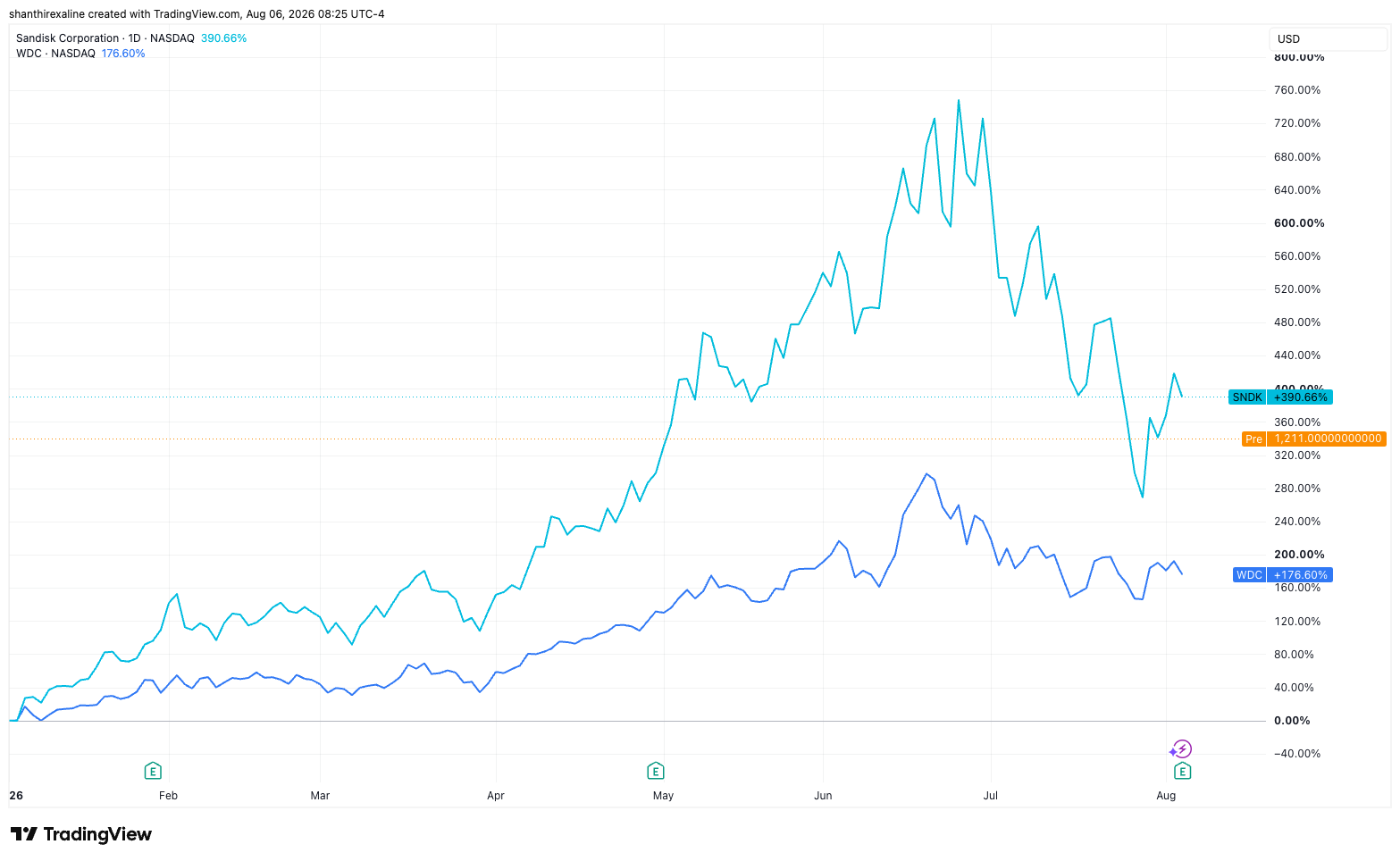
WDC shares fell nearly 15% in premarket, and SNDK, still up roughly 470% year-to-date heading into the print, saw its premarket indication drop more than 10%.
SNDK Vs. WDC: YTD Returns
Source: TradingView
The selling wasn't isolated. It spilled into peers including Micron and SK Hynix, turning a two-company earnings reaction into a sector-wide repricing. This is not a demand story. It's a valuation story. Both stocks had run so far, so fast, that "strong" guidance wasn't enough — the market wanted acceleration, not confirmation. When it didn't get it, investors took profits aggressively.
Wall Street Isn't Buying the Panic
Not everyone reads this week's storage selloff as a warning sign. Morgan Stanley's semiconductor team held its bullish stance on the space through both prints, with SanDisk analyst Joseph Moore reiterating Overweight and calling the September guide "overly conservative" — noting SanDisk has guided below consensus in the June quarter before beating it. His read: this is "literally the healthiest NAND market" seen in 20 years, and the stock's drop reflects a valuation reset against sky-high buy-side expectations, not any crack in underlying demand.
Morgan Stanley's Erik Woodring struck a similar tone on the hard-disk side, keeping his bullish thesis on Western Digital intact despite the stock's sharper post-earnings drop. He points to nearline drive supply being sold out through 2028 and long-term agreements now being negotiated out to 2031 as evidence the upcycle has real staying power, and argues consensus estimates across the group remain too conservative. His one flag:
WDC's growth lagged peer Seagate this quarter — nearline exabyte growth of 23% year-over-year versus Seagate's 42%, and slower cost cuts and margin expansion — which he attributes mainly to the timing of customer orders and product ramps rather than any structural weakness. He expects WDC's growth to reaccelerate above 30% in late 2026 or early 2027 as its newer high-capacity drives ramp, and raised his price target to $676 while maintaining an Overweight rating, though he continues to prefer Seagate tactically.
Why Thursday’s Move Matters Beyond Memory Chips
The read-through for the Nasdaq 100 (NDX) and its futures contract (NQ) is bigger than two storage companies. Memory and storage names have been among the cleanest, most tangible proof points of the AI infrastructure buildout — actual delivered revenue, not just capex promises. If stocks with genuine, already-realized demand can't clear the bar the market has set, it raises a harder question for the rest of the AI-linked complex still carrying stretched valuations off similar 2026 rallies.
It's worth being precise about what's actually happened versus what's still pending. The SNDK/WDC reaction so far reflects premarket positioning — the cash session has not yet confirmed how deep or how contained that selling will be once the broader market, not just futures traders, gets a chance to react.
The Bigger Catalyst: Friday's Jobs Report
That uncertainty collides with a second, unrelated risk event: Friday's Employment Situation report, covering July payrolls, due at 8:30 a.m. ET.
The labor market has already shown signs of cooling. June's report added just 57,000 jobs, well below the 110,000 expected and the weakest reading in four months, with the two prior months revised down by a combined 74,000. A soft July number would extend that trend right as markets are digesting a fresh bout of AI-valuation anxiety.
The interaction between these two forces is what makes this week's setup genuinely uncertain rather than a simple one-way trade:
A weak NFP print could reinforce expectations for a pause ahead of the September Fed meeting — normally a tailwind for growth stocks even as the futures market currently prices a nearly 57% odds of rate hike at the meeting. But if risk appetite is already shaken from the memory-sector selloff, soft jobs data could just as easily be read as confirmation that broader economic growth is slowing, compounding rather than offsetting this week's tech jitters.
A stronger-than-expected NFP print cuts two ways, and which one dominates isn't obvious in advance. On one hand, it could ease growth-slowdown concerns and let markets treat the SNDK/WDC reaction as an isolated, sector-specific repricing rather than a signal about tech more broadly — reinforcing that the economy, and by extension corporate demand, remains on solid footing. On the other hand, a hot print could lift rate-hike expectations, ahead of the September Fed meeting/
Rate hikes tighten financial conditions, pressuring the same high-multiple growth names already under pressure from this week's valuation reset — compounding rather than offsetting the selloff.
In other words, a beat doesn't cleanly resolve the picture for NQ. Whether Friday's number acts as reassurance or as a fresh headwind depends on which narrative — "growth is fine" versus "rate hikes are close at hand" — dominates the market's read.
What Traders Are Watching
For NQ traders, the next 24 hours effectively contain two separate, stackable catalysts: how the cash market actually absorbs the memory-chip selloff once regular trading confirms or fades the premarket move, and how the labor market data reshapes the rate-path narrative heading into September. Neither has fully played out yet — which is exactly what makes this week's setup worth watching rather than assuming.
Retail positioning remains modestly bullish in NQ futures, with profitable traders showing a noticeably stronger long bias than their losing counterparts, according to MarketFramework's Positioning Edge tool. This is a sign that conviction in a tech rebound has not fully faded despite recent selling pressure.


