Precious metals are catching a bid Friday as fresh tariffs and a still-elevated oil market revive the inflation trade, but the two metals aren't moving in lockstep. Silver is running hot; gold is barely budging. That gap says more about what's coming next week than either move does on its own.
The Numbers: A Shared Trade, Different Conviction
Silver is up nearly 2% on the session, trading past $59 an ounce. Gold is higher too, but only by less than half a percentage point — August futures opened around $4,053 and ticked up to about $4,070, a 0.48% gain that leaves the metal still below Thursday's brief push above $4,100.
Both are responding to the same backdrop: new Section 301 tariffs of 10%-12.5% now in effect across 60 trading partners, oil that flirted with $100/barrel this week before pulling back, and a dollar holding firm as traders weigh inflation risk against growth drag. But silver's sharper move suggests it's acting as the higher-beta expression of that trade, while gold is holding back.
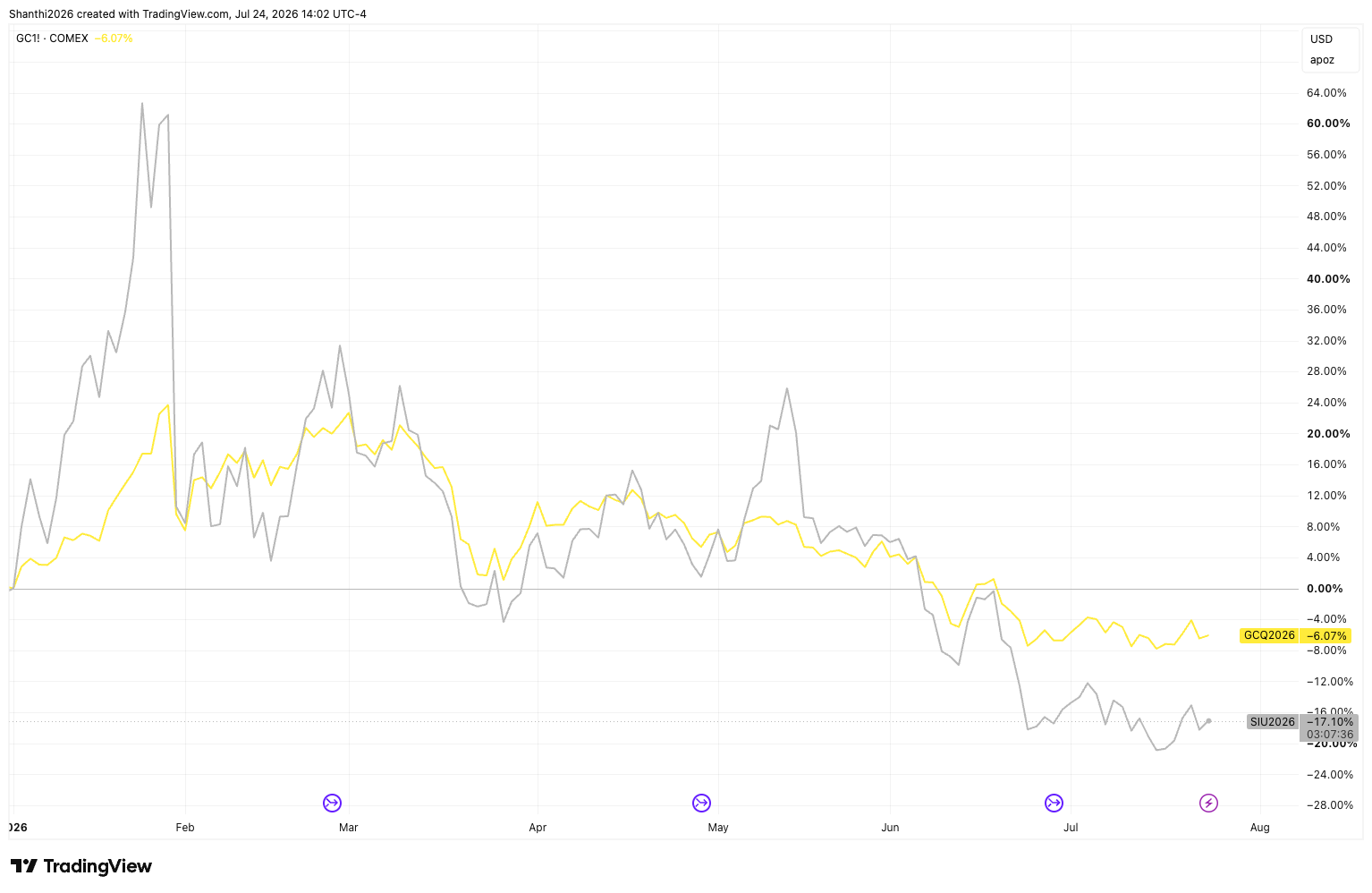
The year-to-date performance shows both metals have lost their luster, with gold faring not as worse as silver. They have come off their respective all time highs scaled in January this year.
Silver Vs. Gold: Which Shone the Brightest This Year
Source: TradingView
Why Silver Has More Room to Run
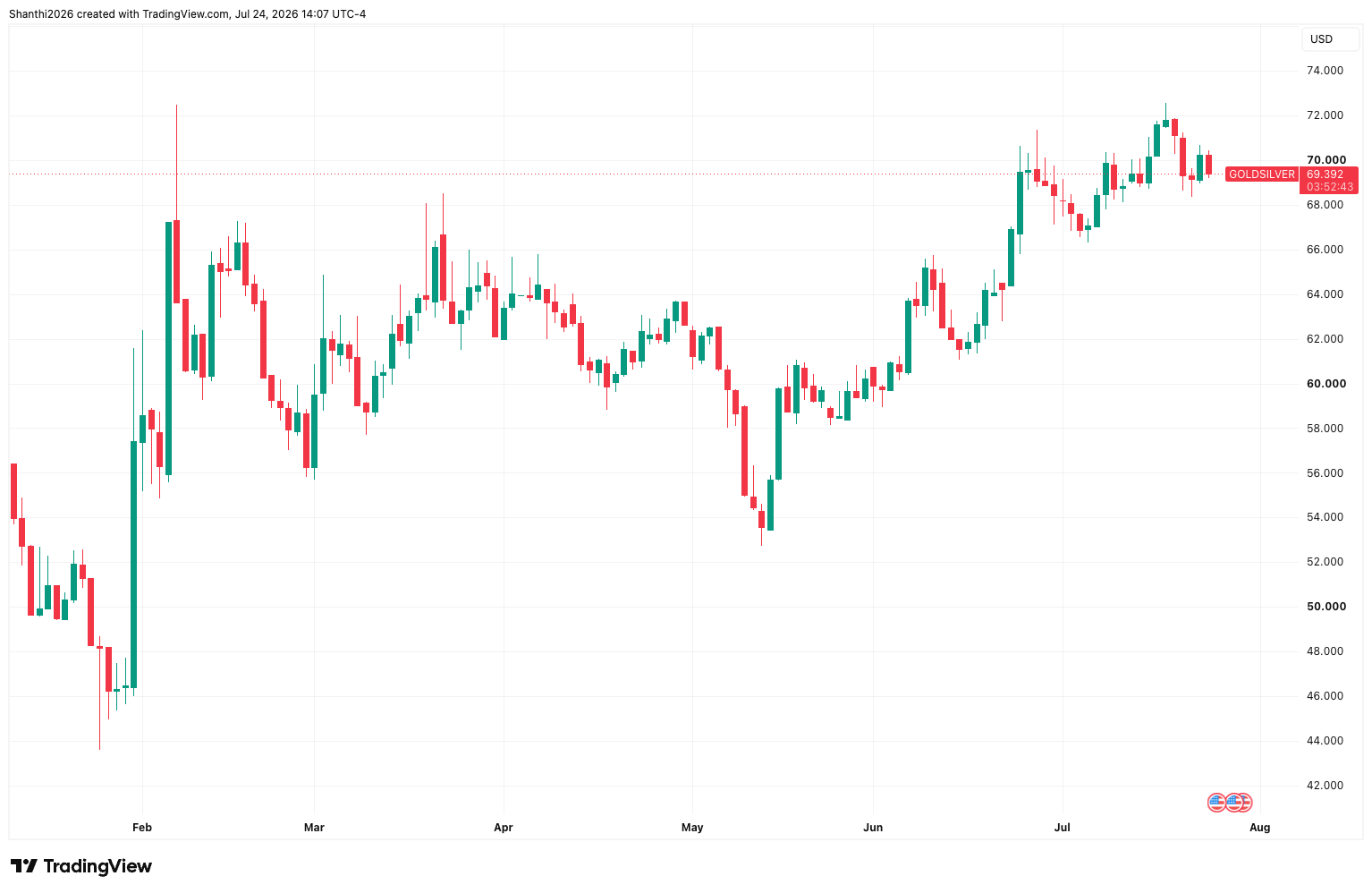
Part of the answer is the gold-silver ratio, which sits near 69:1 — well above the roughly 52:1 level it touched back in May. A ratio this stretched historically signals silver is cheap relative to gold, and any convergence tends to favor silver outperforming on a catch-up basis rather than gold cooling off.
Rising Gold/Silver Ratio
Source: TradingView
There's a structural piece too. Silver's supply deficit has continued to widen even through this year's sharp price correction — the metal is still down about 50% from its January all-time high. That combination of a tightening physical market and a stretched ratio is why some institutional forecasts for silver averaging well above $80 an ounce this year, remain far above current spot levels despite the pullback.
Silver's dual identity also cuts in its favor right now: it's both an inflation hedge and an industrial metal, with industrial uses making up more than half of total demand. That means it can catch a bid from the same tariff-driven inflation narrative lifting gold, while also drawing support from resilient industrial and green-tech demand that hasn't yet shown clear signs of tariff-related damage.
Why Gold Is Holding Back
Gold's muted response points to a market that isn't fully convinced tariffs alone will force the Fed's hand. That's a fair read given this week's labor data — jobless claims came in well below forecast, a signal of labor-market strength that cuts against the case for a dovish Fed pivot.
Markets are currently pricing a relatively low probability of a rate move at next week's meeting, with odds of a move later in September running much higher. That's the real reason gold is stuck in a range: real yields, not tariff headlines, are the metal's dominant driver right now, and the market is waiting for the Fed rather than trading the trade war.
The Real Test: July 28–29 FOMC
Next week's Federal Reserve meeting is the event that will determine whether this week's tariff-driven bid in precious metals has staying power. The meeting doesn't come with a fresh Summary of Economic Projections, which limits how much forward guidance the Fed can offer. But the tone of the statement and press conference will still shape real-yield expectations heading into September, when the odds of a move are considerably higher.
If the Fed leans hawkish on the back of resilient labor data and tariff-driven inflation risk, gold's range-bound behavior could persist or even reverse, while silver's industrial-demand exposure would make it more vulnerable to a growth-scare repricing. If the Fed instead acknowledges tariffs as a fresh, durable inflation input — a fair characterization given Section 301's more permanent legal footing versus the emergency tariffs it replaced — real yields could ease further, and that's the scenario where silver's current outperformance extends rather than fades.
Scenario Analysis: Gold & Silver Into Next Week
| Fed Meeting Outcome | Gold's Potential Move | Silver's Potential Move |
|---|---|---|
| Hawkish Hold | Muted-to-lower; real yields firm, range stays capped below $4,100 | Pulls back hardest — industrial-demand leg gets hit alongside gold's safe-haven leg |
| Neutral Hold | Sideways, $4,000-$4,150 range persists | Continues to outperform gold modestly on mean-reversion and inflation-hedge flow |
| Dovish Hold/Signals rate cuts | Breaks above $4,100, extends toward $4,200 | Outperforms sharply — both legs (inflation hedge + rate-cut beneficiary) fire at once |
| Surprise Hike | Sharp drop, tests $3,900-$3,950 | Drops even harder given industrial-demand sensitivity to a growth scare |
What to Watch
- FOMC statement and press conference, July 28–29: the tone here matters more than any single data point this week.
- Gold-silver ratio: a move back toward 55–60:1 would confirm the mean-reversion trade; a push higher would suggest gold's safe-haven bid is reasserting itself.
- September rate-hike odds: currently running well above the odds for next week — any shift here will move both metals quickly.
- 10-year yield near 4.7%: the pivot level that's already been shaping this week's cross-asset moves in equities, oil, and now metals.
- Industrial demand signals: any tariff-related guidance cuts from electronics or green-tech names would test silver's industrial leg directly.