The U.S. dollar is weaker across the board Thursday morning as traders brace for the all-important monthly jobs report for June. The U.S. Dollar Index (DXY), which tracks the greenback against a basket of major currencies, slipped 0.35% on the day. Despite the decline, the index remains up 2.8% year-to-date (YTD), underscoring the dollar's broader strength in 2026.
Despite its gains, the dollar's resilience is about to face its biggest challenge yet as investors await the June non-farm payrolls (NFP) report, a data release that could reshape interest-rate expectations and determine the next move in the greenback.
The data assumes importance given the softness suggested by recent jobs reports, which have confirmed a “low hire-low fire” environment. The week started with the release of the Job Openings & Labor Turnover Survey (JOLTS) report for May, which showed job openings remaining steady at a two-year high.
Data from outplacement firm Challenger, Gray & Christmas released Wednesday showed announced layoffs falling to 45,849 in June, the lowest monthly total since December 2025. However, the technology sector, which has been a key driver of the stock market's recent rally, continued to shed workers at a notable pace, accounting for the largest share of job cuts during the month. ADP’s June private payrolls report, which may have the strongest directional correlation to the NFP report, showed subpar job growth.
According to MarketFramework data,the 6E contract (based on EUR/USD) is the most actively traded forex contract over the past seven days.
How June Payrolls Could Swing the Dollar's Next Move
The U.S. economy may have seen a cool off in job growth in June following strong , according to the consensus estimates. With interest-rate expectations hanging in the balance, investors will be scrutinizing the following data points from the June NFP reportfor clues on the Fed's next move:
Key Numbers Traders are Watching
| Consensus (June) | May | April | March | |
|---|---|---|---|---|
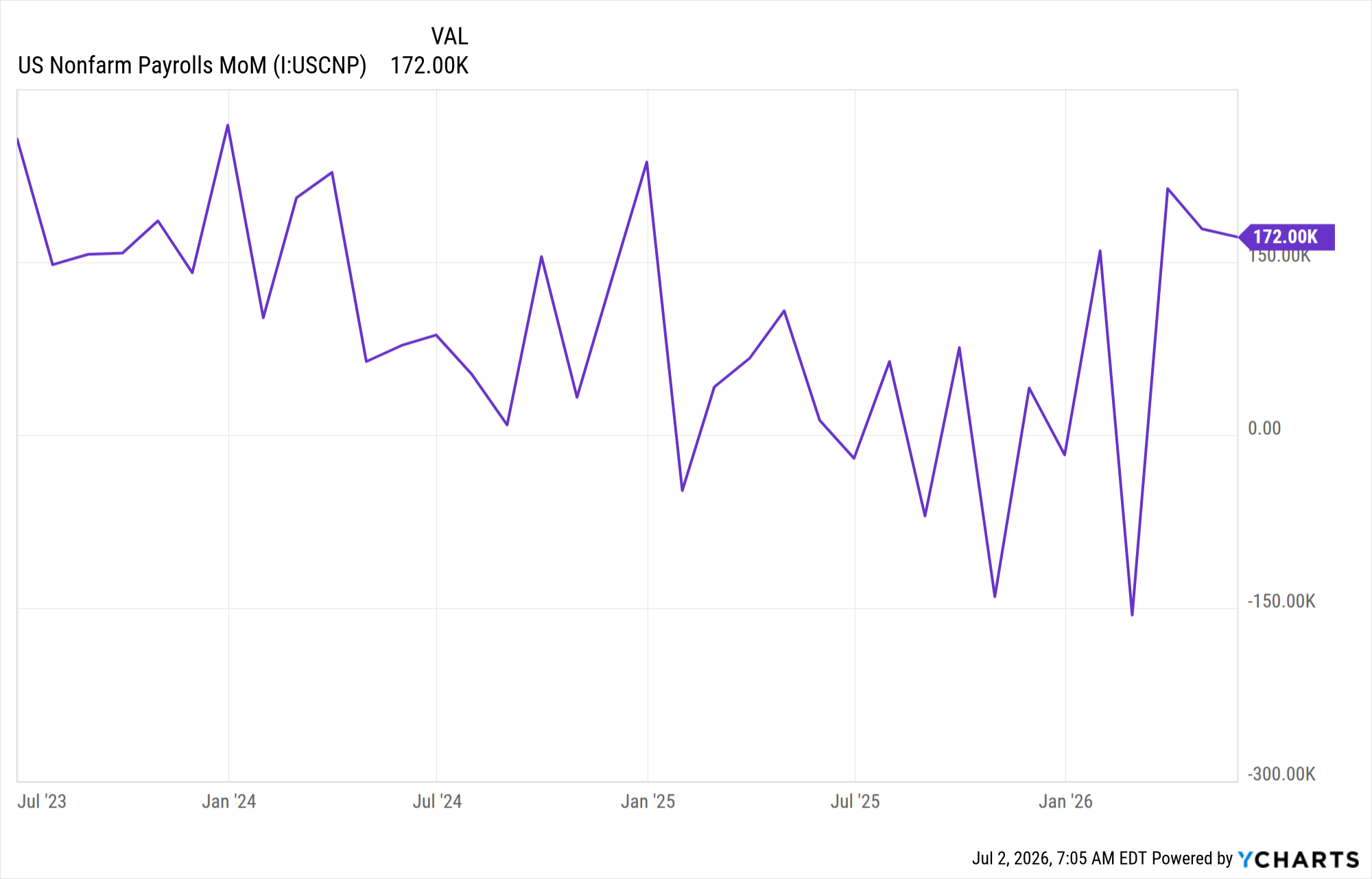
| NFP Payroll Change | +114,000 | +172,000 | +179,000 | +214,000 |
| Revisions to Gains (Previously Announced) | — | — | +64K | +29K |
| Jobless Rate | 4.3% | 4.3% | 4.3% | 4.3% |
| Average Hourly Wage Growth (YoY) | +3.5% | +3.4% | +3.6% | +3.4% |
US Non-farm Payroll Change
Source: Y Charts
What the Fed Is Actually Watching
The stakes behind today's print go beyond a single headline number. New Federal Reserve Chair Kevin Warsh has explicitly moved the central bank away from forward guidance toward a data-dependent framework, telling reporters after his first Federal Open Market Committee (FOMC) meeting in June that the Fed "will decide" on rates based on incoming data .
That shift puts outsized weight on releases like the jobs data. The next concrete test of that framework comes at the July 29 FOMC meeting, and markets have been pricing meaningfully for a hawkish outcome: as of this week. CME FedWatch data show:
- roughly a 34% probability of a 25-basis-point hike as early as July up sharply from just 6% odds in early June
- Roughly 62% probability of a hike in September (48.3% for 25bps and 13.5% for 50 bps)
- probability of at least two hikes by year-end sitting just under 40%.
Traders’ interest is less on whether the report confirms the Fed's hawkish tilt and more on whether it gives Warsh cover to validate what the market has already bet on, or forces a rapid repricing in the other direction.
How will the traders read these numbers and their implications for the Federal Reserve’s policy pathway? How will the outcomes impact the dollar?
Scenario Analysis
| Job Metrics | Market Perception | Dollar Reaction |
|---|---|---|
| Hot print (130K or more job addition), falling jobless rate, AHE up more than 3.6% | Hawkish read | Bullish |
| Hot print (130K or more), steady jobless rate, AHE rising 3.3% or less | Mixed outlook | Modest support |
| In-line print (100K-120K), steady jobless rate, in-line wages (+3.4%-+3.5%) | Market gets what is priced in | Range-bound move |
| Soft print (less than 90K), steady jobless rate, AHE between +3.4% to +3.5% | Dovish read | Sharpest downside risk |
| Soft Print (less than 90K), steady jobless rate, AHE up more than 3.6% | Stagflationary setup | Choppy two-way reaction rather than a clear directional move |
Key Levels to Watch
The DXY sits near a 15-month high (101.80), reached on June 24. The level could serve as the immediate resistance overhead. A strong beat that revives July hike bets would need to clear that level convincingly to signal the rally has genuine follow-through.
On the downside, the 100 psychological level is the first meaningful support to watch on a soft print. On the other hand, a jobs data that forces a rapid unwind of hawkish positioning would open the door toward testing deeper support near the year's lower range (DXY's 52-week low sits around 95.5-95.7). However, that would likely require more than one soft jobs report to materialize, probably alongside a broader shift in Fed expectations.
LPL Head of Macro Strategy Kristian Kerr said, “The key risk to this developing uptrend in the dollar would be a shift in tone from the Fed back toward a more definitive neutral posture, as any softening in policy expectations would likely take some of the support out from under the currency.”
For now, the weight of the evidence suggests the path of least resistance for the dollar is higher. It is important that the dollar stays within the 100-101.6 following Thursday’s data, which will be supportive of the “higher for longer” rate thesis intact. A decisive break in either direction gives traders their clearest signal yet on whether the dollar's 2026 rally has more room to run.


