
The June nonfarm payrolls report drops Thursday morning at 8:30 AM ET, a full day early, compressed by the Independence Day closure and it arrives at a moment when every basis point of Fed rate pricing feels consequential.
After May's blowout 172,000 print, the labor market handed Federal Reserve Chair Kevin Warsh exactly the cover he needed to maintain a hawkish posture. The question for June is whether that cover holds.
Consensus is for approximately 114,000 jobs, a meaningful deceleration. But consensus and outcome have diverged sharply this cycle. Futures traders need to be positioned before Thursday's open, because this number moves everything.
S&P 500, DXY, Gold, the 2-year Treasury yield, and the September FOMC probability in one simultaneous repricing.
Why This NFP Hits Differently Under Warsh
Under the previous Fed regime, non-farm payrolls were a significant but not singular data point. The Fed balanced jobs against inflation, signaled forward guidance, and gave the market a roadmap.
Under Warsh's Fed, that framework is gone. He has explicitly dropped forward guidance, removed the easing bias, and made clear that the Committee will not be pre-committing to a rate path. What that means in practice: each data release carries more weight, not less. There is no narrative to fall back on just the data, and then the reaction.
With the September FOMC meeting currently priced at approximately 65% odds of a 25 basis point hike, the June NFP is the last major labor market input before the July 28–29 meeting sets the tone for September.
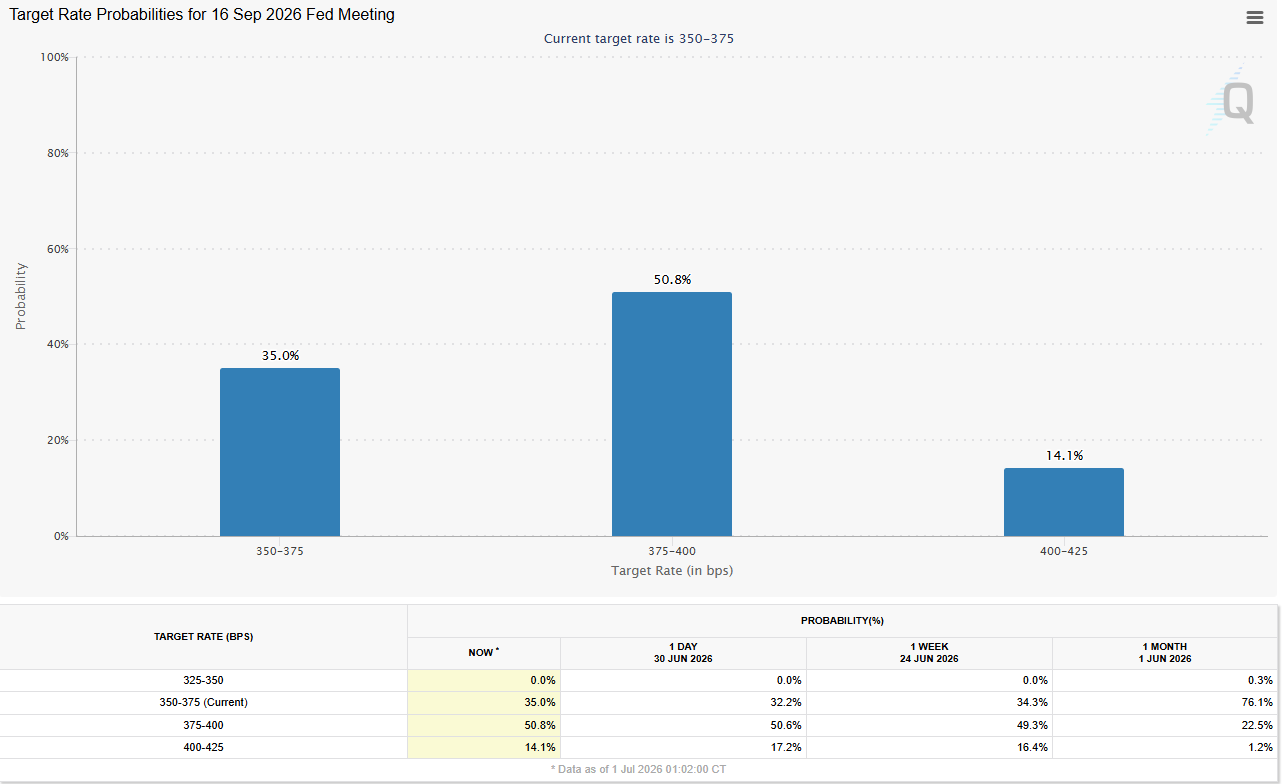
Source: CME FedWatch Tool
A strong print on Thursday validates the hike. A weak print begins the de-pricing process.
Either way, the market moves, and in a holiday-compressed week with no Friday trading, that move has nowhere to dissipate.
What to Watch: Key Metrics and Expectations
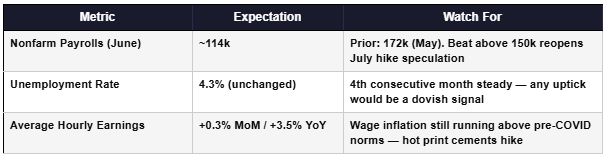
Table Created by Zain Vawda Using Canva
The FIFA World Cup Wild Card
June's payrolls carry a structural seasonal hook that the market has not fully priced: the U.S. is co-hosting the 2026 FIFA World Cup across 16 host cities, with the tournament group stage running through late June and into July.
Event staffing, hospitality, security, transportation, and retail employment associated with World Cup hosting typically shows up as a transitory boost in the headline print for the relevant months. This effect is not captured cleanly in seasonal adjustment models, which were not calibrated for a U.S. World Cup cycle.
The result: June's payrolls print could come in above consensus not because the underlying economy accelerated, but because the World Cup temporarily boosted service sector hiring. Traders should be alert to this distortion. A beat driven by leisure and hospitality does not carry the same Fed-signaling power as a beat in construction, manufacturing, or professional services.
Don't Ignore the Sub-Components: Wages and Unemployment Are the Real Fed Triggers
The headline print will move markets first. But for sustained repricing of the September hike probability, watch two sub-components.
First, Average Hourly Earnings: currently running at approximately +3.4% year-over-year, well above the pre-COVID norm of ~2.5–3.0%. Any upside surprise here, even a tenth, fires the inflation alarm that Warsh's Fed is most sensitive to.
An AHE print above +3.5% YoY alongside a strong headline would push September hike odds toward 80%+ and send the 2-year Treasury yield sharply higher.
Second, the unemployment rate: four consecutive months at 4.3% has been a stabilizing signal. A fifth month holds the narrative.
But a tick up to 4.4%, even with a solid headline would be interpreted as the labor market turning, and would undercut the rate hike case regardless of the payroll count.
Scenario Matrix: How to Trade the Print
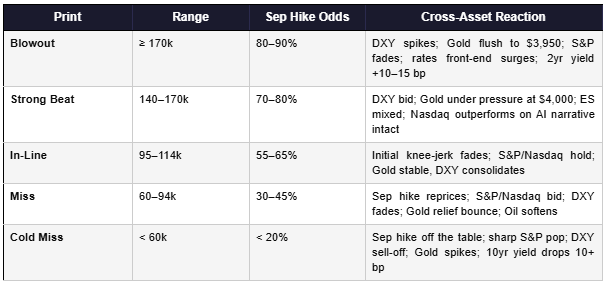
Table Created by Zain Vawda Using Canva
The Holiday Compression Risk
This NFP is structurally different from a typical first-Friday release. Markets close Thursday after the data prints and do not reopen until Monday morning, which also happens to be the first day of SpaceX's Nasdaq-100 inclusion.
That means any Friday price discovery that would normally allow the market to digest, recalibrate, and partially reverse an initial overreaction simply does not exist.
Positions taken going into Thursday's close have to survive a four-day weekend unhedged. For futures traders specifically, liquidity will be thin. Gap risk in either direction is elevated. Size accordingly.


