
The U.S. employment market is softening on the edges, rather than heating up or breaking down, according to two labor market reports released Wednesday. Private sector hiring slowed in June, while at the same time, U.S. employers announced the fewest layoffs in six months.
Hiring Slows as ADP Posts Weakest Gain Since March
ADP's National Employment Report showed private employers added just 98,000 jobs in June, down from 122,000 in May and a step below the pace of hiring seen earlier in the spring. The growth was uneven: education and health services alone accounted for 48,000 of the total gain, roughly half of all private job creation for the month.
On the other hand, leisure and hospitality posted its sixth consecutive month of weak hiring, adding just 2,000 jobs. Financial activities (14,000) and information (7,000) also contributed, but goods-producing industries barely moved, adding only 2,000 jobs combined, with natural resources and mining actually shedding 5,000.
ADP's chief economist, Dr. Nela Richardson, characterized the pace of hiring as reflecting both weaker demand and pockets of labor supply constraint, concluding that "the overall effect is a slowdown in job creation."
Layoffs Fall — But AI's Fingerprint Deepens
The numbers, released Wednesday by outplacement firm Challenger, Gray & Christmas, tell a story with an obvious contradiction. Total layoff announcements fell to 45,849 in June, down 53% from May and the lowest monthly total since December. On paper, that's the kind of cooling that eases fears of a hard landing in the labor market. But AI was cited in 14,029 of those cuts, accounting for 31% of the month's total.
Technology absorbed the brunt of it. The sector logged 15,503 job cuts in June, more than any other industry, bringing its year-to-date (YTD) total to 139,156, an 83% increase over the same period last year. Tech now accounts for nearly a third of all layoffs announced in 2026.
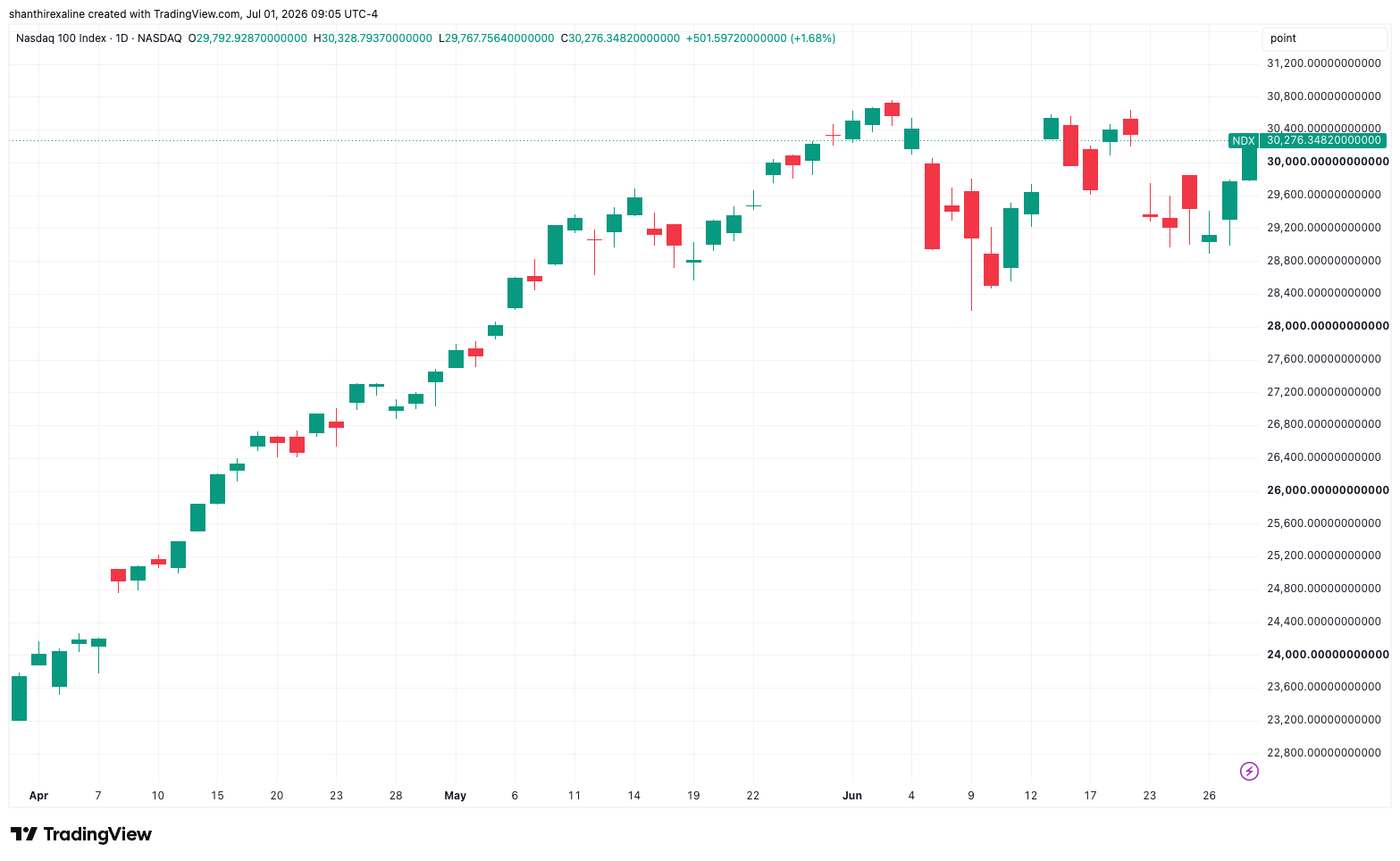
That figure contrasts with the tech sector's stock performance. The same week Challenger published its June numbers, the Nasdaq Composite Index closed out its best first half since 2020. The narrower Nasdaq 100 Index (NDX) clocked a superlative 27.5% gain for the second quarter, powered by the strong performances of mega-cap tech stocks and semiconductor plays.
NDX's Strong Q2 Run
Source: TradingView
According to MarketFramework data, the E-mini Nasdaq 100 (NQ) contract is drawing neutral sentiment among traders. Among profitable trades, the long-short break-up is 53%-47%, while considering non-profitable trades, the ratio is nearly similar at 56%-44%.
"The sector is being reshaped in real time," said Andy Challenger, the firm's senior vice president, of the wave of technology-sector cuts.
That reshaping looks less like contraction and more like redistribution. Even as layoffs mounted, Challenger's data showed announced hiring plans for the first half of 2026 running 10% ahead of the same period last year. Read alongside the layoffs data, it points to a labor market being rewired rather than shrunk. Capital and headcount appear to be concentrating in the infrastructure layer of the AI buildout, while cuts are landing disproportionately on application-layer software roles and functions AI tools can now perform directly.
Taken together, the two reports describe a labor market that is quieter on both ends, characterized by fewer layoffs, but also less hiring. This is the low-churn stagnation economists have been calling "low-hire, low-fire" for much of the past year.
On Tuesday, the U.S. Bureau of Labor Statistics (BLS) reported that job openings remained relatively steady in May. However, because the data reflects labor market conditions from May rather than June, investors may view it as a lagging indicator that does not fully capture the current state of the job market.
What Thursday's Jobs Report Needs to Show
Thursday's monthly non-farm payrolls (NFP) report will tell markets which half of the story the government's data agrees with. Economists expect NFP payrolls to show a gain of roughly 110,000 for June, with unemployment holding at 4.3%, a number that would sit almost exactly between ADP's softer 98,000 private-sector print and the stronger pace seen earlier in the spring.
A print near or above consensus would support the idea that June's slowdown was noise rather than a turn, and would give the Fed further room to stay tight. A miss, particularly one paired with downward revisions to April and May, would be harder to wave off. Either way, Thursday's market reaction will hinge less on the headline number itself than on whether it confirms or breaks the quiet, split picture this week's private data has already sketched out.


