Gold enters the week exactly where it spent most of the last one — pinned to the $4,000 handle, and falling for reasons that have nothing to do with the war that is supposed to be supporting it.
An Inflation Event, Not a Safety Event
Gold futures posted a $4,025.80 high, up $7.00 or 0.17%, with spot changing hands around $4,020.
Firm, but unconvincing: bullion started Monday on a softer footing with the dollar and Treasury yields holding their ground, and traders continuing to trim bullish exposure after last week's decline.
That decline is the frame for everything this week. Gold lost roughly 3% over the five sessions, its biggest weekly loss in six and the steepest since June 1.
It slipped below $4,000 midweek and touched its lowest level since July 1 before bargain hunting pulled it back near $4,011 into Friday's close. The rest of the complex went with it — silver at $55.20 (−0.6%), platinum $1,599.17 (−1.1%), palladium $1,244.16 (−0.4%) — with the gold/silver ratio widening out toward 72.
What Will Drive Gold Prices This Week?
Set the tape against the news flow and the dislocation is stark. Nine consecutive days of U.S. strikes on Iran, a ceasefire Tehran now describes as collapsed, four vessels intercepted in the Strait of Hormuz over the weekend — and gold went down. The market is not trading this conflict as a flight-to-safety event. It is trading it as an inflation event.
Markets now price roughly a 56.3% chance of a September hike — up from 51.2% in a single day — and about 73% by December.
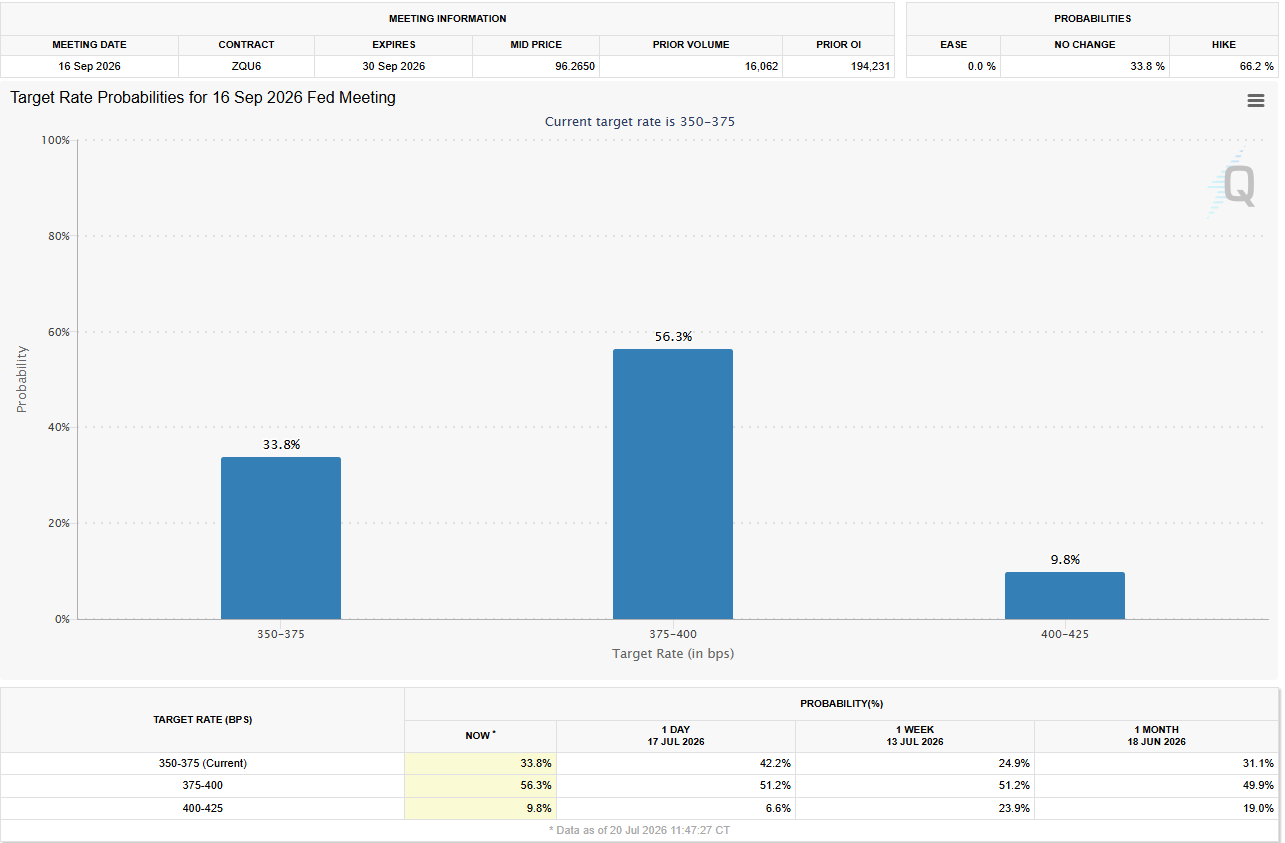
Source: CME FedWatch Tool
10-year TIPS at 2.35%, the opportunity cost of holding a non-yielding asset is doing all the work.
Tim Waterer of KCM Trade put the split plainly: cooler CPI and PPI could not be celebrated while oil was spiking, leaving inflation and yield concerns as the dominant weight on bullion.
What Will Drive Gold Prices This Week?
It is a light U.S. calendar, which concentrates the risk rather than diluting it.
Monday brings the Conference Board's Leading Economic Index and a PBOC rate decision. Tuesday and Wednesday carry no noteworthy US releases.
Thursday is the double-header: jobless claims at 8:30 ET, then the ECB at 08:15 ET, where markets price roughly an 88% chance of a hold at 2.25% after June's surprise hike.
Friday delivers S&P Global flash manufacturing and services PMIs plus June new home sales — the last meaningful macro input before the Fed meets on July 28–29.
SCENARIO MATRIX · NEAREST CATALYST: CLAIMS (THU), FLASH PMIs (FRI)
| Case | Trigger | Gold Path Into Friday |
|---|---|---|
| Bull | Flash PMIs undershoot; claims tick up; oil fades on ceasefire progress | Hike odds soften, real yields ease, $4,060 gives way. First clean run at $4,100 since the June break. |
| Base | Data in line; ECB holds at 2.25%; Hormuz headlines continue without resolution | Range persists. $3,950–$4,060 holds into the FOMC blackout. Low-conviction chop, thin summer volume. |
| Bear | Claims stay near cycle lows, PMIs firm, crude retakes $90 | September pricing pushes past 60%. $3,950 breaks, opening the 1 July low and the $3,942 area beneath it. |
What Are the Charts Saying?
Gold remains locked in a descending wedge, with price at 4,013.5 pressing against the upper boundary that now converges with horizontal resistance at 4,044.4. Two rejections at that confluence in as many sessions underline its significance.
Gold Futures Four-Hour Chart, July 20, 2026
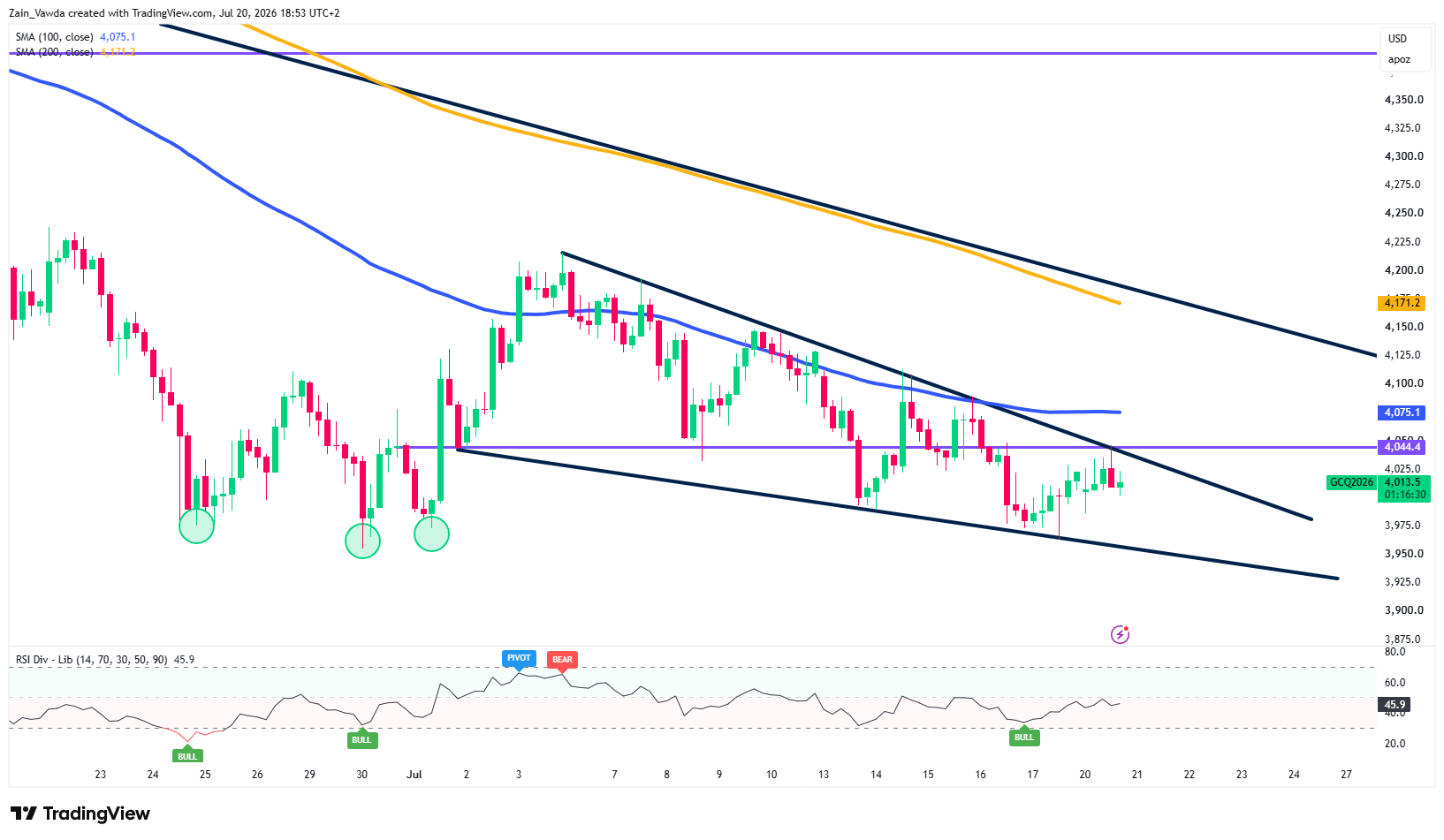
Source: TradingView
The 100-MA (4,075.1) and 200-MA (4,171.2) both slope lower and sit above price, keeping the medium-term structure bearish despite the July 17 bullish RSI divergence that produced the current bounce.
RSI at 45.9 remains below the 50 midline — momentum has stabilised, not turned.
A 4H close above 4,044.4 would break the wedge and target the descending 100-SMA. Failure there keeps 3,970 in play, with wedge support near 3,925 the downside objective on a clean break.