
Updated with analyst comments and additional color on the data.
A quartet of economic reports released Thursday painted a mixed but cautionary picture for monetary policy, as lingering inflation pressures, resilient labor markets, and slowing growth confirmed that the Federal Reserve faces a challenging balancing act heading into its June meeting.
Fed’s Preferred Inflation Gauge Runs Hot
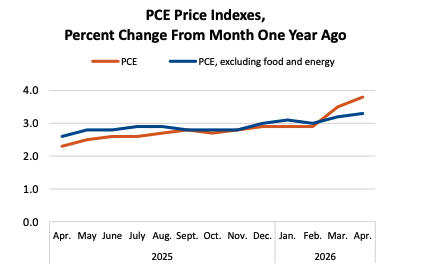
The Price Consumption Expenditure (PCE) index, aka the Federal Reserve’s preferred inflation gauge, ticked up in April from the previous month, a report released by the Bureau of Economic Analysis (BEA) showed.
- Year-over-year (YoY) rate of the PCE index: 3.8%, up from March’s 3.5% (consensus 3.8%);This marked a 3-year high for the metric.
- The annual rate of the core PCE index: 3.3%, up from 3.2% in March (consensus 3.3%)
- Month over month (MoM) PCE inflation rate: 0.4%, down from the previous month’s 0.7% (consensus 0.5%)
- Core PCE inflation’s monthly rate: 0.2% vs. March’s 0.3% (Consensus 0.3%)
Source: BEA
These numbers are released as part of BEA’s personal income and spending report. The report also showed that both personal income remained unchanged MoM, while personal spending climbed 0.5%. The personal income growth slowed from the 0.5% place in March and also undershot the consensus of 0.4%. On the other hand, personal spending, though slowing from March's 1%, rose in line with expectations.
Q1 Growth Revised Down
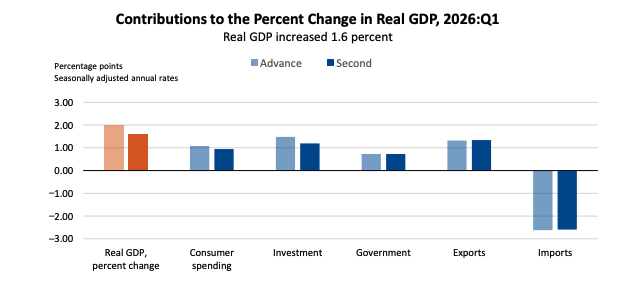
The BEA's second estimate revised first-quarter GDP growth down to 1.6% from the initial 2.0% reading, missing economist expectations of no revision. Despite the downward revision, growth accelerated meaningfully from the fourth quarter's 0.5% pace.
The 0.4 percentage-point differential from the advance estimate reflected downward revisions to investment and consumer spending. While investment was dented by lower-than-initially estimated private non-farm inventory investment, consumer spending revision reflected a downward revision to services that was partly offset by an upward revision to goods.
Contribution to GDP Percentage Change
Source: BEA
The GDP price index, aka GDP deflator, which is a measure of the inflation, was at 3.5%, revised down from the 3.6% estimated in the advance report. The first-quarter PCE and core PCE annual inflation wad at 4.5% and 4.4%, respectively.
Labor Market Steady
The labor market’s resilience was confirmed by the latest weekly jobless claims report. The number of the individuals claiming unemployment benefits was 215,000 for the week ended May 23 compared to the previous week’s upwardly revised average of 210,000 (+1,000) and the consensus of 211,000. Despite the uptick, the numbers remain low from the historical perspective.
The four-week average, which smooths volatility, climbed to 209,000 from the revised reading of 202,750 (+250) for the previous week. It, however, came below the consensus of 211,000.
Seasonally Adjusted Weekly Jobless Claims
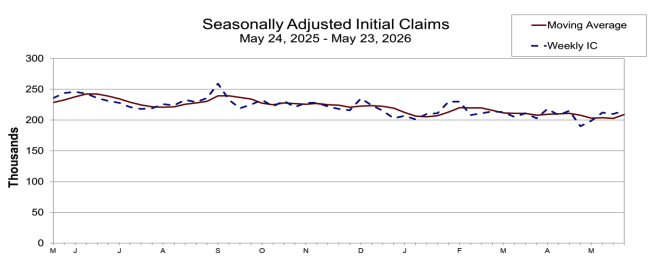
Continuing claims calculated with a week’s lag was 1.786 million for the week ended May 16, higher than the previous week’s revised level 1.771 million (-11,000). Continuing Claims (also called insured unemployment) measures the number of people who have already filed an initial unemployment claim and are still receiving weekly unemployment benefits.
Transportation Boosts Durable Goods Orders
Census Bureau’s durable goods orders report for April showed a 7.9% MoM increase in the orders for goods designed to last for three or more years. Economists had expected a 4% climb, on top of the 1.3% increase for March. Core durable goods orders, which excludes transportation, climbed at a slower rate of 1.1%, matching the March pace.
Transportation orders jumped 21.5%, much faster than March's 1.7% rise. Non-defense capital goods orders, excluding aircraft and part, considered a proxy for capital spending, however, fell 1.1%, reversing the 3.9% increase in March. Shipments of this category of goods climbed 0.4%, slowing from the 1.3% increase in March. Commenting on the data, LPL Chief Economist Jeffrey Roach said, notwithstanding the slower growth, the race to build out artificial intelligence (AI)-related infrastructure will likely continue throughout this year, supporting growth.
Economists Turn Cautious
"The stock market will cheer the resilient consumer spending numbers, but we need to get inflation back under control and ideally do that in a way that preserves (or improves growth), "Northlight Asset Management Chief Investment Officer Chris Zaccarelli said. The strategist said no rate cut be forthcoming in the second half of the year, adding that this kind of data rules out rate cuts even for all of next year.
"We are far from stagflation, but rising inflation coupled with slowing growth is the opposite of what we want in both dimensions," Zaccarelli said.
LPL's Roach shrugged off the first-quarter GDP downgrading and instead remained hopeful that business spending will keep contributing to growth in the near term. R
The economist expects supply constraints to cause inflation pressures to seep into both nondurable and durable goods most likely for the next few months. He said the modest increase (0.1%) in the core services, excluding housing inflation, should be taken with a pinch of salt due to the one-off decline in financial services fees.
Read-Across for Rates
Thursday's data assumes added importance as the macroeconomic and geopolitical backdrop continues to cloud the monetary policy outlook. Inflation expectations have surged in the wake of the Iran conflict, with higher energy prices feeding through the economy and translating into broad-based price pressures.
The Federal Reserve Open Market Committee (FOMC) next convenes June 16-17, with markets virtually certain policymakers will stand pat. The CME FedWatch Tool shows a 99.2% probability the Fed funds rate remains unchanged at 3.50%-3.75%.
Collectively, the data suggests an economy still generating inflation pressure despite modest signs of cooling, leaving the Fed firmly on hold heading into June.


