South Korea’s central bank kept interest rates unchanged on Thursday, choosing to remain cautious amid mounting uncertainty stemming from the Iran conflict and its impact on global inflation. Despite holding rates steady, the tone of the meeting was decisively hawkish, signaling that policymakers are increasingly leaning toward additional tightening in the months ahead.
Following the announcement, South Korea’s benchmark KOSPI Index fell sharply, while the Korean won weakened initially but has trimmed its losses since.
BoK Holds Fire Amid Uncertainties
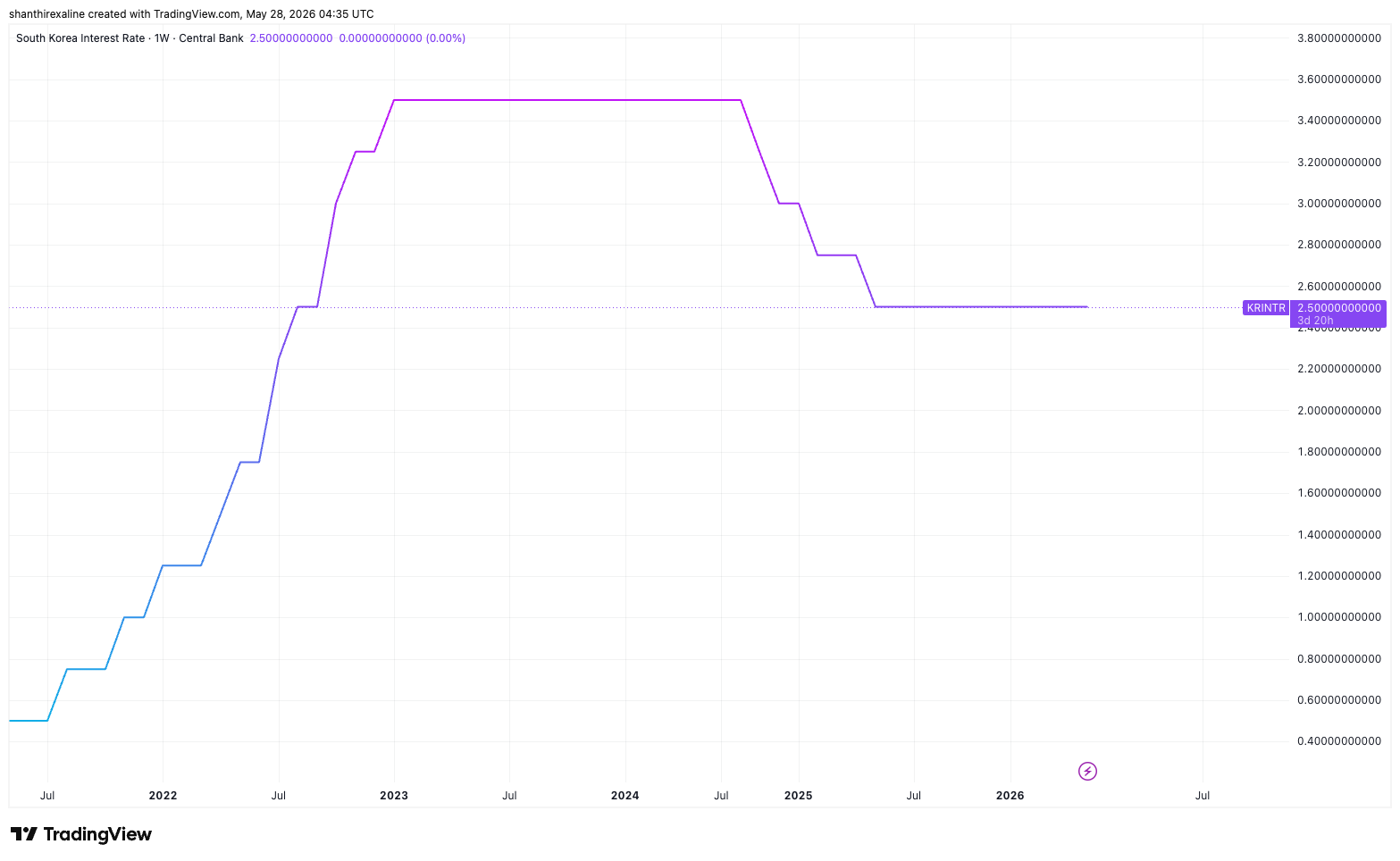
The Bank of Korea (BoK) maintained its benchmark interest rate at 2.50% after concluding its Monetary Policy Board meeting on Thursday. This marked the eighth consecutive meeting in which the central bank opted to keep policy unchanged.
The decision, however, was not unanimous. Five board members voted to hold rates steady, while two supported an immediate 25-basis-point increase to 2.75%, underscoring growing concern within the board over persistent inflationary pressures.
Source: TradingView
In its statement, the BoK acknowledged that inflation risks have intensified due to the Middle East conflict and the resulting spike in global oil prices. At the same time, policymakers noted that strong export performance—particularly in the semiconductor sector—continues to support economic growth.
“Given the uncertainties surrounding developments in the Middle East and their potential spillover effects, the Board judged it appropriate to maintain the current Base Rate while assessing the conflict’s impact on growth and inflation,” the central bank said.
Stronger Growth, But Inflation Risks Are Rising
The BoK raised its 2026 growth outlook to 2.6%, a significant upgrade from the 2% forecast issued earlier this year. The revision was driven largely by resilient semiconductor exports and additional fiscal stimulus measures.
However, the central bank also warned that rising commodity prices and supply-chain disruptions are likely to increase inflationary pressure moving forward.
Consumer inflation is now projected to average 2.7% this year, up from the previous estimate of 2.2%, while core inflation is expected to rise to 2.4%.
As a major energy importer, South Korea remains highly vulnerable to oil price shocks. According to International Energy Agency data, the country imported more than 84% of its energy needs in 2024. With crude oil prices having surged more than 50% since the onset of the Iran conflict earlier this year, policymakers are increasingly concerned about import-driven inflation and its broader economic consequences.
South Korean Energy Trade

Source: IEA
Hawkish Shift in Policy Outlook
Perhaps the most significant development from the meeting was the shift in the BoK’s forward guidance.
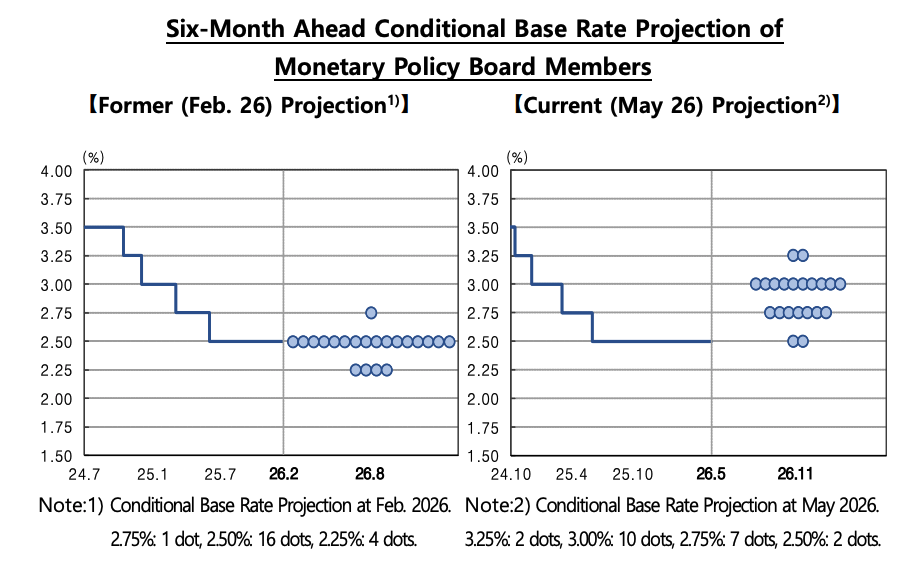
The central bank’s six-month conditional rate projections revealed that a majority of board members now expect rates to move higher. This marks a sharp reversal from earlier projections in February, when most policymakers favored keeping rates unchanged and some even considered the possibility of rate cuts.
Several members now foresee the benchmark interest rate to go up, with a few projecting the possibility of a 50-basis-point tightening cycle. Investment banking firm ING said it believes that the latest dot-plot, which is now centred around 3%, accurately reflects the BoK’s view.
Six-Month Ahead Base Rate Projections of Board Members
Source: BoK
BoK Governor Shin Hyun Song reinforced the hawkish stance during his post-meeting press conference, warning that even if geopolitical tensions ease, energy supply chains may take considerable time to normalize.
He emphasized that inflation is likely to remain above the central bank’s target for an extended period and highlighted ongoing risks tied to currency volatility, elevated housing prices in Seoul, and rising household debt levels.
“Taking these factors into account, it is judged necessary to raise the Base Rate at an appropriate time,” Song stated, adding that future decisions would depend on incoming inflation data, economic growth trends, and financial stability conditions.
ING economists increasingly expect the BoK to resume tightening as early as July, with rates potentially moving toward 3% over the medium term.
What It Means for the US
The BoK’s increasingly hawkish stance also carries important implications for the U.S. and global financial markets. Rising inflation pressures in Asia reinforce the broader global narrative that energy-driven inflation remains a serious risk, especially if Middle East tensions continue to disrupt oil markets. Persistently high oil prices could complicate the Federal Reserve’s efforts to fully tame inflation, potentially delaying future rate cuts.
As the U.S. interest rate differential with the rest of the world widens, the U.S. dollar could stay strong, tightening global financial conditions and weighing on emerging-market currencies and capital flows.
South Korea plays a central role in the global semiconductor industry through companies such as Samsung Electronics and SK Hynix. Memory chipmaker SK Hynix has seen its market capitalization top $1 trillion mark, riding on the artificial intelligence (AI) opportunities.
The BoK’s upgraded growth outlook, driven largely by chip export, signals that global AI and technology demand remains strong. This is positive for U.S. technology firms that depend on Korean semiconductor supply chains, including major American AI and cloud-computing companies.
For South Korea, the challenge will be balancing resilient export-led growth against rising inflation, elevated household debt, and a weakening currency. For global markets and the U.S., the BoK’s shift serves as another reminder that geopolitical shocks, particularly those tied to energy markets, remain a major driver of monetary policy worldwide.
Read Next: Nasdaq Futures Face a Squeeze Setup Even as Hidden Fault Lines Deepen Beneath Rally


