The Nasdaq 100 futures' (NQ) stratospheric ascent stalled on Wednesday, with the contract trading modestly lower early Wednesday. The underlying instrument — the Nasdaq 100 Index — scaled a new peak in the previous session, finishing above the 30K mark for the first time, but has pulled back below the psychological level since.
Since hitting an intraday low of 22,841.42 on March 30, the NDX has advanced over 31%. The blistering rally has left investors gasping for breath, with some increasingly wary of further upside from current levels. Are those fears justified? Are exuberant investors overlooking hidden fault lines?
Under the Hood of the NQ Rally
The underlying Nasdaq 100 (NDX) is a modified market-capitalization-weighted index comprising 100 of the biggest non-financial companies listed on the Nasdaq exchange. Due to the heavy concentration of megacap technology and growth names in the index, it is often considered a barometer of investors’ risk disposition.
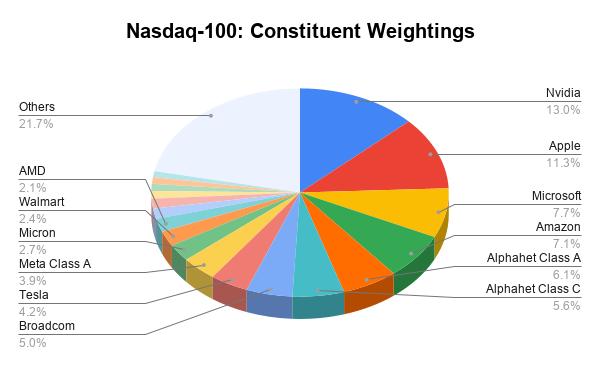
Generated using Slickcharts data
The top four companies in terms of weighting, namely Nvidia, Apple, Microsoft and Amazon, make up 39% of the NDX. A bad quarter for even one of these would meaningfully impact the index.
Semiconductor stocks also punch well above their numerical weight. NVIDIA, Broadcom, Micron Technology, Advanced Micro Devices, ASML Holding, Intel and Lam Research together account for roughly 27% of the index. Incidentally, the Philadelphia Semiconductor Index (SOX) has jumped over 80% year-to-date versus NDX’s 19% rise.
Memory-chip maker Micron Technology on Tuesday crossed the $1 trillion valuation mark, while Advanced Micro Devices, a key rival to NVIDIA, surpassed an $800 billion market capitalization, underscoring the growing dominance of semiconductor stocks within the NDX.
Philadelphia Semiconductor Index Vs. Nasdaq 100 Index (YTD Chart)
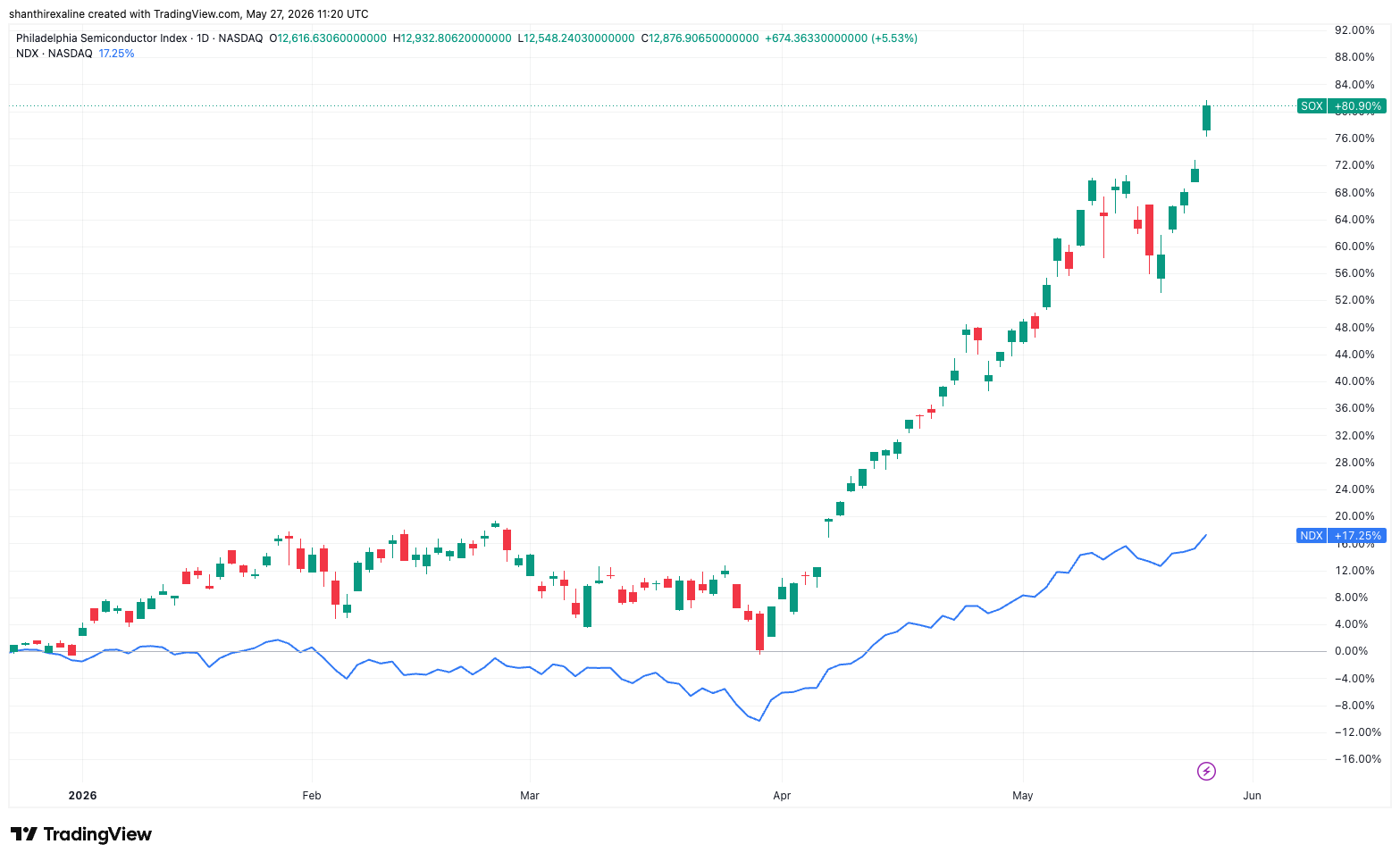
Source: TradingView
As a result, investing in the index or its futures effectively represents a substantial wager on the global chip supply chain, with AI-driven demand acting as the dominant underlying theme.
As the NDX effectively becomes a leveraged bet on AI delivering on its promise, on time, at scale and without regulatory interference, any doubt on any of these or other fronts poses a risk.
NQ’s momentum is clearly to the upside, and more importantly, the rally has persisted despite macroeconomic and geopolitical headwinds that would ordinarily discourage risk-taking. The Federal Reserve’s rate trajectory is rendered uncertain by the U.S.-Iran conflict as the oil supply shock, precipitated by the crisis, stokes inflationary pressure and triggers recession fears. Bond yields have surged higher. In the ordinary course of events, the backdrop would be ideal for investors dumping high-valuation, growth names.
So, what has kept the rally going? The biggest driver of the rally, smothering valuation fears, is the market’s conviction that the AI boom will deliver a sustained surge in earnings growth for mega-cap technology companies. In other words, the market is treating AI as a secular growth story powerful enough to eclipse cyclical macro risks.
But not all investors are convinced the rally is durable. The latest Commitment of Traders (COT) report from the Commodity Futures Trading Commission showed leveraged funds were net short 45,371 Nasdaq-100 (NQ) contracts, with short positions outnumbering longs by roughly 2:1, underscoring a sizeable directional bet against the rally.
By contrast, asset managers and institutional investors — including pension funds, mutual funds, insurance companies and sovereign wealth funds — were net long 92,301 contracts. Unlike fast-money hedge funds, these investors typically operate with longer investment horizons and are less prone to panic-driven positioning shifts.
Leveraged Funds Bet Against Relentless NQ Rally
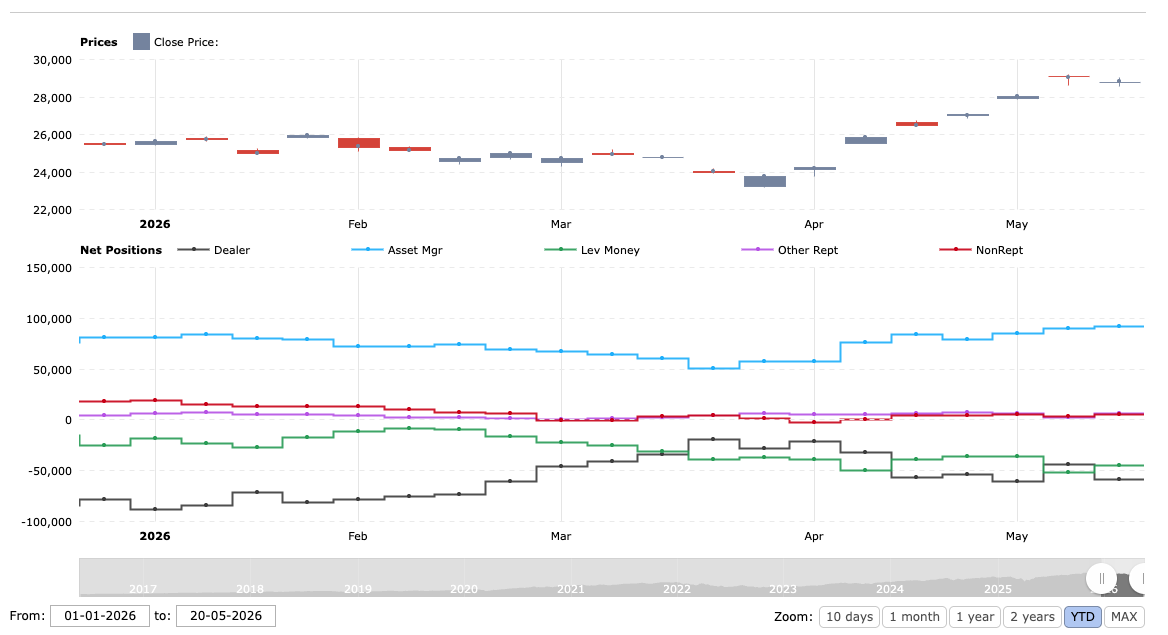
Source: COT data via Tradingster.com
The divergence leaves two sophisticated investor groups on opposite sides of the same trade, and at least one side will eventually have to give way. Historically, such standoffs have often ended with leveraged funds capitulating. Because hedge funds employ leverage, operate under tighter risk limits and face the risk of investor redemptions, they cannot remain in losing positions indefinitely. At some point, short-covering pressure can accelerate rapidly, creating the conditions for a powerful short squeeze.
Indeed, part of the recent rally that appeared disconnected from macro fundamentals may already reflect the unwinding of bearish bets.
The upside momentum, however, is not without risks.
Key Risks to NDX Rally
The fault lines for NDX is as follows:
Extreme Concentration Risk: As seen earlier, the mega-cap tech stocks command a significant share of the index, and an adverse headline on even one titan can swing the NDX by 2%-3% very swiftly.
Investors Looking Past AI Hype: In the early days of the AI revolution, markets rewarded any company that merely mentioned AI. That bar has since risen sharply. Investors now want proof that the billions being ploughed into AI infrastructure are generating sufficient returns.
The stakes are illustrated by a deal announced just last week: Google and Blackstone unveiled a joint AI cloud venture, with Blackstone contributing $5 billion in equity. Bloomberg reported total investment, including leverage, could reach $25 billion. Depreciating that outlay over a decade or more will weigh on Google's earnings regardless of whether revenues materialise on schedule. With the bulk of the spending front-loaded while monetisation ramps gradually, sustaining, let alone expanding, operating margins is a tall order.
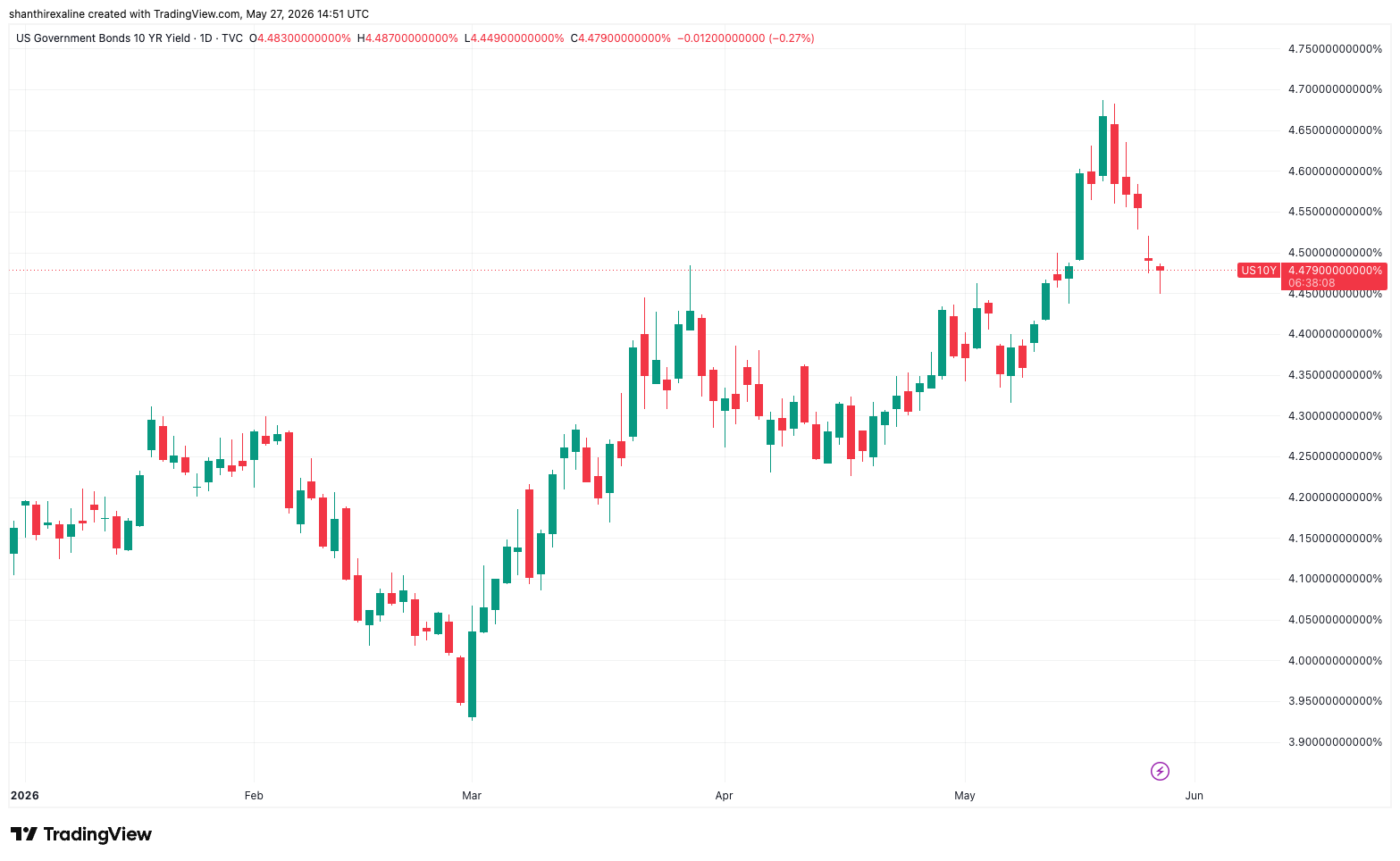
Interest Rate Sensitivity: The 10-year U.S. Treasury note yield hovers around 4.5%, with the rate referring to the return an investor gets from lending to the U.S. government for a decade. The return is considered the closest to a risk-free return. When the risk-free return rises, investors demand higher returns from riskier bets. If not, they would prefer parking their funds in treasuries.
As recently as this month, the 10-year yield spiked past 4.5%, rising as high as 4.687% before falling back.
US 10-Year Treasury Note Yield
Source: TradingView
A materially higher break above 4.5% on the U.S. 10-year is considered a tipping point for equities, according to Mina Krishnan, a multi-asset portfolio manager at Schroders. At these yields, investors begin rotating from growth stocks into bonds, leveraged positions would unwind due to the higher financing costs and the credit market would tighten, slowing the economy.
Whether the rally extends or reverses will hinge on three variables: the pace at which AI investments produce measurable returns, the trajectory of U.S. Treasury yields, and whether geopolitical pressures ease or intensify. Investors would do well to watch these fault lines closely, even as the index continues to set records. In markets driven by narrative as much as numbers, the distance between a breakout and a breakdown is often shorter than it appears.


