
Wall Street returns from a long holiday weekend, walking a familiar tightrope: elevated geopolitical risk on one side, relentless tech-driven momentum on the other. With the U.S. markets closed Monday for Memorial Day, futures traders had a full session offshore to reprice developments in the US-Iran conflict and the verdict, at least this morning, is cautiously bullish.
The S&P 500 futures climbed 0.7%, Dow futures advanced 234 points or roughly 0.5%, and Nasdaq-100 contracts outperformed with a 1.1% advance.
The setup heading into the final week of May is straightforward on the surface: optimism over a potential deal to reopen the Strait of Hormuz is doing the heavy lifting, while a dense data calendar and a handful of high-profile earnings reports will determine whether equity bulls can extend their run or run out of road.
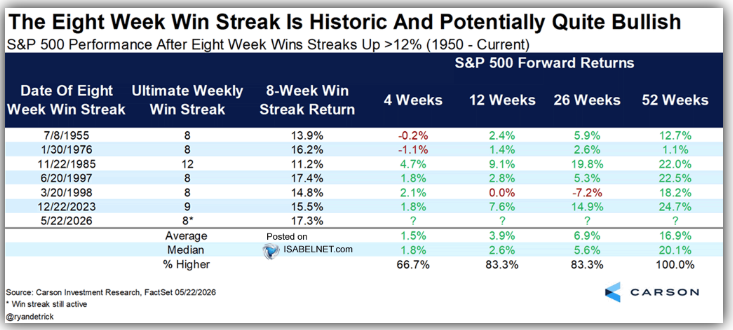
The S&P 500’s 8-Week Win Streak. Will the Streak Continue?
The S&P 500 is on a 8-week winning streak which has only occurred 6 times previously. The index has just navigated a significant portion of earnings season, with market participants wondering how far the rally can go?
Historically, 4 of the previous 6 times the S&P 500 reached 8 consecutive weeks of gains the streak ended. The remaining two times saw the index extend its winning streak to 9 and 12 weeks respectively.
Source: Carson Research, IsabelNet
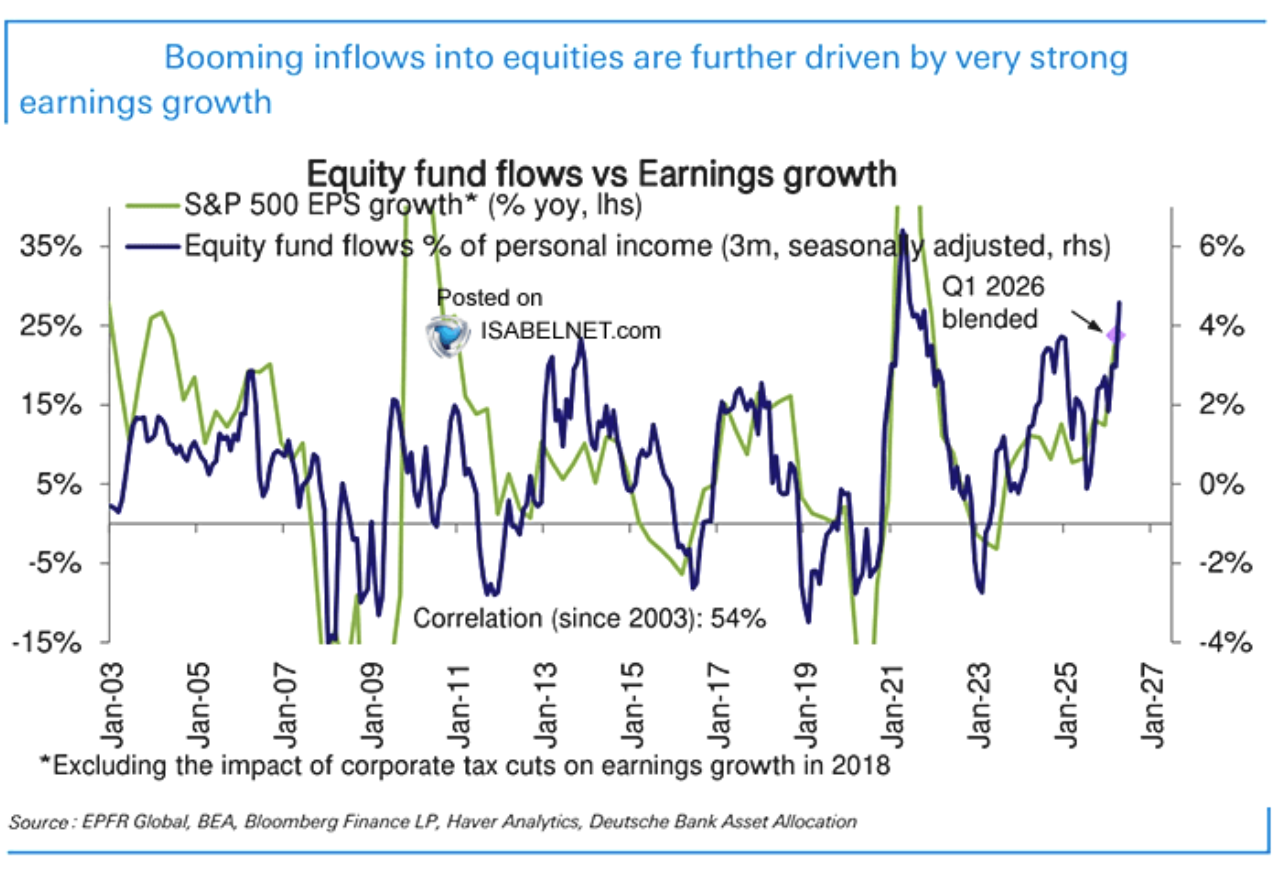
This does leave market participants with a reason for caution. On the flip side though, investors are pouring into equities on the back of solid earnings momentum. As long as earnings hold up, the trend should carry on.
Source: EPFR Global, IsabelNet, Bloomberg Finance LP
The Iran Variable: Progress, Strikes, and the Hormuz Premium
President Trump said Monday that negotiations with Iran were "proceeding nicely," striking a tone that sent risk assets higher across Asian and European sessions overnight. That optimism wasn't uncontested as the US confirmed it conducted what it termed "self-defence" strikes in southern Iran in the early hours of Tuesday, injecting fresh uncertainty into a situation markets have been attempting to price all year.
The immediate reaction in futures was telling: rather than selling off sharply on the news of continued military action, contracts held and extended gains. That resilience reflects a market that has, to a significant degree, learned to live with the geopolitical backdrop while remaining acutely sensitive to any signal in either direction from Tehran or Washington.
The Treasury market is already behaving as though a deal is more likely than not with the 10-year yield falling five basis points overnight, and the 30-year, which briefly spiked above 5.19% last week before retreating to 5.09% by Thursday's close, is tracking lower again this morning.
Traders should not mistake resilience for complacency. Each diplomatic headline carries outsized market sensitivity. Any sign of hardening from Tehran or an escalation in military exchange could quickly invert the current tone.
The Data Calendar: A Heavyweight Week
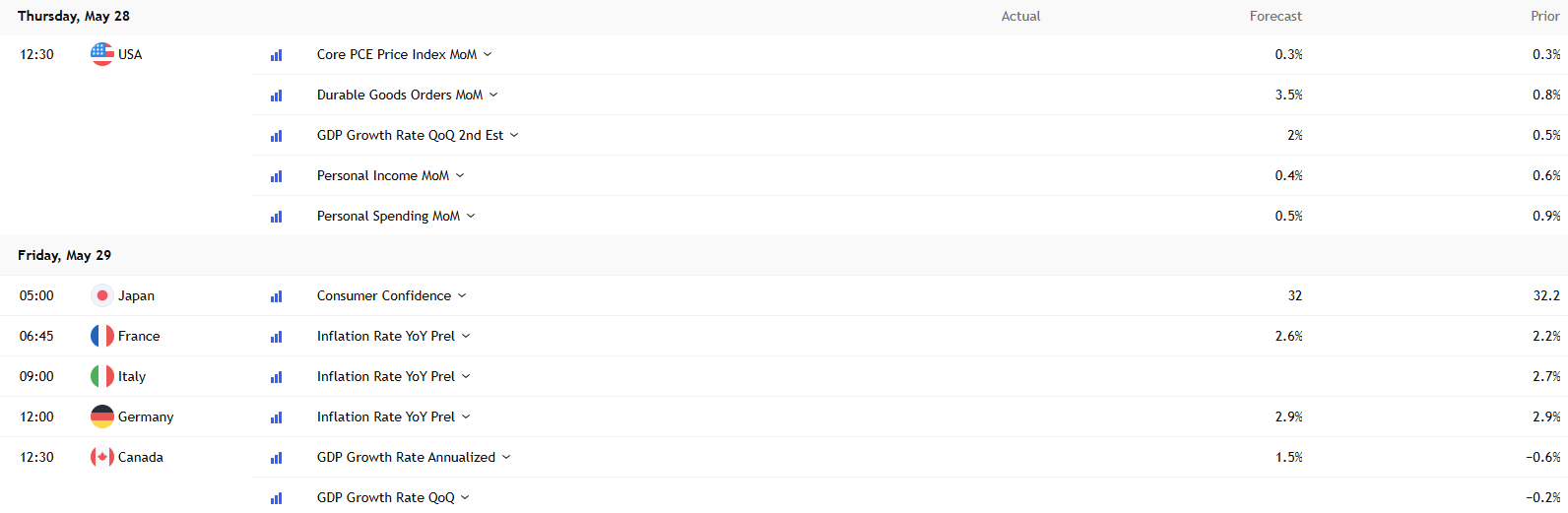
For index futures traders, the macro calendar this week is not background noise. It is the main event.
Source: TradingView
Thursday, May 28 is the session to mark. The Bureau of Economic Analysis releases its second estimate of Q1 2026 GDP alongside April's core PCE price index, the Federal Reserve's preferred inflation gauge both at 8:30 a.m. ET.
The advance estimate showed real GDP grew at an annualised rate of 2.0% in Q1, a reading that reflected solid consumer spending and investment but was accompanied by a sharp jump in the PCE price index, which rose 4.5% versus 2.9% in the prior quarter. Core PCE ex-food and energy came in at 4.3%.
Thursday's revision and the April PCE print will matter disproportionately for two reasons. First, new Fed Chair Kevin Warsh who took office last week has signalled a markedly more hawkish posture than his predecessor, with a preference for tighter policy and balance sheet reduction. Any upside surprise in PCE will harden expectations that rate cuts remain a distant prospect and could revive the long-end yield volatility that rattled risk assets last week.
Second, the personal income and spending figures released alongside PCE will offer the freshest read on consumer health at a time when fuel costs are quietly compressing household budgets.
The consumer confidence and sentiment complex will also draw attention after the University of Michigan's final May reading last Friday flagged a significant deterioration in inflation expectations.
Markets do appear to be pricing in a stagflationary cocktail of softening growth and sticky energy-driven inflation, a print that reinforces that narrative could pressure both bonds and equities simultaneously.
Earnings: AI Meets Enterprise Reality
Three names this week carry the potential to move index futures in meaningful ways.
Salesforce (CRM) reports Wednesday. As a Dow Jones Industrial Average component, any significant earnings surprise, positive or negative may have a direct mechanical impact on Dow futures. The enterprise software giant has navigated a complex environment in which AI-driven demand for its Agentforce platform is accelerating, but macro headwinds and cautious enterprise spending have complicated the picture. Guidance language around AI contract growth and operating margins will be watched closely.
Dell Technologies (DELL) also reports Wednesday. After Nvidia's blockbuster quarter last week, revenue beat but guidance failed to satisfy the most optimistic estimates, Dell's server and AI infrastructure commentary will serve as a real-economy cross-check on data centre demand. Dell is a key downstream beneficiary of the AI build-out cycle; tepid demand signals from its commercial PC segment could weigh on broader tech sentiment.
Zscaler (ZS), a Nasdaq-100 component, rounds out the week's noteworthy prints. The cloud security name has been a proxy for enterprise IT spending appetites, and any commentary on deal velocity and federal government contract exposure will be relevant in the current geopolitical environment.
Bottom Line
The path of least resistance in index futures remains higher but this week tests that assumption more rigorously than the past several. The confluence of a geopolitical situation that can pivot on a single headline, a PCE print that could force a hawkish market re-think, and Dow-component earnings at elevated valuations creates a week where the range of outcomes is genuinely wide.
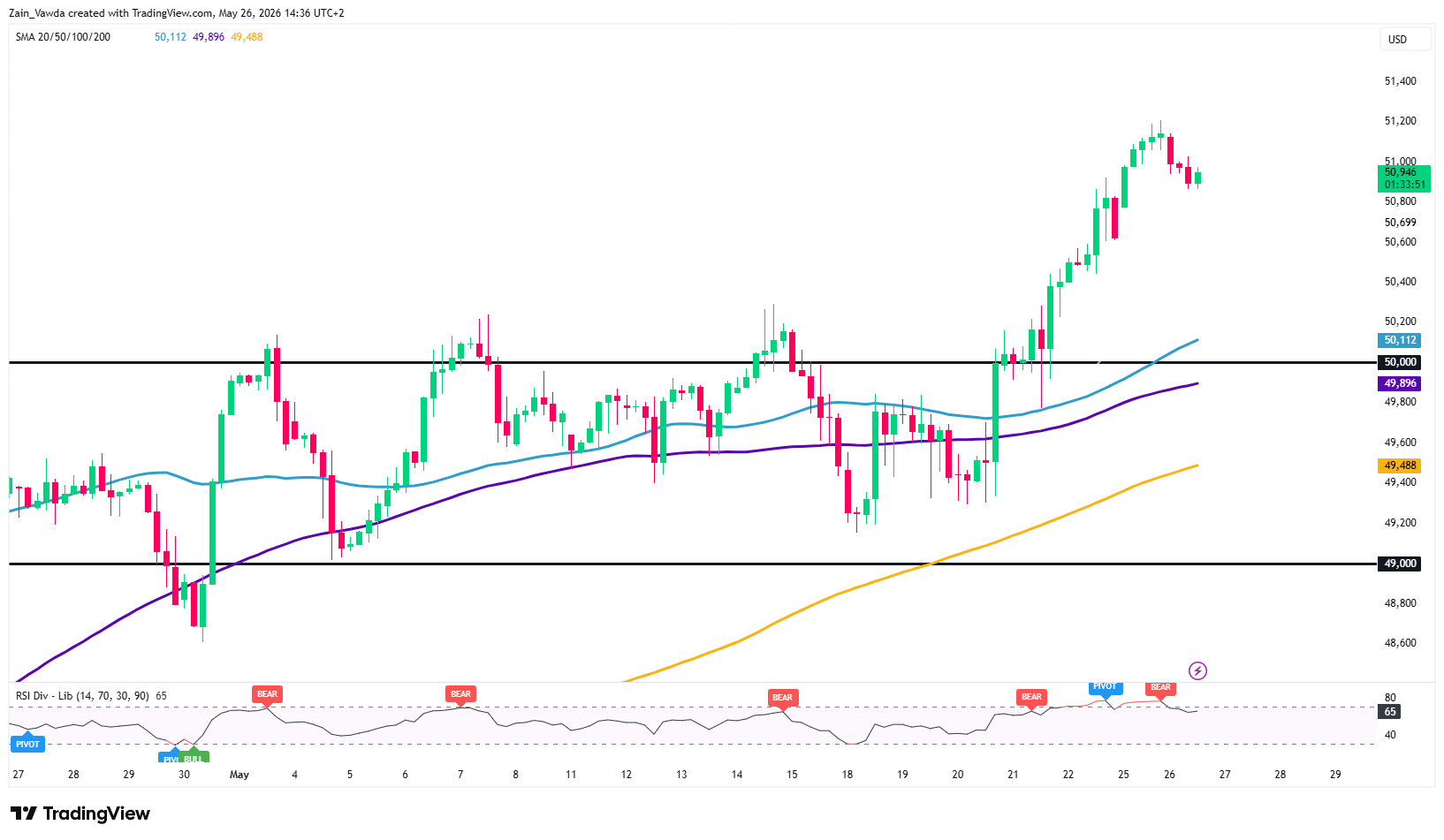
Dow Jones Futures Four-Hour Chart, May 26, 2026
Source: TradingView
Key Levels to Watch:
51,200, 52,500, 55,000, 50,300, 50,000, 49488 (200-day MA)
Bulls will argue that eight consecutive weeks of S&P gains reflect something more durable than geopolitical hope, namely, the AI-driven earnings cycle that continues to underpin big-cap tech.
Bears will counter that a core PCE print above expectations, combined with a stall in Iran negotiations, creates the precise conditions for a sharp unwind of an overstretched rally.
Watch the Thursday morning data window. It may be the most consequential 90 minutes of trading in weeks.
Read Next: Stock and Bond Yield Correlation Hits 1990s Lows: What It Means for the S&P 500

