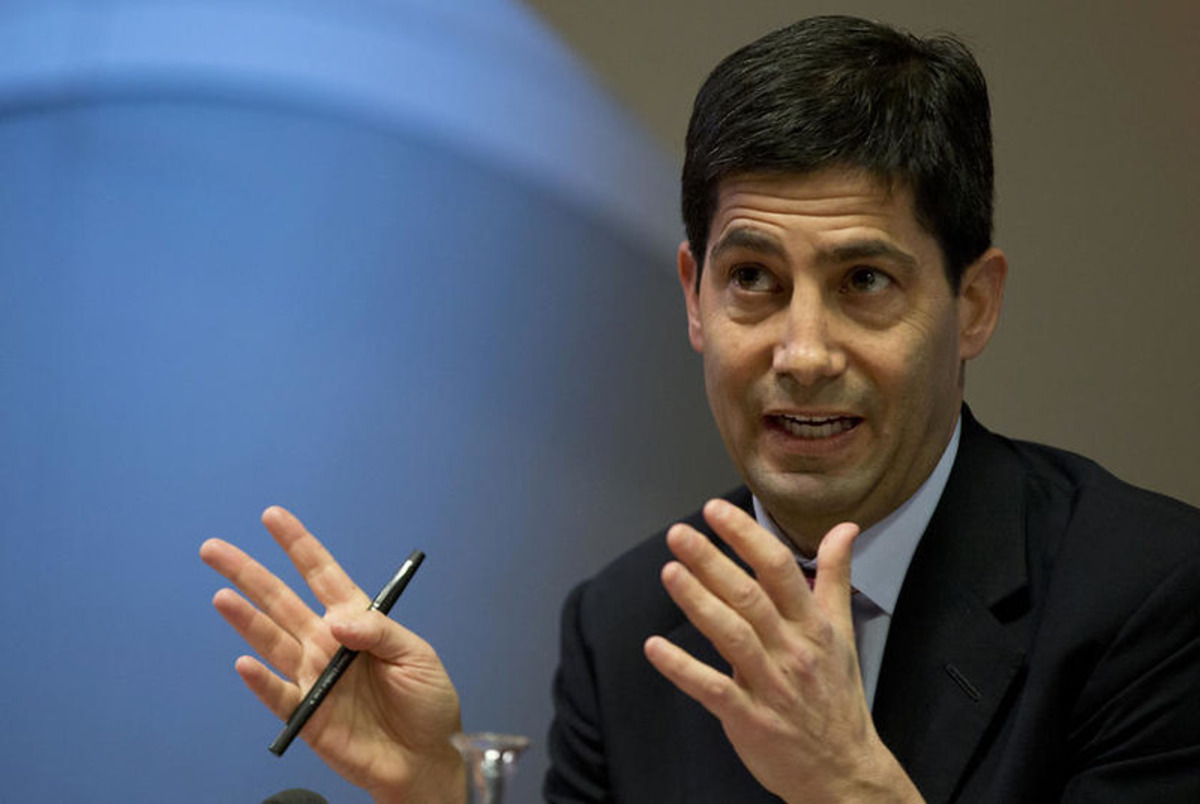
Federal Reserve Chair designate Kevin Warsh, a former central bank governor, is set to be sworn into office by President Donald Trump on Friday. As the old guard, defined by its wait-and-watch, cautious approach, makes way for new leadership, all eyes are on the incoming central bank chief and his stewardship of the institution at a time when macroeconomic challenges loom large.
Trump may have just handed him considerable latitude. The president reportedly said this week he would let Warsh operate freely, describing him as a talented individual who would perform well in the role. Weighing in on those remarks, economist Mohamed El-Erian suggested this points to the conclusion that the prolonged tension dominating headlines may have been less a structural rift between the White House and the institution itself, and more a personal friction between the President and Powell.
Ever since Trump assumed office for a second term, he has been at loggerheads with Powell over the direction of interest rates. He and his administration have been incessant with their calls for “Too late Powell” (to reduce interest rates) to step down. The Department of Justice.
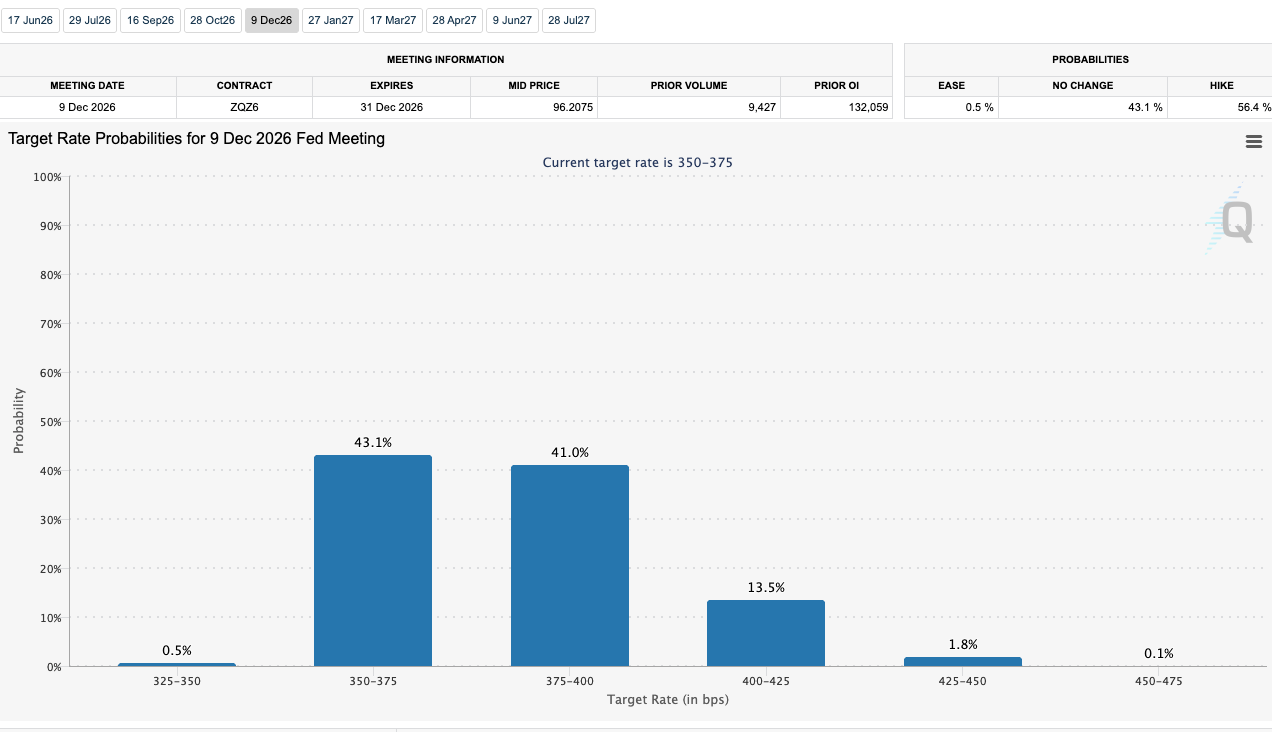
As Warsh prepares to take the helm at the Federal Reserve, futures markets are already passing judgment. The CME FedWatch tool prices in a near-certain 98.8% probability of no change at the June 16–17 meeting, the first under his watch. More strikingly, a rate cut has been fully priced out for 2026, with the odds of a rate hike running at roughly 60% by the year's final meeting on December 8–9.
CME FedWatch Tool
Source: FedWatch Tool
Warsh’s Rate Philosophy: Divergence, Risk and Internal Resistance
The question uppermost in traders' minds is how far Warsh's philosophy will diverge from that of his predecessor, Jerome Powell, and how closely his moves will align with the administration's priorities.
Lloyd Financial Group Chief Investment Officer Colin Symons sees a huge potential change. Explaining his thinking, Symons said Warsh wants to cut rates to help the lower rungs of the K-shaped economy, a term used to describe a pattern of recovery where different segments of the population move in opposite directions. While this threatens inflation risk, the incoming Fed chair wants to fight it by shrinking the Fed balance sheet.
This would likely need looser bank capital requirements to accomplish, which doesn't seem like a popular idea with at least some other governors, the strategist said.
Fed to Get a New Preferred Inflation Gauge?
The Fed now considers the core price consumption expenditure (PCE) index as its preferred inflation measure. While testifying before the Senate Banking Committee, Warsh signaled that he would go with other inflation measures such as the median inflation or trimmed mean inflation, which excludes extreme moves on both ends.
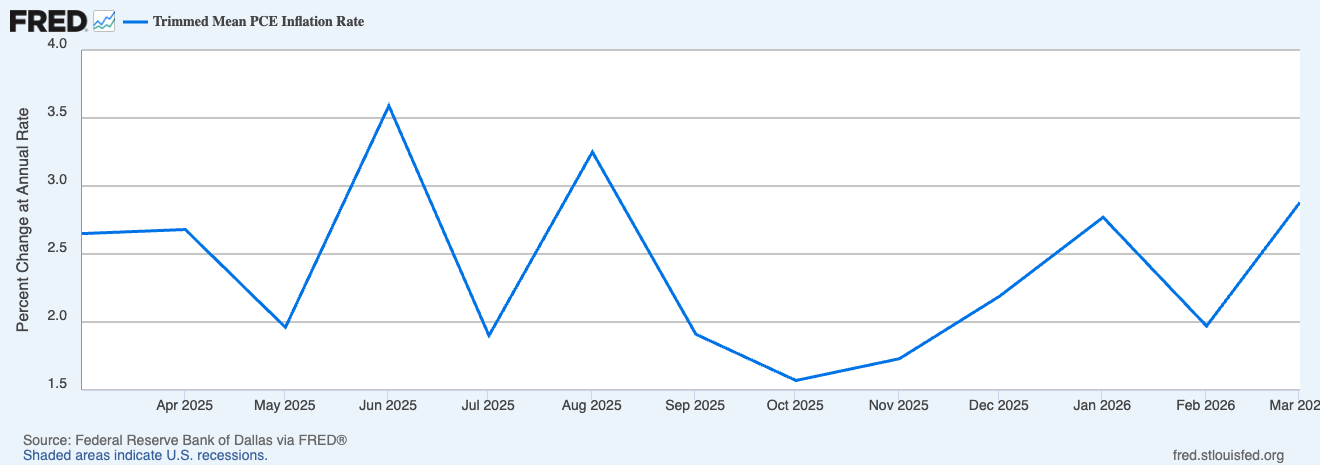
The Dallas Fed’s trimmed mean PCE inflation rate is at 2.9% for March, while PCE and core PCE inflation rate reads 3.5% and 3.2%, respectively, for the month.Warsh has highlighted that the underlying inflation has remained favorable when viewed through this lens. If Warsh manages to get his way, the path to rate cut opens.
Dallas Fed Trimmed Mean CPI Inflation
Source: St. Louis Fed
Not all align with Warsh on this. Bank of America economist Aditya Bhave has pointed out that the trimmed mean has overstated inflation more than the core PCE in some past instances. The economist also opined that certain events such as the oil shock seen in the wake of the U.S.-Iran conflict, are broad based, and not the kind of isolated outlier, the trimming process is designed to remove.
Inflation or Jobs: Where Does Warsh Draw the Line?
The Fed operates with the dual mandate of ascertaining price stability and maximum employment, with the former defined as maintaining average inflation rate at 2% over the long term. Maximum employment refers to sustainable employment without triggering rampant inflation.
Although the two goals look complementary in theory, in reality they frequently pull in opposite directions. If inflation takes priority, the central bank typically raises interest rates, making borrowing more expensive. On the other hand, focusing on employment will make the Fed lean toward rate cuts to stimulate growth and hiring.
Lloyd Financial’s Symons thinks Warsh will want to take on both but will likely lean more towards growth. “He thinks you can stimulate with lower rates and ramp down inflation by controlling the balance sheet,” the strategist said.
In a structurally higher inflation world, Warsh would focus on the Fed’s balance sheet, Symons said, adding that the incoming Fed official is likely to work more closely with the Treasury in adjusting the duration of issuance to control liquidity.
How would adjusting the duration of bond issuance help? Offering longer duration bonds, instead of bills will reduce liquidity and slow the economy, bringing down inflation. “Ideally, he'd want to cut rates and shrink the balance sheet, but probably has to convince the rest of the Fed for that,” Symons said.
The strategist also pointed out that Warsh, being a big believer in artificial intelligence (AI), will expect the technology’s deflationary impact to help control inflation.
Hawk or Market Ally? Warsh's Fed Decoded
Warsh wore his hawk feathers proudly during his tenure as Fed Governor from 2006 to 2011, navigating the white-knuckle years of the global financial crisis. But markets have since recalibrated their read on him. With the political reality of a Trump-aligned Fed raising expectations that he will lean toward keeping rates accommodative, whatever his instincts may dictate.
That said, Symons said the market will still see him as a hawk if it is more concerned about reduced liquidity from a smaller balance sheet. The market may also take exception to his thinking about having less forward guidance, which is likely to create uncertainty around monetary policy decisions.
Warsh's Independence: Conviction or Political Compliance?
Warsh’s predecessor Powell has all along been a strong advocate of Fed’s independence. Will Warsh's stated preference for less forward guidance be a deliberate break from Powell's transparent, telegraphed approach? During his 2006–2011 tenure, Warsh never dissented from an FOMC vote, suggesting pragmatic institutional loyalty over ideological rigidity.
Whether that instinct holds under a president with a well-documented appetite for pressuring the Fed remains the central unanswered question.
The incoming Fed chair will inherit an institution facing one of its most delicate balancing acts in years. The challenge before Warsh is not merely about calibrating rates or shrinking the balance sheet, but about convincing investors, policymakers and households alike that the Fed can adapt to a changing economic order without becoming politically subordinate to it.
Read Next: Dollar Holds Firm as Traders Brace for FOMC Minutes to Reveal Depth of Fed's Hawkish Fracture


