
Federal Reserve Chair Kevin Warsh delivered one of the clearest hawkish signals of his tenure, pushing financial markets to dramatically rethink the odds of a September interest-rate increase.
Markets now price roughly a 63.9% probability of a 25-basis-point Fed hike at the September meeting, up sharply from around 35% before Warsh's Jackson Hole speech and 41.43% a week ago.
Rate Move Odds
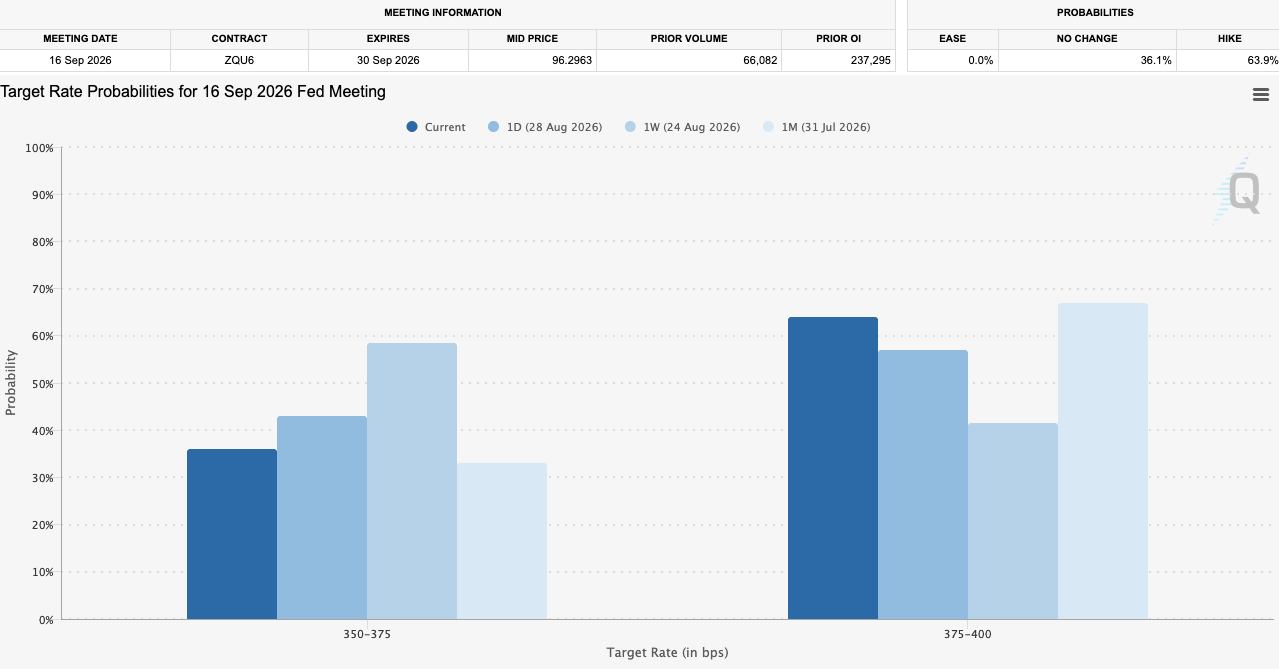
Source: CME
Yet the dollar's response has been surprisingly restrained.
The U.S. Dollar Index initially jumped after Warsh warned that the Fed would have "more work to do" if inflation does not move toward the 2% target with sufficient speed. The two-year Treasury yield also surged, reflecting a sharp repricing of near-term Fed policy.
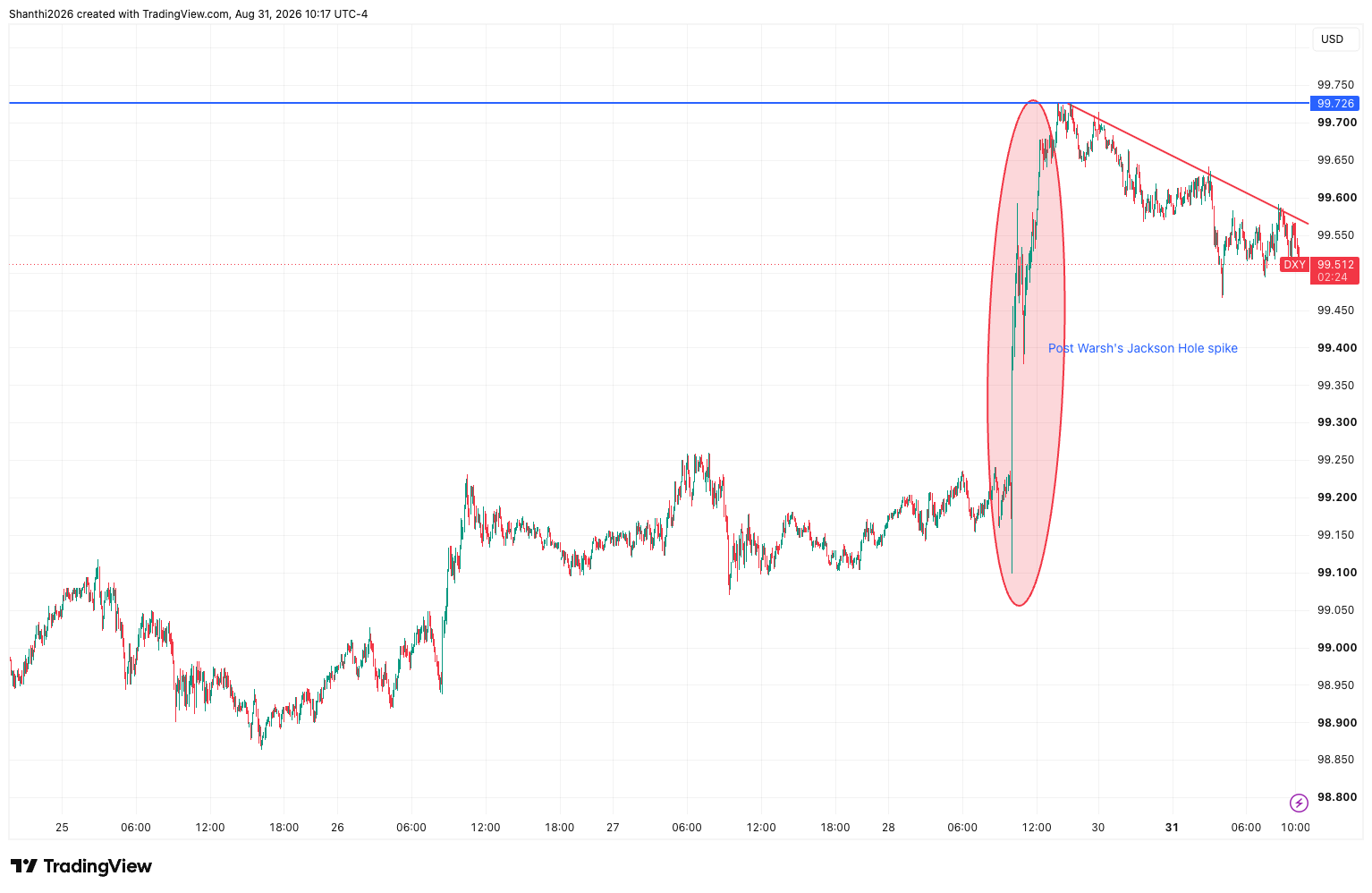
Source: TradingView
But by Monday, the dollar had slipped modestly despite the market assigning a better-than-even chance to a September hike.
That apparent disconnect raises a crucial question for dollar traders: If markets are pricing a hawkish Fed, why isn't the dollar rallying more aggressively?
Warsh Changed the Rate-Hike Equation
Warsh's Jackson Hole message was significant because he did not simply acknowledge persistent inflation but explicitly left the door open to renewed tightening.
His argument was essentially conditional: if inflation does not demonstrate convincing progress toward 2%, the Fed may need to do more.
That changed the market's policy distribution.
Before the speech, investors were largely positioned around the possibility that the Fed could pause and eventually ease. Warsh instead forced traders to consider the opposite scenario: the next move could be higher, not lower.
Why the Dollar Isn't Following Rates Higher
Normally, a higher expected U.S. policy rate should strengthen the dollar by increasing the relative return on dollar-denominated assets.
But currency markets trade relative expectations, not the absolute level of U.S. rates.
The dollar therefore needs more than a hawkish Fed. Traders need to believe that U.S. monetary policy will become materially tighter relative to policy elsewhere.
That distinction matters now.
The market has already absorbed a large portion of the Warsh shock. With September hike odds at over 60%, traders are no longer reacting to the possibility of a hike as an unexpected event. The question has shifted toward whether the incoming data will validate the pricing.
That makes the upcoming U.S. jobs and inflation reports critical.
If inflation remains sticky and employment stays resilient, the dollar could receive another leg higher as markets price a greater probability of tightening. But if inflation cools or the labor market deteriorates, September hike expectations could unwind quickly.
The Dollar Is Also Fighting Other Forces
The dollar's muted reaction also reflects forces beyond monetary policy.
Month-end positioning can create temporary currency flows that obscure the underlying macro signal. At the same time, geopolitical developments and renewed oil-price volatility are complicating the inflation outlook.
Higher crude prices can reinforce the hawkish Fed narrative by raising concerns about renewed inflation. But they can also create growth risks, particularly if the increase in energy costs becomes persistent.
That leaves the dollar caught between two competing interpretations.
- Higher oil + higher inflation expectations = potentially hawkish for the dollar.
- Higher oil + weaker growth expectations = potentially less supportive for the dollar.
The market therefore needs to determine which channel dominates.
Treasury Yields May Be Sending the Cleaner Signal
For now, the bond market may provide a clearer indication of how seriously investors are taking Warsh.
The two-year Treasury yield jumped sharply following his speech, reflecting the direct impact of changing expectations for the Fed's policy rate. The two-year yield rose more than 12 basis points on Friday, its largest one-day increase since March.
That is important because the front end of the Treasury curve is highly sensitive to expectations for Fed policy.
The dollar, by contrast, is influenced by a much broader set of variables.
This creates a potentially important divergence for traders: if two-year yields continue rising while the dollar fails to follow, the market may be signaling that the hawkish Fed repricing is becoming increasingly priced in.
Conversely, if both yields and the dollar break higher together, it would suggest that markets are moving beyond merely pricing a September hike and beginning to price a more persistent tightening cycle.
Fast Money Went Dollar Long Before Warsh Spoke
Heading into Warsh’s hawkish surprise, leveraged funds were already building dollar-long positions. This suggests leveraged funds (hedge funds, commodity trading advisors (CTAs) and other trading-oriented accounts that move more quickly in and out of positions using leverage) were front-running a stronger dollar outcome even before Warsh's speech confirmed it. This is consistent with the broader tape as well. DXY had climbed to a two-week high of 99.55 in the days before the speech, and then only modestly gave back ground afterward.
The asset manager pullback is an interesting counter-signal. Real money trimmed dollar longs the same week leveraged funds added them. This is a classic setup where two different types of institutional money pull in opposite directions right before a catalyst. It is worth watching this week’s report to see who was right.
Retail Traders Bet on Euro Strength
While institutional leveraged funds were quietly building dollar-long positions ahead of Warsh's Jackson Hole speech, retail traders were positioned for the opposite outcome. MarketFramework's Top Traded Contracts tool shows a strong long leaning holding for the Euro FX (6E) futures contract at least for a week. The result is a $2,800 loss for the week, with even the minority of traders who flipped short mostly ending up on the losing side.
Since the euro carries the largest weighting in the DXY (more than half of the basket), this isn't a peripheral story to the dollar's rally but close to the core of it. A crowd leaning hard into euro strength just as the greenback caught a hawkish-Fed bids offers a small but clean illustration of how retail positioning and macro catalysts can collide.
Dollar Pullback May Be More Noise Than Reversal
Colin Symons of Lloyd Financial views the dollar’s latest pullback as less significant than the sharp move that preceded it. After surging on Friday as markets digested Warsh’s hawkish message, the dollar has surrendered some of those gains as traders search for a new equilibrium. The DXY slipped about 0.14% Monday after hitting a two-week high on Friday.
“We went up an awful lot on Friday and now are giving some of that back,” Symons said, arguing that the market is likely still “searching for the appropriate level.”
The bigger test, in his view, comes from the economic data still due before the Fed's September meeting. JOLTS, ISM and nonfarm payrolls will determine whether the roughly 60% probability of a September rate hike can climb further or begin to fade. That makes the dollar's next move increasingly dependent on whether the data can validate the hawkish repricing rather than simply on Warsh's remarks themselves.
Strong employment combined with sticky inflation would strengthen Warsh's case and could push September hike odds substantially higher.
That scenario would likely be bullish for the dollar and Treasury yields, while creating additional pressure on rate-sensitive assets such as technology stocks and gold.
A softer combination would have the opposite effect.
If payrolls weaken and inflation continues to cool, traders could quickly question whether the Fed really needs to raise rates. In that case, the current 60% probability could unwind, pulling Treasury yields and the dollar lower.
Symons also points to the Treasury's long-end buyback program, which begins September 9, as another potential influence on the currency. Treasury has increased the size of its longer-dated buyback operations to at least $4 billion per operation, with the program running through the remainder of the current refunding quarter.
Three Scenarios for the Dollar
| Scenario | Fed Pricing | Dollar Reaction | Market Implication |
|---|---|---|---|
| Hawkish validation | September hike odds rise well above 60% | Bullish | DXY gains as yields move higher |
| Data-dependent pause | Odds remain around 50%-60% | Range-bound | Dollar consolidates near recent highs |
| Hawkish repricing unwinds | Odds fall sharply below 50% | Bearish | Dollar and front-end yields retreat |
The Bottom Line
Warsh has fundamentally changed the short-term Fed narrative.
The market has moved from asking when the Fed might pause to seriously considering whether it could raise rates again in September. With hike odds around 60%, that repricing is already substantial.
But the dollar's inability to extend its gains suggests traders are not willing to extrapolate Warsh's hawkishness indefinitely.
For the dollar, the next catalyst is therefore not another Fed speech. It is the data.
If the numbers confirm Warsh's inflation concerns, the dollar could finally catch up with the hawkish repricing in rates. If they don't, the current 60% hike probability could prove to be a high-water mark rather than the beginning of a sustained dollar rally.

