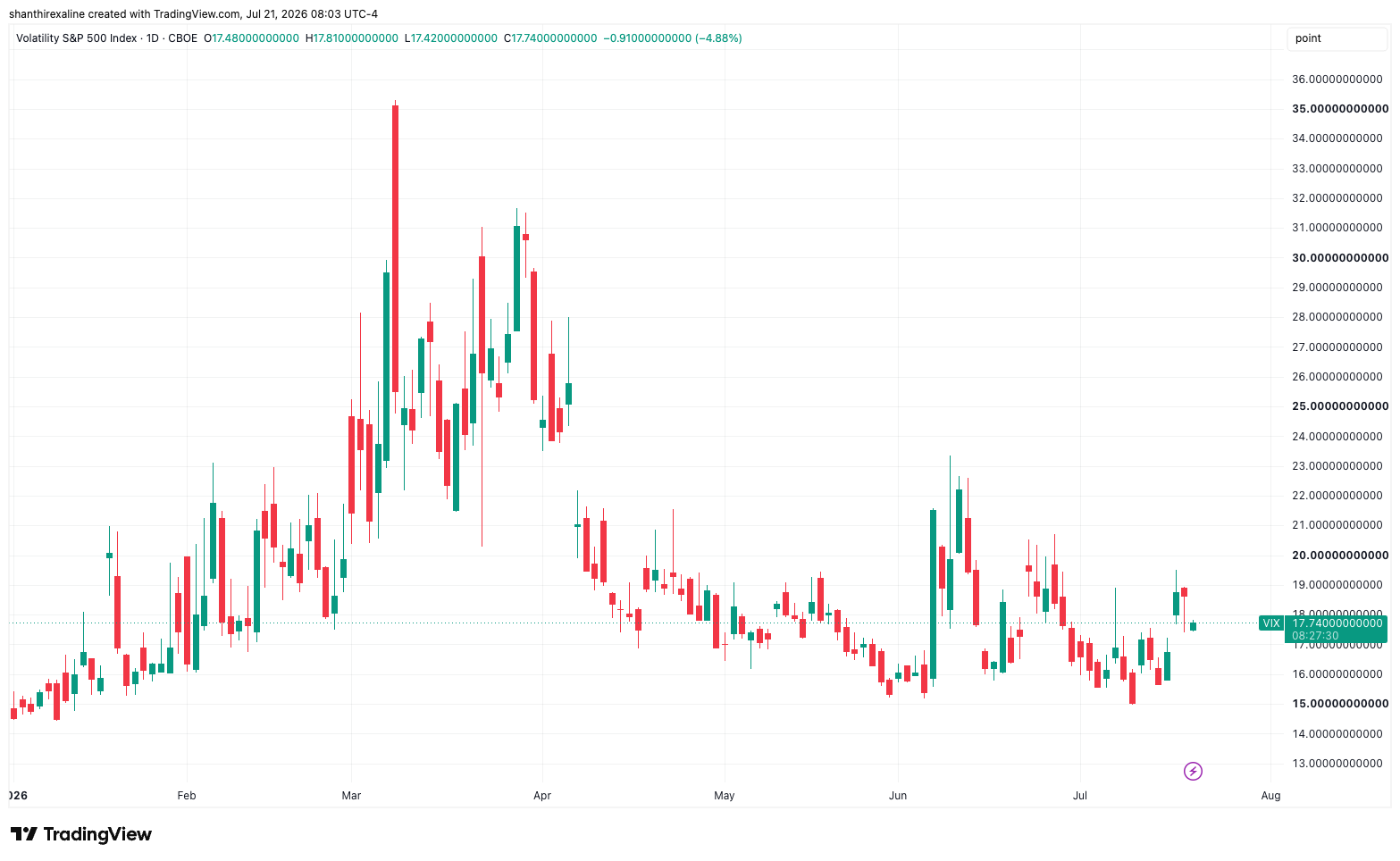
The CBOE Volatility Index (VIX) eased to around 17.78 in Tuesday's premarket, down roughly 4.7% and continuing a slide that took it from 18.65 at Monday's close into the mid-teens — a level it has mostly occupied for the past month, even through 10 consecutive nights of U.S. strikes on Iran. On the surface, that looks like a market shrugging off geopolitical risk. Look closer at the calendar and the VIX's move tracks something else almost perfectly: the return of risk appetite for AI and semiconductor names.
Volatility Subsides
Source:TradingView
Chips, Not Crude, Set Last Week's Tone
The dominant story going into this week wasn't Iran — it was a chip-sector rout. Futures slid hard on July 17 as the semiconductor sell-off deepened, dragging AI-linked names down with it. The Philadelphia Semiconductor Index (SOX) fell into bear-market territory by Friday, though it recovered some ground on Monday. A disappointing earnings report from Netflix, the first among the mega-caps to report, served to aggravate the weakness.
That sell-off was sharp enough to pull South Korea's Kospi down 4.5% in a single session and strip more than 20% off the index over the prior month, even after a year in which it had gained over 50%.
Iran-related oil risk, by contrast, has been running in the background for over a week and a half as a slower-burn risk the market has had time to digest and price incrementally, rather than a shock that forces volatility higher overnight.
That distinction matters for reading the VIX. A gauge built on S&P 500-wide 30-day option pricing responds most to the risk that's moving fastest and hitting the most heavily-weighted names. Last week, that was chips, not crude.
Tuesday's Rebound Is an AI Story
The reversal playing out in Tuesday's premarket reads as a direct unwind of that chip panic, not a Iran-risk repricing:
- Asian tech led the bounce: South Korea's Kospi jumped 3.56% and Japan's Nikkei 225 added 3.26%, both markets heavily weighted toward semiconductors and AI-adjacent names, effectively clawing back a chunk of last week's losses in a single session.
- Alibaba previewed a new flagship AI model, namely Qwen3.8 Max, which the company positioned as second only to Anthropic's Fable 5. The stock climbed 4.67% on Monday, a reminder that the AI product cycle, not just the capex debate, is still generating bullish headlines.
- Nasdaq 100 futures led index gains Tuesday, up roughly 1.3% versus a more modest 0.5% gain in the S&P 500, consistent with tech/AI names doing most of the work, rather than a broad risk-on move across all sectors.
Check out MarketFramework's Positioning Edge tool to see where retail traders are placing their bets and where profitable and unprofitable traders are diverging in real time.
Why This Framing Beats ‘Complacency’
The more common read on a falling VIX amid unresolved geopolitical risk is complacency, i.e. traders are ignoring a real threat. But the data argues for something more specific: Iran/oil risk was never the primary driver of the VIX's recent moves. The chip-sector selloff was. Once that panic started reversing, the volatility premium tied to it unwound too, even though the Iran situation itself hasn't materially changed.
That reframes the real open question for this week: Is the market ignoring war risk? Is the AI-capex bubble fear that drove last week's selloff actually resolved, or is Tuesday's bounce a reprieve that gets tested again by Wednesday's Alphabet earnings?
Alphabet's results, and specifically its capex guidance, arrive as the next real catalyst for the trade that's been setting the VIX's tone all along.
The Forward-Looking Trade
If the VIX really has been tracking the AI trade more than Iran risk, that has implications well beyond Tuesday's bounce:
- Volatility as an AI sentiment proxy: If this pattern holds, the VIX becomes a cleaner real-time gauge of AI-capex confidence than oil or geopolitical headlines for the rest of the earnings season. Under such a scenario, the index is worth tracking alongside chip-name implied vol (SOX-linked options) rather than crude volatility going forward.
- Alphabet Wednesday is the pivot, not just an earnings print: A strong capex number could compress the VIX further and extend the Nasdaq's premarket lead over the S&P. On the other hand, a disappointment, especially anything read as confirming an AI-spending bubble, would likely spike the VIX back toward or above the 20.72 high seen in the past month, undoing Tuesday's move in a single session.
- A second test looms with Tesla: Even if Alphabet reassures on capex, Tesla's full print could reintroduce doubt about AI/autonomy-adjacent spending specifically.
- Watch for the trade broadening or staying narrow: If Tuesday's bounce is really an AI-specific unwind rather than genuine risk appetite, breadth should stay narrow (Nasdaq 100 outperforming Dow/S&P). A move where financials, industrials, and small caps join in would suggest the rally has legs beyond just AI names and that the VIX's decline reflects something more durable than a single sector's mood swing.
- Positioning implication: If VIX truly is an AI-sentiment proxy right now, options traders may want to treat Wednesday's Alphabet print less like a single-stock event and more like a market-wide volatility event. Implied vol on index products could reprice sharply around the print regardless of what oil or Iran headlines do that day.
LPL Chief Technical Strategist Adam Turnquist said the current volatility levels, though well below its long-term average, do not appear sufficiently depressed to trigger a contrarian signal toward mean reversion. That said, history indicates the seasonal backdrop becomes increasingly favorable for higher volatility over the next several months. “A busy event calendar including the midterm elections, earnings season, important monetary policy decisions, and lingering geopolitical tensions in the Middle East could be catalysts for volatility to trend higher over the coming months,” he said.