
The Philadelphia Semiconductor Index (SOX) fell more than 11% last week alone and has now dropped over 20% from its recent peak of 14,655.29, pushing the benchmark into bear-market territory. The magnitude of the decline is notable not because chip fundamentals have suddenly deteriorated, but because semiconductors have been the market's primary conduit for AI optimism.
Chips In Bear Engulf
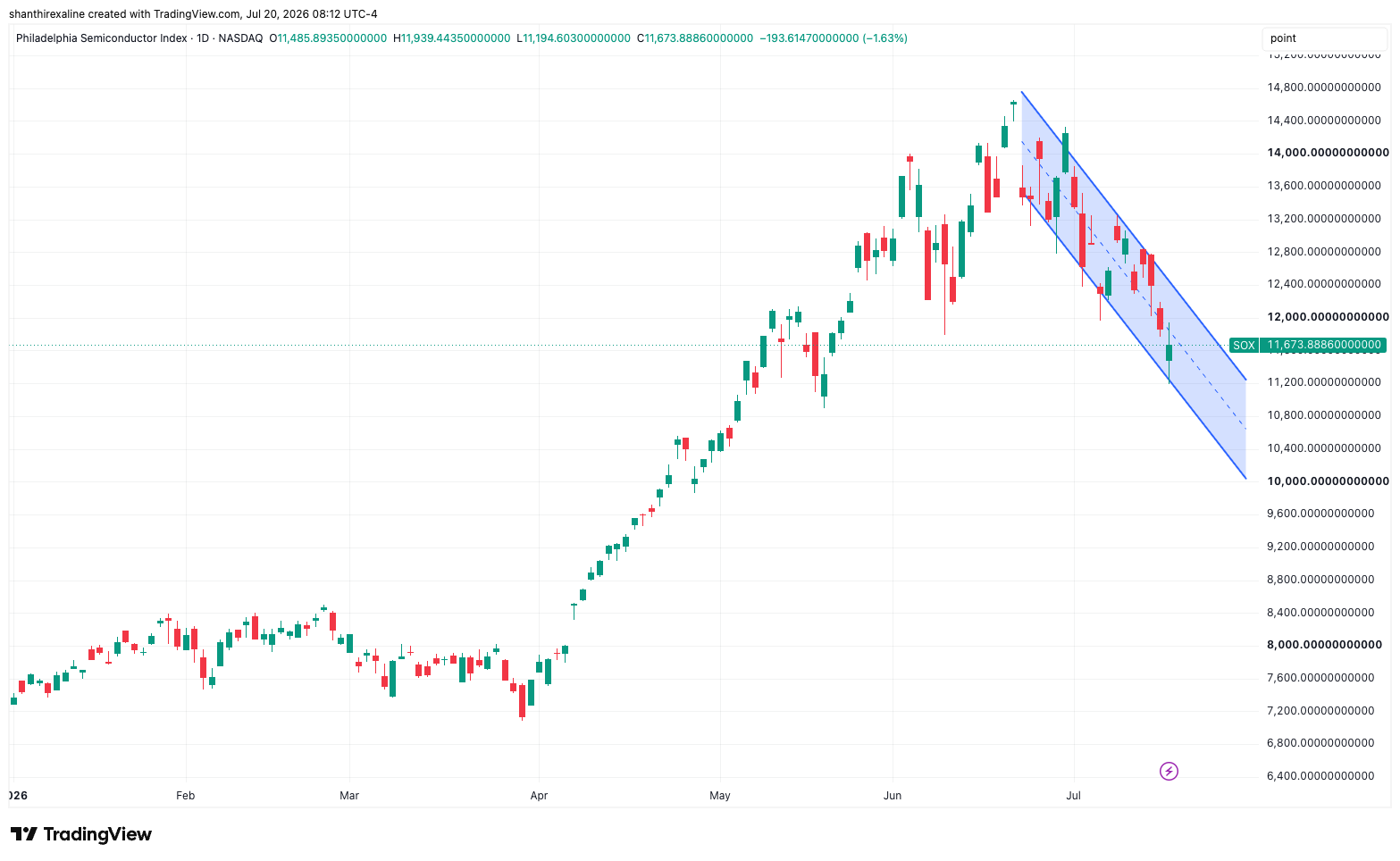
Source: TradingView
The sell-off suggests investors are beginning to question whether future returns on artificial intelligence (AI) infrastructure spending can justify the sector's lofty valuations, shifting the debate from demand strength today to the sustainability of hyperscaler spending tomorrow. With Alphabet's earnings due this week, the focus is increasingly on whether Big Tech remains committed to aggressive AI investment plans that underpin the semiconductor industry's growth outlook.
Why the timing matters
The move is happening against a macro backdrop that amplifies rather than absorbs the shock. The 10-year Treasury yields sit near 4.56%, the 30-year trades at nearly 5.1%, and futures markets are now pricing meaningful odds of a Fed rate hike rather than a cut, driven by oil prices that spiked above $90 a barrel on renewed Gulf tensions.
Futures Market Rapidly Pricing In Coming Fed Hikes
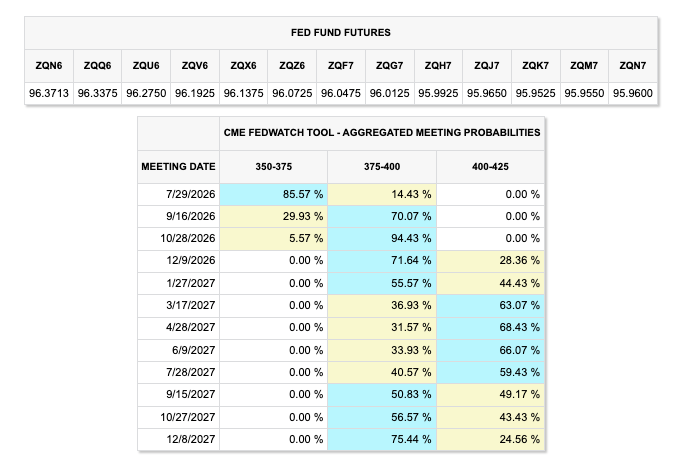
Source: CME FedWatch Tool
Rising discount rates compress the present value of long-duration growth stories, making it a case where a higher cost of capital is actively re-rating the multiple the market is willing to assign to unproven AI returns.
IBM's warning last week that enterprise clients are pulling back software spending added a second, more direct wound: it's the first concrete signal from inside Big Tech's own client base that AI-adjacent budgets may be tightening, rather than just investors speculating about it from the outside.
The specific question Alphabet's print answers
The sell-off has been driven by a repricing of expectations, not by hard evidence of demand deterioration. That distinction is the crux of the "correction vs. structural repricing" debate, and Alphabet is positioned to supply the first real data point either way, for three reasons:
Scale of commitment: Alphabet has guided to roughly $175 billion in 2026 capital expenditures, a large share of which flows directly into the chip and data-center supply chain. A change in that number (up, flat, or down) is a direct read on hyperscaler conviction, not a proxy.
Cloud as the monetization proof point: Google Cloud's growth rate has been cited repeatedly as evidence that AI infrastructure spend is converting into revenue. A deceleration here would undercut the bull case for the entire sector, since Cloud is one of the cleanest lines connecting capex to realized returns.
Free cash flow trajectory: FCF fell 47% year-over-year last quarter as capex ramped. Commentary on how management is thinking about that trade-off: sustained investment versus capital discipline. This will be read by the market as a signal for how the other hyperscalers (Microsoft, Meta, Amazon) are likely to frame their own upcoming guidance.
Saxo strategists considers a clean beat as one would combine:
- Revenue outperformance
- Strong AI and cloud growth
- Profit margin preservation despite higher infrastructure costs
- Capex stabilizing
- Forward guidance that shows revenue growth outpacing cost increase
The consensus estimates call for earnings per share (EPS) of $2.89 and revenue of $116.91 billion, up 25% and 21%, respectively, from a year ago. Saxo flagged AI spending growth and/or softening search monetization and cloud growth as main risks for Alphabet.
Two scenarios, and why they diverge sharply
Cooling, not cracking: If Alphabet reaffirms or raises capex guidance while showing Cloud margins holding or improving, it argues the SOX decline is a valuation reset — multiples catching down to a higher-rate environment — rather than a demand problem. This would likely trigger at least a partial retracement in chip names, particularly those most tied to hyperscaler capex (memory, networking, foundry-adjacent suppliers).
Cracking: If Alphabet trims capex commentary, flags cloud margin pressure, or hedges on TPU/AI infrastructure demand, it would corroborate IBM's warning as the start of a pattern rather than an isolated data point, turning the SOX move from a re-rating into the leading edge of an actual spending slowdown. That scenario has materially worse implications for the sector, since it would imply the next hyperscalers to report (Microsoft, Meta) carry the same risk.
Market outlook
Putting the pieces together, this week's setup is less about Alphabet in isolation and more about three forces converging on the same trade at once: a semiconductor sector already down 20% and technically in bear-market territory, a bond market pricing a genuine hiking cycle rather than a pause, and a hyperscaler earnings calendar that's about to test whether AI capex conviction can survive both.
For NQ and ES, that argues for asymmetric positioning around the print rather than a simple long/short bias. The SOX's 20% drawdown means a "cooling, not cracking" outcome. Saxo's clean-beat criteria of revenue outperformance, preserved margins, and stabilizing capex likely triggers a sharper relief rally than the downside from a "cracking" outcome, since a reasonable amount of bad news already appears priced in.
But that asymmetry is conditional on clarity: a mixed or hedged print, where Alphabet beats headline numbers but hedges on Cloud margins or TPU demand, risks leaving both the semiconductor complex and broader indices in the same uncertain holding pattern they're in now, unresolved and still repricing against a tightening backdrop.
The practical read for the desk: treat Wednesday's print as a two-part signal rather than one. The immediate market reaction Wednesday after-hours will trade the headline beat/miss, but the more important move likely unfolds Thursday, once the CapEx and Cloud-margin commentary has been fully parsed.
Check out MarketFramework's Positioning Edge tool to see where retail traders are placing their bets and where profitable and unprofitable traders are diverging in real time.