USD/JPY has seen a massive jump in volatility over the last few trading sessions.
After spending time near the 160.00 "danger zone," the pair has faced intense selling pressure, dropping nearly 1% over two sessions and falling to a four-week low around the 157.20 region.
That drop extended in Thursday trade with USD/JPY down over 2% on the day hitting fresh lows around 155.40.
This sharp appreciation of the Japanese Yen has caught the market's attention, shifting the focus entirely to what the Bank of Japan (BOJ) and the U.S. Federal Reserve will do next.
The Backdrop - Macro
The primary driver behind the Yen's recent strength is the growing expectation that the Bank of Japan is preparing to tighten its monetary policy.
- Hawkish BOJ Expectations: Recent remarks from BOJ policymaker Hajime Takata suggested a "nimble approach" to adjusting interest rates to fight inflation. Combined with Governor Kazuo Ueda's comments that inflation is aligning with their 2% target, markets are now pricing in an 80% chance of at least a 0.25% rate increase at their September meeting. This shift has pushed Japanese 10-year government bond yields above the 3.00% mark, making Yen-denominated assets much more attractive to investors.
- Intervention Fears: Speculation is brewing that Japanese authorities recently conducted a "rate check." Historically, this is often a final warning sign before the Ministry of Finance intervenes directly in the market to smooth out wild currency swings.
- US Dollar Weakness: The Yen's surge is also being aided by a broadly softer U.S. Dollar as markets prepare for upcoming U.S. economic data and potential policy shifts from the Federal Reserve.
The catch: the rate gap still favours the dollar
Here is the problem for yen bulls. U.S. 10-year yields are still around 4.8%, against roughly 3% in Japan. That gap is the engine of the “carry trade”, borrowing cheap yen to buy higher-yielding dollars which has pressured the yen for years. As long as the gap stays wide, the pull on USD/JPY is upward.
History is split on what intervention does next. One camp (including MUFG) notes that in 1995, 1998 and 2011, USD/JPY revisited or broke through the intervention levels before a genuine change in fundamentals, not the intervention itself finally turned the pair.
The other camp (including Brown Brothers Harriman) counters that every coordinated U.S. intervention since 1998 has worked, and that the U.S.–Japan real-yield spread points USD/JPY toward about 140 over time.
Both can be right: the spike is real, but what happens after depends on the rate gap, not the headline.
What Do The Charts Say
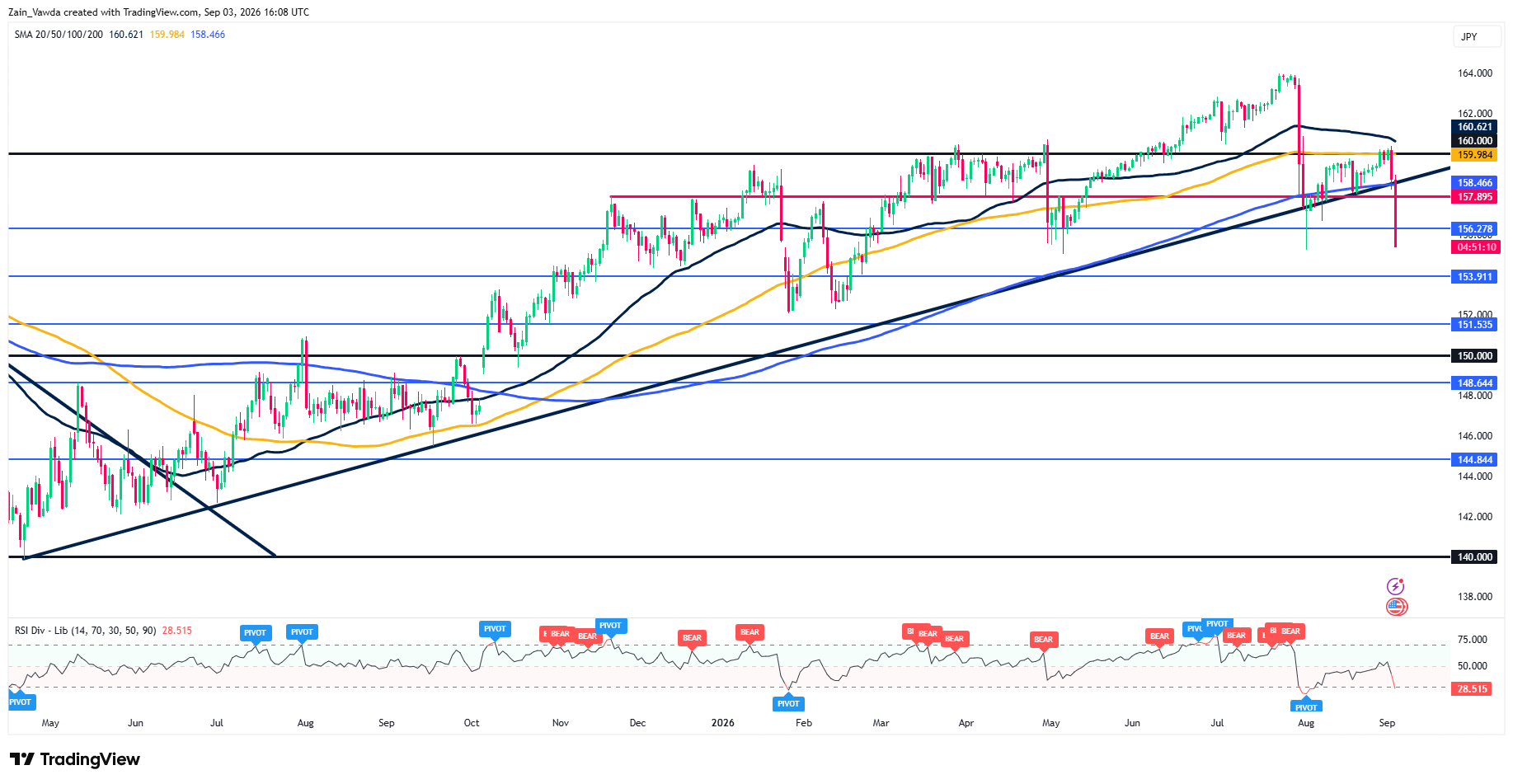
On the daily timeframe, USD/JPY has experienced a major bearish reversal, decisively breaking below its multi-month ascending trendline and key horizontal support at 157.895.
The sharp sell-off pushed price beneath the 200-day Moving Average at 158.466, signaling a significant shift in market structure. With the daily RSI falling into oversold territory near 28.5, downside momentum remains dominant, exposing lower key structural support targets at 153.911 and 151.535. Overhead, broken support levels at 156.278 and 157.895 now act as key resistance zones on any macro retest.
USD/JPY Daily Chart, September 3, 2026
Source: TradingView
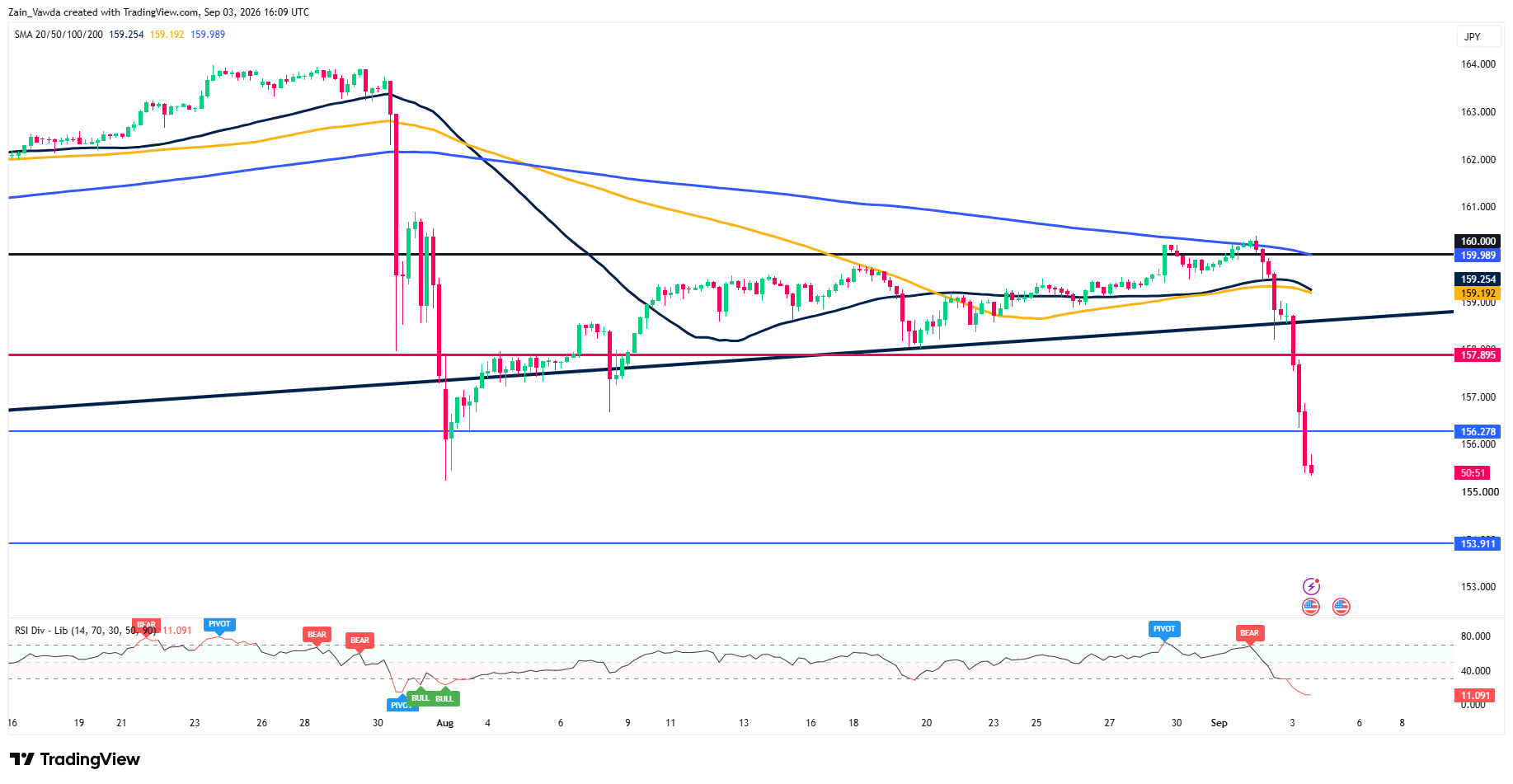
The 4-hour chart reinforces this aggressive bearish sentiment, displaying a rapid breakdown through the 20, 50, 100, and 200 MAs after failing to sustain gains above 160.00.
Price has sliced past 156.278 toward 155.40, with the 4-hour RSI plunging to an extreme oversold reading of 11.09. While this deeply oversold RSI hints at the potential for a brief technical bounce or consolidation, any intraday recovery toward the 156.278–157.895 resistance corridor is likely to face heavy selling pressure.
As long as price remains capped below the 158.46 zone, the broader multi-timeframe outlook favors continued downside risk toward 153.911.
USD/JPY Four-Hour Chart, September 3, 2026
Source: TradingView
What Comes Next?
As long as expectations for a BOJ rate hike continue to grow, downside pressure on USD/JPY is likely to persist in the short term. Here is what traders should watch closely:
- The BOJ's September Meeting: Any further hints from officials confirming a rate hike will fuel even more Yen strength.
- Intervention Watch: Keep a close eye on news out of Japan. Rapid, extreme moves in the exchange rate often force the government to step in and buy or sell the currency.
- US Economic Data (NFP): The upcoming U.S. jobs data (Non-Farm Payrolls) and Federal Reserve commentary will decide the U.S. dollar's fate. If U.S. data comes out stronger than expected or the Fed sounds hawkish, the U.S. Dollar could bounce back, slowing down the Yen's current rally and bringing the USD/JPY back into a balanced range.