Al Brooks
He wrote the book on price action, four of them in fact, and more than thirty-five years in he still shows up almost every day to read the E-mini S&P 500 bar by bar for anyone who wants to learn.
Compiled by MarketFramework editorial · Last reviewed Oct 8, 2026
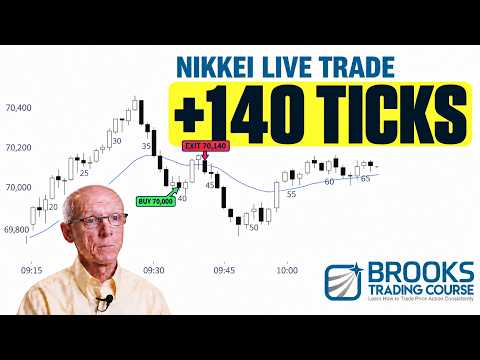 ▶ Featured video · Sep 13, 2026
Editorial profile. Al Brooks is not affiliated with, sponsored by, or endorsed by MarketFramework or MyFundedFutures, and this profile is not endorsed by Al. MarketFramework is operated by MyFundedFutures, a futures prop firm. Compiled from public sources; performance figures are as stated by the creator and are not independently verified. Corrections & removal requests.
Al Brooks is a Sacramento-based futures trader, author and educator who left a career as an ophthalmologist to trade full time in 1990. He trades the E-mini S&P 500 on 5-minute charts using price action alone, wrote the four Wiley books that codified the discipline, and teaches it through the Brooks Trading Course and a daily live trading room.
Trades
E-mini S&P
ES · 5-minute chart
Style
Price action
discretionary · 20-bar EMA only
Trading since
1987
full time from 1990 · self-reported
Based
Sacramento, CA
YouTube
213K
subscribers · Oct 2026
Teaches at
Brooks Trading Course
also the Brooks Price Action room
LIVE FROM MYFUNDEDFUTURES
Where prop traders are positioned in ES right now
Al's market, read from thousands of live MyFundedFutures evaluation and funded accounts.
Loading live positioning…
Open Positioning Edge for the full chart, history and time & sales. Not trade advice.
BEST KNOWN FOR
The price action canon
Brooks is the author of Reading Price Charts Bar by Bar (Wiley, 2009) and the three-volume Trading Price Action series (Wiley, 2011–12), roughly 540,000 words that many retail futures traders treat as the reference text on price action. Interviewers routinely introduce him as the "father" or "godfather" of price action, and his vocabulary (Always In, second entries, spike and channel, measured moves) has become the shared language of a whole generation of E-mini traders.
IN AL'S WORDS
“I look at price action differently from most traders. This is because I believe that there is significance to every tick that takes place during the day. None of what happens is noise.”
brookstradingcourse.com, About Al Brooks
“I looked at charts from 100 years ago and they are the same as charts today.”
Desire To Trade podcast, 2017
“You are trading against the smartest, best trained people in the world. This course is about as long as a course in business school. It gives traders a chance to learn the skills they need to compete with the best traders in the world.”
brookstradingcourse.com, About Al Brooks
Al Brooks's featured video
“Watch Al Brooks Trade the Nikkei Live—with Tom Hougaard & Tim Stout” · published Sep 13, 2026 · 48.3K views
Who is Al Brooks?
Al Brooks is a professional futures trader, author and lecturer based in Sacramento, California. He holds a mathematics degree from Trinity College (1974) and an MD from the University of Chicago’s Pritzker School of Medicine (1978). As he tells it, he taught eye surgery at Emory University and practised ophthalmology in Los Angeles before leaving medicine. He has said he began trading in 1987, shorting S&P 500 futures shortly before that October’s crash. He went full time in 1990, two years after the birth of twin daughters made a surgical schedule impractical.
His public reputation rests on four books published by Wiley. Reading Price Charts Bar by Bar (2009) was followed by the Trading Price Action trilogy, Trends, Trading Ranges and Reversals (2011–12), a 540,000-word set that Wiley reissued in paperback in 2025. The books are dense by design. Readers describe working through them over months, and Brooks has framed his course as being "about as long as a course in business school." Futures magazine, where he was a technical-analysis contributor for years, called him "the trader’s trader," a line his site still quotes.
Since 2009 he has taught through the Brooks Trading Course, a video programme of more than a hundred lessons covering the full price action cycle. He also runs the Brooks Price Action trading room, where he and four other traders analyse markets live each weekday. His YouTube channel, opened in January 2010, has grown to roughly 211,000 subscribers on a near-daily cadence of end-of-day E-mini reviews, weekend Bitcoin reports and occasional live-trading sessions.
He remains an active market educator rather than a retired author. In June 2026 he ran a live trading workshop in Macau alongside Tom Hougaard and Tim Stout, followed by a widely watched live Nikkei session in September. On 12 October 2026 he headlines the Friendly Bear Conference in Los Angeles, again alongside Tom Hougaard. He has lectured on scalping at the Chicago Mercantile Exchange and is a regular MoneyShow and TradersExpo speaker. His books have a notable following in Brazil, where he appeared on the Traders of the World podcast in January 2026.
Few people in retail trading have shaped how others see a chart the way Brooks has. The vocabulary he coined is used daily by traders who have never read him, and his books are being reissued fifteen years on. More than three decades into his trading career, he is still trading live on stage in Macau and Los Angeles. That combination of rigour, longevity and generosity is why "the trader’s trader" has stuck.
How Al trades
Every tick matters: the price action premise
Brooks’s method starts from a bold premise: that there is information in every bar and that nothing on the chart is noise. He trades the E-mini S&P 500 from a 5-minute chart with a single 20-bar exponential moving average and no other indicators. He reads the sequence of bars, their size, closes, overlap and follow-through, as evidence of which side is in control and how confident each side is.
The organising concept is "Always In." At any moment the market is treated as either Always In Long or Always In Short. The trader’s first job is to decide which, then to look for trades in that direction until the chart provides enough evidence of a reversal to flip the assessment. Counter-trend trades exist in his framework, but they are held to a much higher standard.
Market cycle: breakout, channel, trading range
Brooks describes markets as cycling through three states: a breakout (or spike) becomes a channel, the channel eventually becomes a trading range, and from the range the next breakout emerges. "Spike and channel" is the canonical trend shape in his writing: a fast initial move followed by a slower, overlapping continuation that tends to be retraced back to the start of the channel once it ends.
Trading ranges get their own volume in the trilogy because, in his estimate, markets spend most of their time in them. Inside a range the rules invert: fade breakouts, expect reversals at the extremes, and treat the middle as no-man’s-land. Correctly identifying which state the market is in decides which set of rules applies.
Second entries, measured moves and the trader’s equation
His best-known entry technique is the bar-counting of pullbacks. In a bull trend, the first bar that breaks above the previous bar’s high after a pullback is a High 1. If that fails and the market pulls back again, the next such bar is a High 2, the "second entry," which Brooks treats as one of the highest-probability setups in trending markets. Low 1 and Low 2 are the mirror image in bear trends.
Targets are framed as measured moves: the height of a spike, range or flag projected from the breakout point. Every trade is then judged against what he calls the trader’s equation, in which probability of success multiplied by reward must exceed probability of failure multiplied by risk. Much of his teaching is about estimating that probability honestly from the chart rather than from hope.
Markets, sessions and instruments
The E-mini S&P 500 is his home market and the subject of his daily reviews. His published reports and videos also cover EUR/USD, crude oil, the FTSE, DAX, Nasdaq, Nifty and Bitcoin futures, and he sells a separate forex course. He trades and teaches intraday scalps and swings on the 5-minute chart, and also discusses daily-chart swing trading and options.
As with any trader profiled here, the approach is described from his own books, course materials and public statements; it is not a recommendation, and futures trading carries a substantial risk of loss.
See how the wider prop-trading field is positioned in ES while you study a method like this: MarketFramework's Positioning Edge shows live long/short splits across ES, NQ, MES and MNQ from real evaluation and funded accounts, and Prop Backtest scores strategies against prop-firm rules.
Al Brooks's career timeline
Graduates MD from the University of Chicago’s Pritzker School of Medicine, after a mathematics degree at Trinity College in 1974. source
Begins trading; shorts S&P 500 futures shortly before the October crash (self-reported). source
Leaves his ophthalmology practice to trade full time (self-reported). source
Wiley publishes Reading Price Charts Bar by Bar; he begins teaching traders. source
Opens the Brooks Trading Course YouTube channel in January. source
Wiley publishes the Trading Price Action trilogy (Trends, Trading Ranges, Reversals) across 2011–12. source
Presents "Patterns on the Open" as a futures.io webinar; the recording becomes one of his most-viewed videos. source
Wiley reissues the trilogy in paperback; appears on Desire To Trade episode 523. source
Runs a live trading workshop in Macau (June), trades the Nikkei live on YouTube (September), opens his Euro and US trading rooms for an open house (1 October) and speaks at the Friendly Bear Conference in Los Angeles (12 October). source
Al Brooks's videos
LATEST
E-mini S&P 500 Small Pullback Bear Trend - October 16, 2026
E-mini SP500 Opening Bull V Reversal Spike & Channel Bull Trend Day - October 15, 2026
E-mini S&P 500 Small Pullback Bear Trend - October 14, 2026
SP500 E-mini 5 Min Climactic Bear Selloff, Bull Reversal & Trading Range Day - October 13, 2026
E-mini S&P500 Lower High Major Trend Reversal - October 12, 2026
Bitcoin Daily Wedge Bull Flag at 20 day EMA - September 13, 2026
Watch Al Brooks Trade the Nikkei Live—with Tom Hougaard & Tim Stout
E-mini S&P500 Big Gap Up on Open Then Sideways Trading Range Day - September 11, 2026
SP500 E mini 5 Min Broad Bear Flag Trading Range Day
E-mini S&P 500 Horizontal Trading Range - September 9, 2026
MOST POPULAR
5 Steps to Finding Today’s Trades
Scalping series: #01 Rules for scalping
Brooks Price Action: Trading Opening Breakouts & Reversals
Scalping series: #02 Scalping 2-minute Emini chart
Scalping series: #03 Ten Emini scalps on 15-second chart
Prop firms Al works with
No prop-firm partnerships announced.
He has not announced a prop-firm partnership; his teaching is independent of any firm or platform.
His workshop co-presenters (Tom Hougaard, Tim Stout) are independent traders and educators, not prop firms.
We list a firm relationship only with dated public evidence from the last 30 days, re-checked each editorial pass.
AL BROOKS: FREQUENTLY ASKED
What does Al Brooks trade?
Primarily the E-mini S&P 500 futures contract on a 5-minute chart, traded intraday as scalps and swings. His daily and weekend reports also cover EUR/USD, crude oil, the FTSE, DAX, Nasdaq, Nifty and Bitcoin futures.
What is Al Brooks best known for?
His four Wiley books on price action, Reading Price Charts Bar by Bar and the Trading Price Action trilogy, and the vocabulary they introduced. Always In, High 1 and High 2 second entries, spike and channel, measured moves and the trader’s equation all come from those books. He teaches the method through the Brooks Trading Course and a daily live trading room.
Is Al Brooks a doctor?
Yes. He earned an MD from the University of Chicago in 1978 and worked as an ophthalmologist, including teaching eye surgery at Emory University, before leaving medicine to trade full time in 1990.
What is Al Brooks’s net worth?
Brooks has not disclosed his net worth, and MarketFramework does not estimate net worth for the traders it profiles.
Which prop firm does Al Brooks use?
None announced. His teaching is independent of any firm or platform.
In what order should you read the Al Brooks books?
Brooks’s own course follows the sequence of the trilogy: Trading Price Action Trends first, then Trading Ranges, then Reversals. Reading Price Charts Bar by Bar (2009) is the earlier single-volume treatment that the trilogy expanded.
SOURCES
- Brooks Trading Course: About Al Brooksaccessed Sep 14, 2026
- Brooks Trading Course: YouTube channelaccessed Sep 14, 2026
- Wiley author biography (Trading Price Action Trading Ranges, 2025 edition)accessed Sep 14, 2026
- DailyForex: Al Brooks: Ophthalmologist Turned Trader (2014)accessed Sep 14, 2026
- Desire To Trade: Al Brooks interview (2017)accessed Sep 14, 2026
- MoneyShow, speaker profileaccessed Sep 14, 2026
- Brooks Trading Course, trading room open house, October 2026accessed Sep 30, 2026
- The Friendly Bear: Al Brooks on why consistency beats getting rich (Aug 2026)accessed Sep 30, 2026
Are you Al Brooks? Update your profile or pick your featured video.