Japan and the U.S. confirmed that they conducted a coordinated yen-buying intervention over the weekend, marking a rare joint operation to arrest the Japanese currency's slide to fresh 40-year lows. The coordinated move underscores growing concern over disorderly currency moves, with both governments signaling they are prepared to intervene again if necessary.
Whether the intervention can deliver lasting support for the yen, however, remains an open question. History suggests intervention can slow speculative momentum and stabilize markets in the near term, but it rarely reverses a currency's trend unless the underlying macroeconomic drivers also change. In this case, the primary catalyst behind the yen's weakness—the wide interest rate differential between Japan and the United States—remains intact.
That puts this week's U.S. labor market data, particularly the July non-farm payrolls (NFP) report, firmly in focus.
What Bessent, Katayama Said
Officials framed the move as protecting against spillover risk, i.e. a disorderly yen and Japanese government bond sell-off adding upward pressure to already-rising U.S. Treasury yields.
Japan's top currency diplomat, Atsushi Mimura, told reporters the joint intervention reflected the depth of the U.S.-Japan alliance. In a statement, Japan’s Finance Minister Satsuki Katayama said the coordinated move countered excessive volatility and disorderly movements in the Japanese yen in recent months and that her ministry remained vigilant.
The Japanese Ministry of Finance remains attentive and in close communication with our counterparts at the U.S. Treasury. We will not hesitate to conduct further joint intervention.
U.S. Treasury Secretary Scott Bessent echoed similar sentiments. He also said the U.S. “strongly supports Japan's decisive market and monetary steps to correct the substantial undervaluation of the yen.”
The pairing of the two governments is what sets this apart. It's the first coordinated currency intervention by Japan and the U.S. since 2011. But that earlier episode was aimed at weakening an overly strong yen after the Tōhoku earthquake.
For a joint operation specifically defending the yen through buying, analysts point further back:
This is the first joint Yen buying FX intervention between the US and Japan since 1998 – or close to 30 years – and the first since the 2011 Tohoku earthquake in which the US, Japan and other G7 countries intervened in JPY FX markets — MUFG Economist Michael Wan
Chart courtesy of MUFG
How it was done
Katayama said in her statement that the Ministry of Finance purchased yen in coordination with the U.S. Treasury on Friday. She also said Japan plans to utilize the Federal Reserve's Foreign and International Monetary Authorities (FIMA) Repo Facility in the future. FIMA allows foreign central banks, including the Bank of Japan, to temporarily obtain U.S. dollars by pledging their U.S. Treasury securities to the Federal Reserve. It was created to ease dollar funding strains, especially during periods of market stress.
Delving into the modus operandi by the U.S. Treasury, a Financial Times report indicated the New York Fed sold euros for yen on Treasury's behalf, executed through Morgan Stanley and Goldman Sachs.
Size estimates remain modest by historical standards. Bessent's own notes reportedly pointed to a $5 billion –10 billion intervention, well below the tens of billions Japan has deployed solo in past episodes.
The market reaction
The intervention followed a failed solo attempt by Tokyo just days earlier. After Thursday's initial intervention play, USD/JPY pushed back toward 160 on Friday before Japanese officials brought in the U.S. for a joint effort. That earlier solo move had broken below both key daily moving averages for the first time since July of last year.
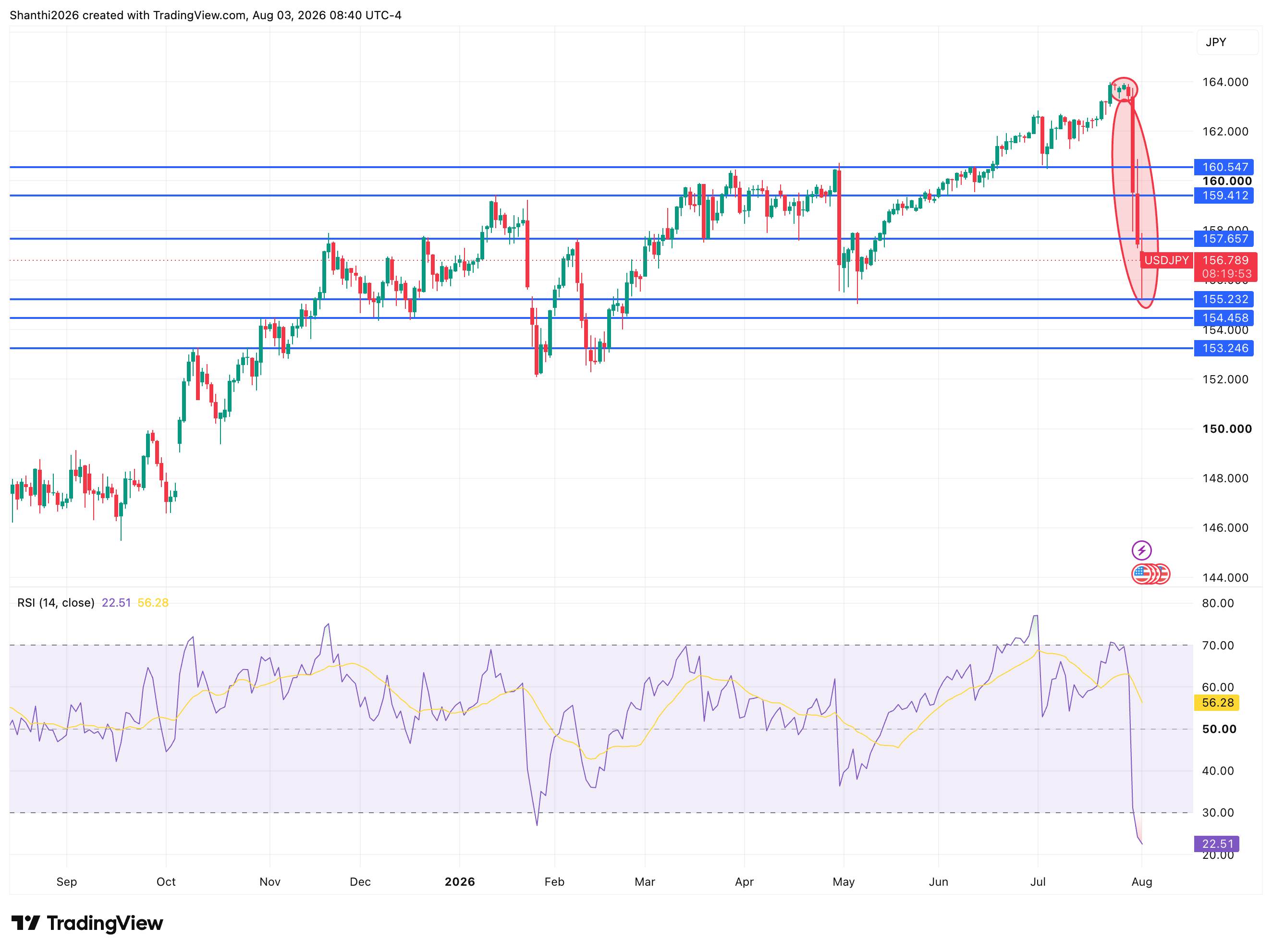
On Monday, at last check, the USD/JPY traded at 156.64, down about 0.50%. The overnight low touched 155.2150, marking the lowest level for the pair since May 6.
USD/JPY has suffered a sharp bearish reversal after failing to sustain a breakout above the 164.00 resistance area, with heavy selling dragging the pair below the key 160.55 and 159.41 support levels in a single session. The next major support lies at 157.66, followed by 155.23, where buyers previously stepped in. A decisive break below 155.23 would expose 154.46 and 153.25, signaling a deeper correction from the 2026 highs.
Source: TradingView
Momentum indicators point to an oversold market following the intervention-driven plunge. The 14-day RSI has collapsed to 22.5, its lowest reading in months, suggesting selling may have become overstretched and raising the possibility of a near-term relief bounce. Any recovery, however, is likely to face resistance at 157.66, followed by 159.41 and 160.55, with a move back above those levels needed to restore the broader bullish trend.
Positioning risk still hangs over the pair
Analysts caution the bigger threat isn't the intervention itself but what happens if it triggers a rush for the exits. Yen short positioning sits near record levels, meaning any further move could see a large number of traders attempting to exit through the same door at once, the kind of setup that produces sharp, fast candles.
The latest CFTC Commitments of Traders (COT) report for the week ended July 28 shows speculative traders remained heavily bearish on the Japanese yen. Leveraged funds held 178,742 short contracts against 76,752 longs, leaving a net short position of nearly 102,000 contracts, underscoring continued bets that the wide U.S.-Japan interest rate gap will keep pressure on the currency.
Meanwhile, dealer intermediaries remained heavily net long, while asset managers held a more balanced stance. Total open interest rose by 8,570 contracts to 432,366, with leveraged funds trimming longs and adding fresh shorts during the week, suggesting bearish conviction remained intact despite rising expectations of official intervention.
That said, retail traders were heavily positioned for yen strength ahead of the intervention, with 75% of 6J futures positions held long over the past seven days, according to MarketFramework's Most Traded Contracts tool. Around 70% of winning trades were long positions, indicating that bullish retail traders largely benefited from the yen's sharp appreciation.
What Strategists Say
While calling the latest joint intervention as “historic” and “significant,” MUFG’s Wan said he expects it to play an important role in the short-term in clearing out Yen shorts. That said, the economist viewed that the fundamentals likely still need to change for a more durable move lower in USD/JPY.
This includes still low real interest rates, and concerns by the market around the fiscal spending trajectory of [the] government. On this front, our global team is forecasting the Bank of Japan to deliver faster rate hikes than are priced in by markets, and is one important factor driving our forecast for USD/JPY to move lower over time.
ING forex strategists said this intervention does not change the fundamentals of a Fed close to hiking and Tokyo running a loose set of monetary and fiscal policies, which are weighing on the yen.
We struggle to see this bilateral action driving USD/JPY sustainably below 155. But equally, it does serve as a containment exercise, limiting investors from chasing USD/JPY through 160 and buying time for Tokyo to introduce more yen-positive policies.
The potential policy moves include more incentives to invest in Japanese domestic assets.
Forward look: payrolls is the real test
The intervention buys time, but it doesn't settle the underlying driver. The core pressure on the yen remains the rate gap — the BoJ holding at 1% against a Fed leaning hawkish — which has kept the yen carry trade under strain.
That gap is now squarely in the hands of Friday's US jobs report. Five straight days of U.S. labor-market data this week will test whether the intervention-driven drop extends or the dollar reclaims dominance, with the non-farm payrolls release due Friday,
A hot print would likely reignite Fed rate-hike expectations and push USD/JPY back toward the 158 zone officials have already shown they're willing to defend. On the contrary, a soft one would let the rate differential, and with it, the yen's rebound, continue without further joint intervention.


