
Forty-eight hours ago the Dow Jones Industrial Average closed above 53,000 for the first time in its history.
By Wednesday morning it was trading below 52,500, down roughly 1% in early dealings, after U.S. President DonaldTrump told the NATO summit in Ankara that the ceasefire with Iran was “over” and U.S. forces struck more than 80 targets inside the country overnight.
The Nasdaq is falling too, but for a different reason, and understanding the difference between the two sell-offs is the key to trading either index this week.
The Tape: Two Indices, Two Problems
Shortly after Wednesday’s open, the Dow was down more than 500 points near 52,440, the S&P 500 had lost around 0.6%, and the Nasdaq Composite was off a comparatively modest 0.4%, with the VIX jumping roughly 8% to above 17.
CBOE Volatility Index
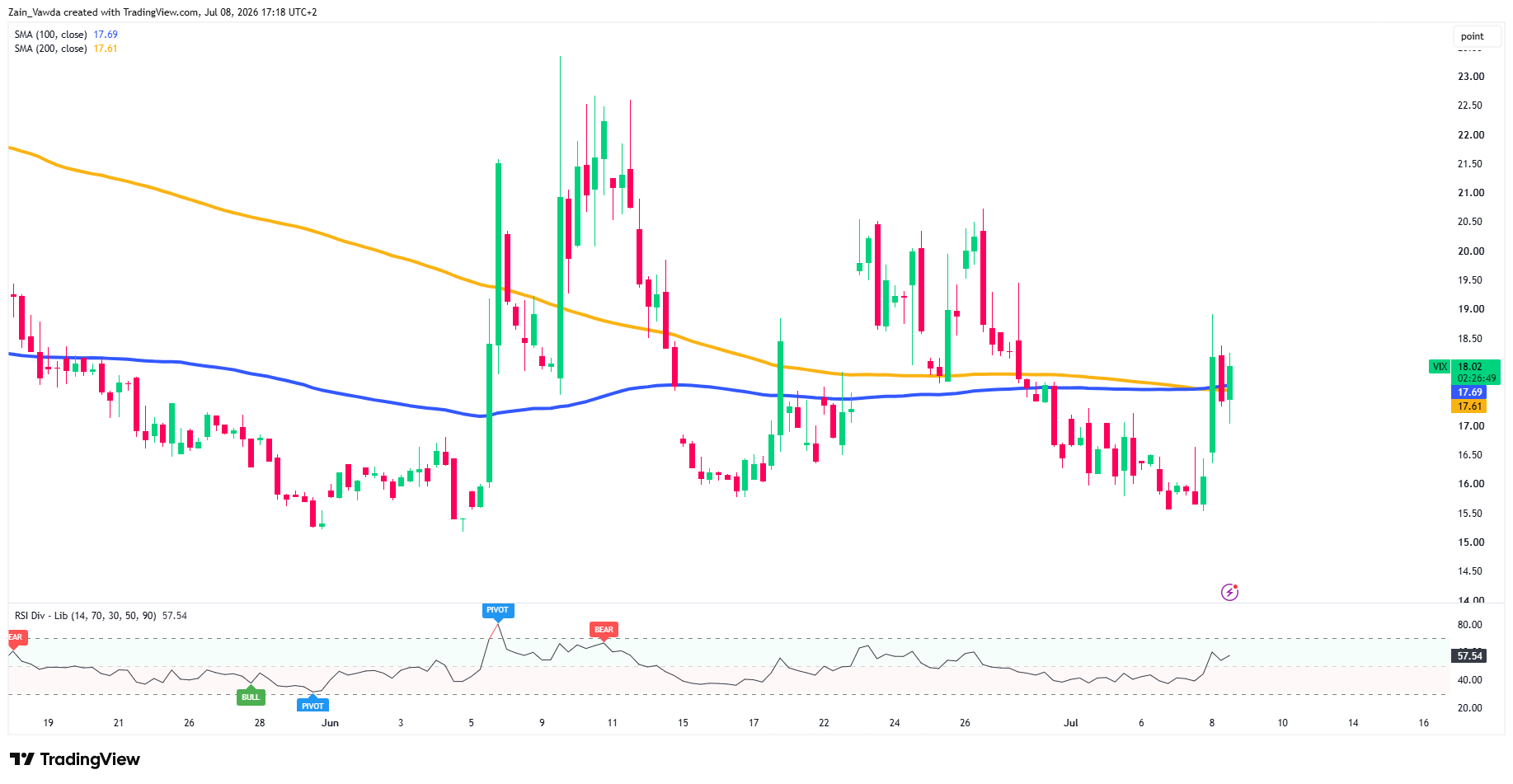
Source: TradingView
The Dow’s decline is an external shock: energy-driven inflation risk and a geopolitical re-escalation that lifted Brent toward $78.50 after the Treasury revoked Iran’s oil-sale waiver.
The Nasdaq’s weakness is internal and older. The Nasdaq-100 fell 1.8% on Tuesday, extending a rotation out of AI infrastructure that has now run for the better part of two weeks.
Tuesday’s catalysts were telling: Samsung delivered a roughly 19-fold jump in quarterly operating profit and the stock still sold off, while a Reuters report that DeepSeek is developing its own AI chip pressured Nvidia and the broader semiconductor complex, sending the VanEck Semiconductor ETF down more than 4.5%.
The structural issue: It appears former technology and AI-infrastructure leaders are breaking below their 50-day moving averages, and what has spared the broader market a deeper correction so far is rotation, money migrating into healthcare, biotech, financials, transports and insurance.
Bloomberg’s read of Tuesday’s session made the same point from the other side: Despite the tech drawdown, most S&P 500 constituents actually rose. That rotation is precisely why the Dow set records while the Nasdaq bled and why Wednesday is dangerous.
An oil-shock inflation hits the rotation’s destination sectors too, threatening the one mechanism that has been absorbing tech selling.
SpaceX and the Index-Mechanics Subplot
SpaceX' Nasdaq-100 inclusion, the structural story we have tracked since the Fast Entry announcement, delivered a harsh first verdict: the stock fell nearly 7% on Tuesday, its debut day in the index, before recovering about 1% in Wednesday’s premarket near $151.
A concentrated momentum name entering a benchmark just as the AI complex de-rates is a reminder that inclusion flow is a one-day mechanical bid — not a valuation floor.
The Macro Overlay: Minutes at 2:00 PM
Hanging over both indices is the release of the June FOMC minutes at 2:00 p.m. ET — the committee’s only detailed account of the hike debate, given Chair Warsh’s abandonment of forward guidance. Nine of 18 June dots projected at least one 2026 hike, and Wednesday’s oil spike leans hawkish by feeding directly into the inflation outlook.
For the rate-sensitive Nasdaq, a hawkish read compounds an already broken technical picture; for the Dow, it adds a rates headwind to the geopolitical one.
Scenario Matrix: Dow & Nasdaq Into the Close
| Scenario | Trigger | Implications/Price Path |
|---|---|---|
| Bull | De-escalation signals from Ankara or Tehran; minutes reveal hike hesitation among voting members | Relief bid; Dow retests 53,000, Nasdaq stabilizes as real-yield pressure eases on the AI complex |
| Base | Hostilities simmer without new strikes; minutes confirm a divided, data-dependent committee | Dow consolidates 52,300–52,800; Nasdaq lags on continued rotation with semis capping every bounce |
| Bear | Further Hormuz escalation plus “persistent” inflation language in the minutes | Rotation destinations get hit too; correlated downside with the Nasdaq leading and VIX extending above 18 |
If advancing issues hold up while tech falls, the rotation regime survives and dips in the Dow remain buyable. If breadth collapses alongside the AI names, the market loses its shock absorber, and the two separate sell-offs become one.


