The U.S. Federal Reserve releases the minutes of its June 16–17 meeting on Wednesday, at 2:00 p.m. ET, giving the first full account of how Fed Chair Kevin Warsh runs the room. The June decision to hold the funds rate at 3.50%–3.75% was unanimous, adopted by a 12–0 vote.
What was not unanimous was where policy goes next, and that is the argument the minutes will finally put on the record.
A Unanimous Vote Hiding a Split Committee
The June statement dropped the prior easing bias and committed the Fed to bringing inflation down, a hawkish shift that sent the major indexes down 1% or more on the day.
The Summary of Economic Projections showed why: policymakers marked 2026 GDP growth down to 2.2% while projecting inflation to prove more persistent, and nine officials penciled in at least one more hike before year-end. The committee, in effect, came out split down the middle on the 2026 hike question.
The most unusual detail was the dot that wasn't there. Warsh declined to submit his own rate projection, consistent with his long-held skepticism of forward guidance, which he argues boxes policymakers in when circumstances change.
That omission makes Wednesday's minutes disproportionately important: with the Chair refusing to signal through the dot plot, the minutes are the only window into how hard the hike camp pushed, whether any members wanted to move in June rather than wait, and what conditions the committee attached to tightening later this year.
The Jobs Miss Changed the Odds — Not the Question
Positioning has shifted materially since the meeting the minutes describe.
June payrolls printed just 57,000 against a 110,000 consensus on July 2, and September hike odds fell to roughly 50–55% on CME FedWatch, down from about 66% before the report.
Markets now assign around a 75% probability to a hold at the July 28–29 meeting, though pricing still carries roughly a 70% chance the funds rate sits a quarter-point higher, at 3.75%–4.00%, by the September meeting.
CME FedWatch Tool - Aggregated Meeting Probabilities
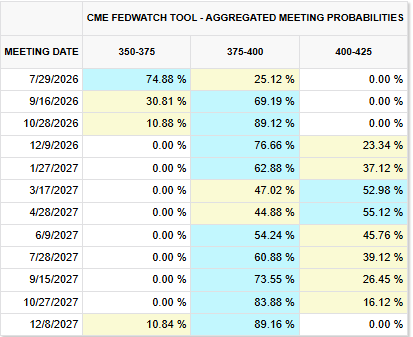
Source: CME FedWatch Tool
That gap, a committee half-inclined to hike versus a labor market that just blinked is exactly the tension traders will read the minutes against.
The inflation detail is where the minutes could genuinely surprise. May headline CPI ran 4.2% year-over-year, but energy inflated by the Hormuz disruption did most of the work, while core rose just 0.2% on the month.
If the minutes show broad agreement that the energy spike should be looked through as supply-driven, the hawkish June optics soften considerably, particularly with crude now trading in the high $60s.
If instead they reveal concern about energy bleeding into inflation expectations, the September hike scenario hardens regardless of one soft payrolls print.
Watch, too, for any discussion behind Warsh's five newly announced policy task forces, including reviews of communications and the inflation framework which could reshape how this Fed signals altogether.
Potential Scenario Matrix — Rates, Dollar and Index Futures Reaction
| Scenario | What the Minutes Show | Market Implication |
|---|---|---|
| Hawkish | Members argued for a June hike; energy inflation framed as a risk to expectations; high bar to look through headline CPI | Rate hike expectations price September back above 60%; DXY firms, gold retests $4,100 support, ES and NQ extend the tech de-rating |
| Base | Split preserved: hawks want optionality, no urgency before seeing June and July CPI | Two-way chop into July 14 CPI; rates markets hold current pricing, equities trade the AI story instead |
| Dovish | Broad agreement the energy spike is transitory supply shock; emphasis on softening labor demand | Hike odds fade toward the low 40s; yields and DXY ease, Gold extends its rebound, Nasdaq finds a rate tailwind |
While everyone is busy parsing the upcoming FOMC minutes for hints on interest rates, the real contrarian edge might be retail trader positioning. View the latest retail data on the S&P 500, Nasdaq 100, gold, and silver using the Trade Validator tool.


