
A leading indicator of economic activity fell more than expected in June, suggesting that the economic outlook remains on uncertain footing. The Conference Board's Leading Economic Index (LEI) declined 0.2%, reversing a 0.1% increase in the previous month and exceeding economists' expectations for a 0.1% drop. The weaker reading stands in stark contrast to an ebullient stock market that has continued to climb despite geopolitical tensions, trade uncertainty, and signs of slowing economic momentum. The divergence highlights a growing disconnect between Main Street and Wall Street, raising the question of whether investors are looking through near-term economic weakness in anticipation of stronger earnings and easier monetary policy ahead.
LEI's Monthly swings
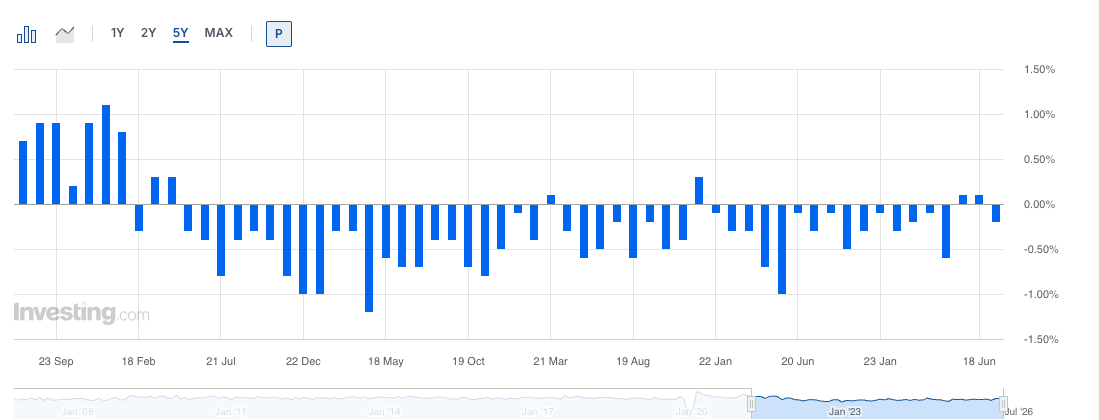
Source: Conference Board data via Investing.com
The mechanics of the divergence
The answer is embedded in the LEI's own composition. May's brief uptick was, by the Conference Board's own account, fueled entirely by financial components — stock prices and the interest rate spread — while the non-financial side stayed weak, with consumer expectations acting as a persistent drag and only the ISM New Orders Index showing any real strength. That means the "improvement" the index showed heading into summer was never a broad-based economic signal; it was largely a reflection of the stock market's own strength feeding back into the index that's supposed to be forecasting the economy independently of the market. June's reversal back to a 0.2% decline suggests that prop is now fading, even as equities themselves haven't caught up to that message yet.
Why the gap matters more now than usual
This isn't a brand-new signal. The LEI's six-month trend was still negative as of the May report (-0.3% from November to May), though that decline had been shrinking compared to the sharper -1.3% contraction in the prior six-month window.
June's reversal back to a decline raises the question of whether that improving trend stalls out or resumes, rather than confirming a fresh deterioration. What's changed is the backdrop the divergence is playing out against: oil above $90 on renewed Gulf tensions, Treasury yields climbing (10-year near 4.56%, 30-year near 5.1%), and Fed funds futures now pricing real odds of a hike rather than a cut. Historically, a weakening leading-indicator trend colliding with a tightening monetary backdrop is a combination markets don't shrug off for long — it removes the easy explanation ("the Fed will cut if growth slows") that's cushioned equity strength in past soft patches.
Reading the components, not just the headline
The more useful question for traders isn't "did the LEI beat or miss" but which components drove the June decline. The decline is primarily due to building permits, and consumer expectations, a materially more bearish read of the real economy, and one that would validate the recession-signal language the Conference Board has attached to this series in recent months.
That said, one offsetting impact would come from strong business investment related to artificial intelligence. The board expects this to support economic activity, while inflation continues to improve. Consequently, it nudged up the U.S. GDP growth forecast for 2026 to 1.9% from 1.8%.
The Main Street/Wall Street gap explained
The LEI is designed to gauge the likely direction of the broader economy over the coming months. It incorporates indicators such as manufacturing orders, consumer expectations, building permits, and labor-market data, all of which tend to reflect conditions facing households and businesses. In other words, it is closer to a "Main Street" measure of economic momentum.
The stock market, by contrast, is a forward-looking discounting mechanism. Equity prices reflect investors' expectations for future corporate earnings, liquidity conditions, and interest rates rather than current economic activity. A slowing economy does not necessarily imply lower stock prices if investors believe corporate profits will remain resilient or that the Federal Reserve will respond with lower interest rates.
Today's disconnect is particularly pronounced because market leadership is concentrated in a handful of mega-cap technology companies whose earnings are less tied to the domestic economic cycle than the average business. AI-related investment, strong balance sheets, and global revenue streams have allowed these firms to continue delivering growth even as leading indicators point to softer economic conditions.
Another factor is that weakness in the LEI may itself be interpreted bullishly by investors. Softer economic data can increase expectations of future Fed rate cuts, lowering discount rates and boosting equity valuations. In that sense, what Main Street views as economic weakness, Wall Street may view as monetary-policy relief.
The result is a market that is increasingly trading on the outlook for earnings and interest rates, while the LEI is signaling caution about underlying economic activity. The key question for investors is whether corporate profits can continue to outperform an economy that appears to be losing momentum. If earnings remain strong, Wall Street can continue to ignore Main Street. If economic softness eventually starts showing up in revenue growth and hiring, the gap between the two is likely to narrow.
Check out MarketFramework's Positioning Edge live data on where the crowd is positioned versus where the money is actually being made.
What this means for ES
For equity markets, the risk is that the factors currently supporting optimism begin to weaken simultaneously. If the LEI continues to soften and investors start pricing in a more meaningful economic slowdown rather than merely anticipating Fed rate cuts, the market's narrative of resilient growth could come under pressure. That would challenge the view that weaker data is inherently bullish for stocks. In such a scenario, Wall Street may no longer be able to look through the weakness showing up on Main Street, narrowing the gap between economic reality and market expectations. Investors will be watching Alphabet's earnings and macroeconomic data closely for clues as to whether they reinforce concerns about slowing growth or provide a fresh catalyst for equities to continue defying the leading indicators.