
The S&P 500 is on track for a third consecutive weekly gain, but traders face a much more eventful calendar next week as the July Federal Open Market Committee (FOMC) minutes and a barrage of manufacturing and economic data could test the rally’s momentum and clarify the rate outlook further
The S&P 500 is heading into the weekend near record territory after closing at an all-time high on Thursday, extending a powerful run that has pushed the benchmark roughly 14% higher so far this year.
The rally has been helped by a combination of resilient corporate earnings and softer inflation data, which have reduced concerns that the Federal Reserve will need to tighten policy further. But Friday's weaker-than-expected July retail sales report introduced a more complicated signal: economic momentum may be cooling faster than investors had anticipated.
That leaves traders heading into next week with a familiar question: How much economic weakness is bullish for stocks because it reduces rate pressure, and when does it become bearish because it threatens earnings?
The Rally Has Momentum but the Bar Is Getting Higher
The S&P 500 closed Thursday at 7,798.99, a record high, after rising 0.65%. The Nasdaq Composite also advanced 0.81%, while seven of the 11 S&P 500 sectors finished higher.
The broader backdrop remains supportive. Earnings have continued to beat expectations, with roughly 85% of companies reporting so far exceeding analysts' profit forecasts, according to recent market data. Investors have also responded positively to evidence that inflation is no longer accelerating as rapidly as feared.
But the market is now trading at elevated levels, meaning the next leg higher may require fresh catalysts rather than simply a continuation of the existing narrative.
Next week's data could provide exactly that or challenge it.
Fed Minutes Could Reveal How Divided Policymakers Were
The biggest scheduled event is the release of the minutes from the Federal Reserve's July 28-29 meeting on Wednesday, August 19.
The minutes will be closely watched for clues about the debate surrounding the Fed's policy path and the possibility of a September rate move.
That debate has become more important after the latest run of economic data. Softer employment and retail sales figures have reduced the urgency for further tightening, while recent inflation readings have been relatively benign.
For equity traders, the most bullish outcome would be evidence that policymakers are increasingly comfortable with inflation and see less need to keep monetary policy restrictive.
But a more hawkish discussion could quickly change the tone. If the minutes reveal that officials remain concerned about persistent inflation or believe another rate increase may still be necessary, Treasury yields could rise and put pressure on high-duration equity valuations.
Manufacturing Data Will Test the Growth Story
The Fed minutes will arrive amid a busy run of economic indicators.
Monday brings the Empire State Manufacturing Survey, while Tuesday includes industrial production and capacity utilization. Thursday follows with the Philadelphia Fed Manufacturing Index, and a day later flash S&P August manufacturing and services purchasing managers’ indices are due. The week also includes housing data and leading indicators.
The manufacturing reports will matter because they offer a real-time look at whether economic activity is stabilizing or losing momentum.
A pickup in manufacturing activity could reinforce the soft-landing narrative by suggesting growth remains resilient even as inflation cools. That would be positive for earnings, although it could also keep Treasury yields elevated by reducing expectations for aggressive monetary easing.
A sharp deterioration, on the other hand, could strengthen the case for lower rates—but would raise questions about the durability of corporate earnings and the broader economic expansion.
Treasury Yields Remain a Key Risk to the Rally
The bond market could ultimately determine how much room the S&P 500 has to extend its gains.
The 10-year Treasury yield was around 4.66% Friday, while the two-year yield was near 4.14%. The divergence reflects a market that is simultaneously reassessing near-term Fed policy and demanding substantial compensation for holding longer-dated government debt.
For stocks, the issue is straightforward: if economic data weaken enough to push yields lower, falling discount rates can support equity valuations. But if long-term yields rise because investors remain concerned about inflation, fiscal deficits, Treasury supply or geopolitical risks, stocks could face pressure even if the Fed becomes less hawkish.
That makes the reaction in Treasury futures particularly important for equity traders next week.
Positioning Gives Bulls an Advantage but Raises the Stakes
The market's positioning adds another layer to the setup.
MarketFramework's show a bullish bias among E-mini S&P 500 (ES) traders, with profitable traders positioned more aggressively long than unprofitable traders. That suggests traders who have been successful recently are leaning into the rally rather than positioning defensively.
Bullish positioning can help fuel further gains if the S&P 500 continues higher. But it can also amplify downside if the market receives a hawkish Fed signal or economic data that challenge the current soft-landing narrative.
In other words, the stronger the bullish positioning becomes, the more important the next catalyst becomes.
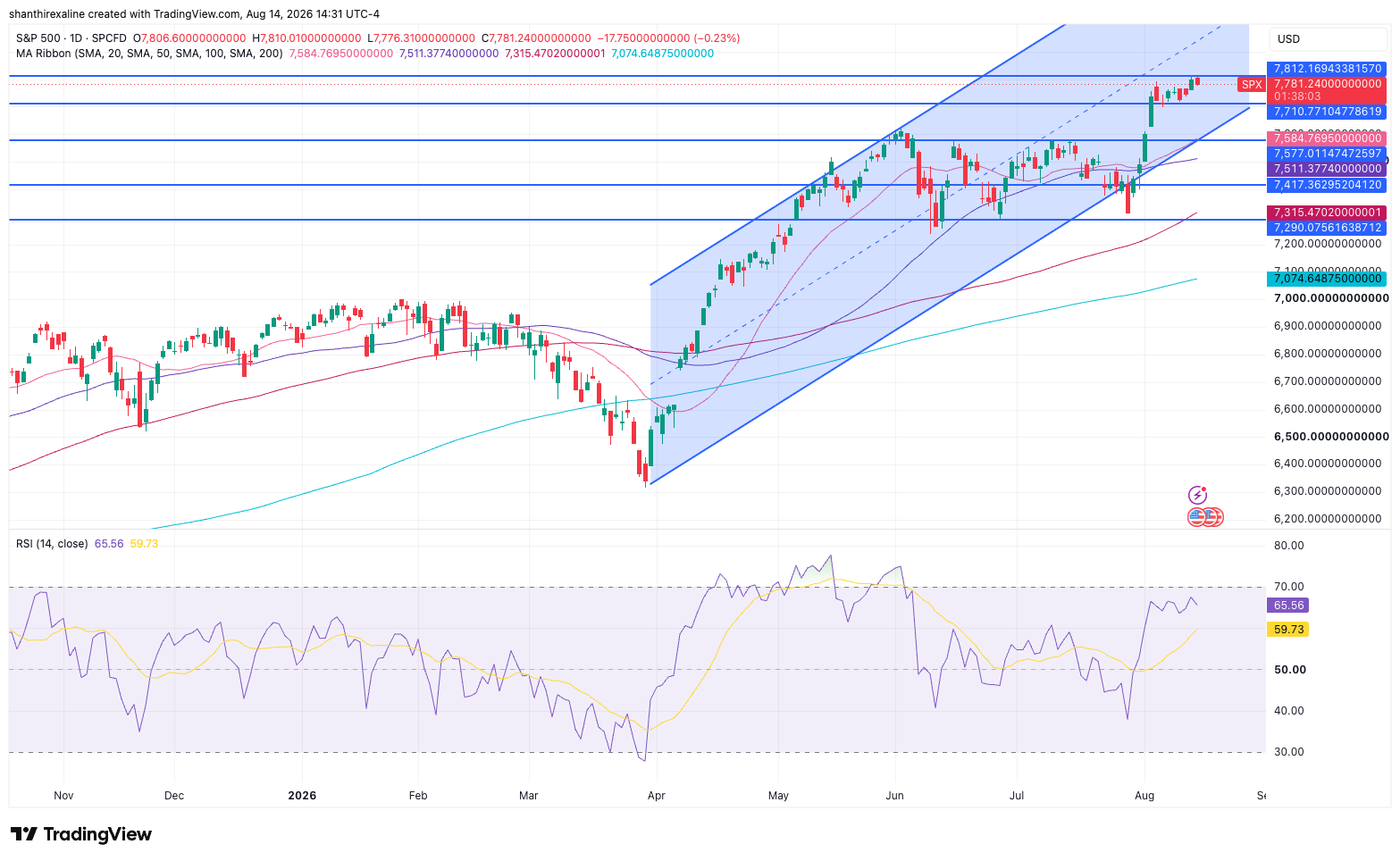
From a technical perspective, the S&P 500 remains firmly in an uptrend after breaking above the upper end of its recent consolidation range and registering a fresh record high near 7,810. Price action continues to hold above all major moving averages, with the 20-day SMA (7,585) providing immediate dynamic support and the rising channel intact.
Source: TradingView
Momentum has improved, with the RSI climbing to 65.6, approaching overbought territory but not yet flashing an extreme reading. A sustained break above the 7,810-7,820 area could open the door toward the upper channel target near 7,900, while initial support lies around 7,710, followed by the 7,630-7,650 zone where the channel midpoint and recent breakout levels converge. As long as the index remains within the ascending channel, the technical bias favors buying dips rather than fading strength.
Three Scenarios for Next Week
Bullish: The Fed minutes show limited appetite for additional tightening, manufacturing data remain resilient, and Treasury yields ease. That combination would allow traders to maintain the soft-landing narrative and potentially push the S&P 500 into fresh record territory.
Mixed: The minutes retain a hawkish tone, but economic data remain broadly stable. In that scenario, the S&P 500 could continue grinding higher, but elevated Treasury yields may limit the upside.
Bearish: The Fed minutes reveal significant concern about inflation while manufacturing data remain strong enough to keep rate expectations elevated. Alternatively, a sharp deterioration in manufacturing could revive growth concerns. Either outcome could increase volatility, particularly with positioning already leaning bullish.
For now, the bulls retain the upper hand. The rally may still have room to run—but next week's data will determine whether the market gets another reason to buy or finally gets a reason to take profits.


